New York City Names: Where Its Boroughs and Streets Came From
Wall Street is named for a real wall, the Bowery for a Dutch farm, and Canal Street for a canal that actually ran where the traffic runs now. A lot of New York City’s names work like that: they’re labels from the 1600s that stuck around long after the thing they described was gone.
Getting ready for a trip? Here’s where the names on your map came from. Most are settled. A few, starting with Manhattan itself, are still argued over, and we’ll tell you which.
The five boroughs
Manhattan
Name origin: Disputed. Nobody agrees on what Manhattan means, and the argument is more than 200 years old. William Wallace Tooker, who wrote a short book on the name in 1901, said he knew of no Native place name with more guesses attached to it.
The Moravian missionary John Heckewelder wrote in 1817 that Delaware people told him it meant “the island where we all became intoxicated,” from the day the Dutch first gave them liquor. He later added that the people he called the Mahicanni tied the name instead to a kind of wood used for bows and arrows. Tooker rejected both, pointing out that the name was in use before the Dutch settled there, and argued for “the island of hills.” The Smithsonian’s Handbook of American Indians (1907) gives yet another reading, “an island formed by the tide,” credited to J. D. Prince. Henry Gannett’s 1905 place-name book splits the difference: “variously said to refer to ‘island’ or ‘place of drunkenness.’” So if someone tells you what Manhattan means, you’ll know there’s more than one answer.
Brooklyn
Brooklyn started out as the Dutch village of Breuckelen, named after a village of the same name in the province of Utrecht, in the Netherlands. Gannett says the Dutch word signifies “broken up land” or “marshy land.” Brooklyn is also Kings County, which Gannett says was named for the Stuart dynasty.
The Bronx
The Bronx is named for a person. Jonas Bronck came to New Netherland in 1639, got a deed from local Native leaders for land across the Harlem River from Manhattan, and called his house “Emaus.” He died in 1643, but his name stayed on “Bronck’s land” and on the river. I. N. Phelps Stokes, whose six-volume Iconography of Manhattan Island catalogs the island’s history, put it simply: “The Bronx River, Bronx Borough, and Bronx County are all named for this early settler.”
Queens
Queens matches Kings next door. Gannett says the county was named for Catherine of Braganza, wife of King Charles II of England.
Staten Island
Staten Island was “named by the Dutch for the Staaten general,” Gannett says. That’s the States General of the Dutch Republic, which, James W. Gerard wrote in 1874, held final authority over New Netherland.
Neighborhoods
Harlem
Harlem is named for Haarlem, the old city in North Holland. On March 4, 1658, Peter Stuyvesant’s council ordered a new village at the north end of Manhattan, and it was called Nieuw Haerlem. The historian James Riker thought the name was “conferred, no doubt, by Stuyvesant,” and noted that the name flattered no settler, since none came from Haarlem. His guess: the Dutch city’s famous stand against a Spanish siege made a brave name for a risky frontier village.
Greenwich Village
Name origin: Disputed. You’ll often read that Admiral Sir Peter Warren named Greenwich after his house there, and Albert Ulmann’s 1903 street-name guide says just that. The records don’t back it up. Stokes found that Warren’s house was known as Greenwich House by 1737, but the neighborhood had been called Greenwich since at least 1696, when a will called one Yellis Mandeville “of Greenwich in the County of New York.” Stokes pointed out that Mandeville had lived for twenty years near a Long Island village that Dutch maps called Greenwijck, but he couldn’t say who picked the name. Before any of that, the city’s Landmarks Preservation Commission notes, the area was known in Native times as Sappokanican.
Flatbush
Flatbush is a Dutch description that outlived the official name. The early settlers called the woodland ’t Vlacke Bosch, which the 1884 History of the County of Kings translates as “the Flat-Wood.” Stuyvesant named the village Midwout, “Middle-Wood,” and that stayed the name in public records until 1776. Flatbush, an English version of the old Dutch phrase, showed up after the English took over in 1664, and it’s the one that won.
Coney Island
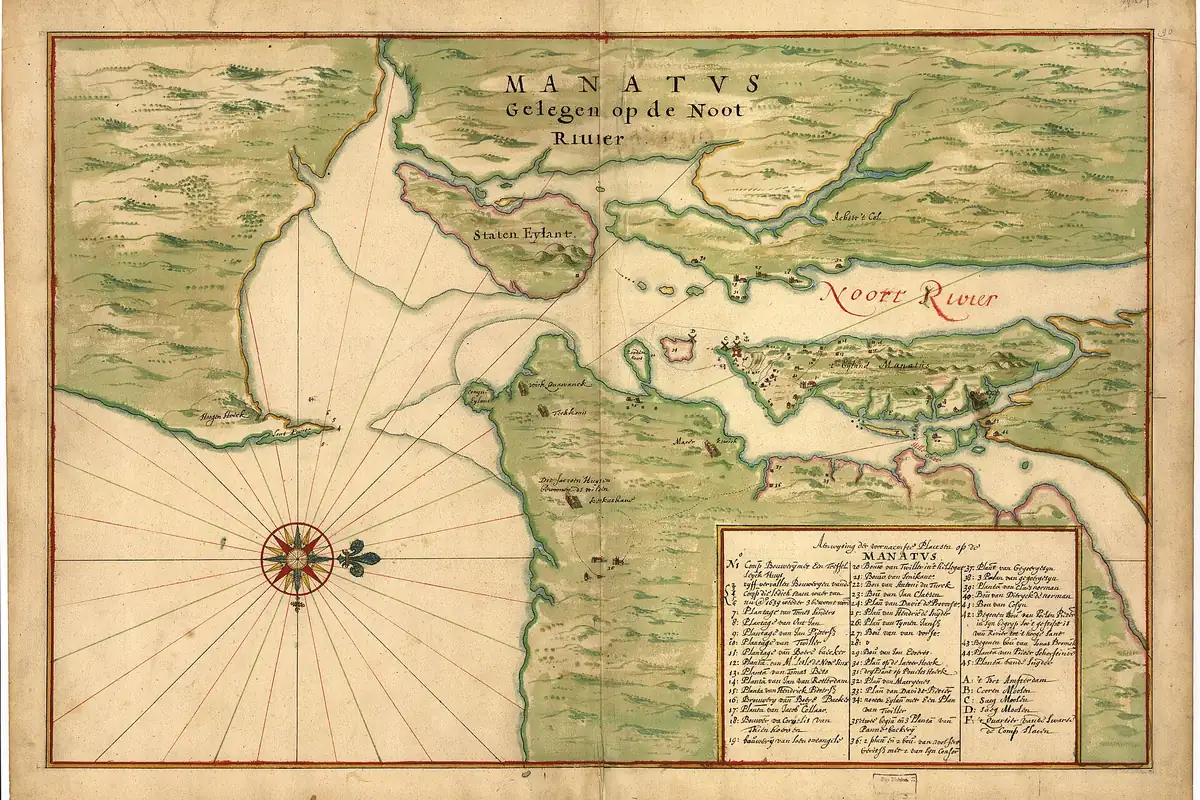
Name origin: Disputed. The name is old: a Dutch map from 1639 already labels it Conyne Eylant. The NYC Municipal Archives explains it as the Dutch konijn, rabbit, so Rabbit Island, and notes the island had a large rabbit population. Not everyone bought that. In a talk to the New-York Historical Society in 1816, Judge Egbert Benson said it was really Conyn’s Island, after a Dutch family name, and complained that a tradition about rabbits was just beginning to form because of the sound of the word. Its older name, recorded in colonial deeds, was Narrioch.
Gramercy
Name origin: Disputed. Gramercy sounds English, but it’s a worn-down Dutch name, Crommessie, which turns up in a 1674 deed. Stokes says Gramercy Park sits on the site of the old Crommessie swamp or pond. Ulmann, writing earlier, described it as a hill shaped like a hooked knife, a krom messje in Dutch, and an early city council record does mention “Crummashie hill.” Both agree on how Crommessie became Gramercy. They don’t agree on what the original name described.
SoHo and Tribeca
These two sound like they’ve always been there, but they’re 20th-century acronyms. SoHo means “South of Houston,” a name the Landmarks Preservation Commission says was adopted by artists who moved in the 1960s into what then seemed a doomed neighborhood. Tribeca stands for “Triangle Below Canal Street” and was coined in the mid-1970s, out of city planning studies for a zoning district that really was roughly triangular.
Streets
Broadway
Broadway was the earliest public road on Manhattan, and its name evolved with it. Stokes traced the records: the Common Highway in 1643, the Heerewegh in 1649, “The Broad Highway” in 1657 and Broadway by 1668. The route itself may be older than the Dutch. Reginald Bolton, who mapped Native trails in 1922, wrote that lower Broadway is “reasonably assumed to have been the successor of a native path,” and that a trail up the east side of the Hudson is “in great part followed by Broadway.”
Wall Street
There really was a wall. The Dutch town’s palisades ran along its northern edge, a little north of the present street, and Stokes notes the street was called the Cingel before 1657. Gerard said the palisades went up under Governor Kieft and were strengthened in 1653, when war with New England threatened. At Broadway and Wall, you’re near where Gerard placed the old Land Gate.
The Bowery
Bouwerie is Dutch for farm, and the farm in question was Peter Stuyvesant’s, near today’s Third Avenue and 13th Street. The path from his farm to town was Bowery Lane, then Bowery Road, and in 1813 the city made it officially The Bowery.
Canal Street
Canal Street “was originally a real canal,” Ulmann wrote, forty feet wide with trees on both sides, carrying water from the old Collect Pond to the Hudson. Stokes’s records show the street was projected in 1796 and that a great sewer was laid through it in 1819 and 1820. In 1903, Ulmann added that the old stone bridge at Broadway was still under the pavement.
Landmarks and airports
Times Square
Times Square used to be Long Acre Square. In 1904, the year the subway opened with a major station at 42nd Street and Broadway, the area was renamed in honor of the newly built Times Building, according to the Landmarks Preservation Commission. Theater managers had already been pushing north along Broadway to Long Acre Square, so the new name landed on a growing theater district.
The Battery
The Battery at the tip of Manhattan is named for gun batteries. Ulmann says a platform was put up there in 1693 to serve as a battery, and Stokes lists a “half-moon” fortification built there by Leisler in 1689. The fort you’ll see there today started as the Southwest Battery, built between 1808 and 1811 with 28 cannons. The National Park Service notes it never had occasion to fire on an enemy, and in 1817 it was renamed Castle Clinton for DeWitt Clinton.
LaGuardia Airport
LaGuardia carries the name of Fiorello La Guardia, the mayor who pushed for a city airport at North Beach, Queens, and presided at the groundbreaking in 1937. The Landmarks Preservation Commission points out why the name fits: La Guardia took flying lessons in 1913 and in World War I flew as a pilot bombardier on the Italian-Austrian front.
JFK Airport
Before it was JFK, it was Idlewild, and that name was never even official. The land bought for the airport included the Idlewild golf course, and the place was known as Idlewild, then New York International Airport, and since late 1963 as John F. Kennedy International Airport, according to the Landmarks Preservation Commission.
So a walk downtown is a walk through the old Dutch town: a wall, a farm road and a broad highway, all still on the street signs.
Quick answers
What does the name Manhattan mean?
Nobody knows for sure. Versions include “the island where we all became intoxicated” (Heckewelder), “the island of hills” (Tooker) and “an island formed by the tide” (the Smithsonian’s handbook, citing J. D. Prince), and none of them is settled.
Why is it called Wall Street?
Because of a wall. The Dutch put up a line of palisades near the present street, and the road along it became Wall Street.
Is Coney Island named after rabbits?
Maybe. The NYC Municipal Archives traces it to the Dutch konijn, rabbit, but Judge Egbert Benson argued in 1816 that it came from a Dutch family named Conyn.
Who is the Bronx named after?
Jonas Bronck, who settled north of the Harlem River in 1639. Stokes says the river, the borough and the county are all named for him.
Key dates
- 1639A Dutch map of Manhattan and its surroundings labels Conyne Eylant, today's Coney Island. Jonas Bronck arrives the same year.
- 1657Records call Manhattan's main road "The Broad Highway." By 1668 it's Broadway.
- 1658March 4: Peter Stuyvesant's council orders a new village at the north end of Manhattan. It becomes Nieuw Haerlem.
- 1696September 15: the earliest record Stokes found of the name Greenwich for the area that's now Greenwich Village.
- 1808-1811The Southwest Battery, today's Castle Clinton, goes up off the tip of Manhattan.
- 1813Bowery Lane officially becomes The Bowery.
- 1904Long Acre Square is renamed Times Square for the new Times Building.
- 1963The airport long known as Idlewild takes the name of John F. Kennedy.
Historical Sources & References
- Henry Gannett, The Origin of Certain Place Names in the United States (USGS, 1905). Entries for Brooklyn, Flatbush, Harlem, Kings, Manhattan, Queens and Staten Island.
- William Wallace Tooker, The Origin of the Name Manhattan (1901). Heckewelder’s versions, and “the island of hills.”
- Frederick Webb Hodge, ed., Handbook of American Indians North of Mexico, Part 1 (1907), entry “Manhattan,” p. 800. “An island formed by the tide,” credited to J. D. Prince.
- I. N. Phelps Stokes, The Iconography of Manhattan Island, vol. 2 (1916), pp. 182-184, 204. “Conyne Eylant” on the 1639 Manatus Map; Jonas Bronck.
- Stokes, Iconography, vol. 3 (1918), Landmark Map Reference Key, pp. 945, 968, 994-999. Broadway’s early names, the Cingel, the Bowery, Canal Street and the Battery.
- Stokes, Iconography, vol. 4 (1922), pp. 376, 469. “Crummashie hill,” and Crommessie “corrupted into Gramercy” (June 13, 1710).
- Stokes, Iconography, vol. 6 (1928), pp. 99, 157-159. Crommessie in 1674; Greenwich in 1696 and Greenwich House by 1737.
- Albert Ulmann, A Landmark History of New York, Also the Origin of Street Names (1903), pp. 258-266. Six street-name entries used here.
- Reginald Pelham Bolton, Indian Paths in the Great Metropolis (1922). Broadway’s Native path and Bronck’s 1639 purchase.
- James W. Gerard, The Old Streets of New York under the Dutch (1874). The States General’s authority, the palisades along Wall Street and the Land Gate.
- James Riker, Revised History of Harlem (1904), pp. 170-174. The 1658 ordinance and the name Nieuw Haerlem.
- Henry R. Stiles, ed., History of the County of Kings and the City of Brooklyn, vol. 1 (1884). Breuckelen (p. 81), ’t Vlacke Bosch and Midwout (pp. 218-219), and Narrioch on Coney Island (pp. 189-191).
- Egbert Benson, Memoir Read Before the Historical Society of the State of New-York (1816; 1825 ed.), pp. 26, 53. Conyn’s Island and his doubts about the rabbits.
- NYC Municipal Archives, “Coney Island, from rabbits, to hucksters to ‘The World’s Largest Playground’” (2019). Conyne Island as the Dutch konijn, rabbit.
- NYC Landmarks Preservation Commission, Greenwich Village Historic District report (1969). Sappokanican and the English name Greenwich.
- LPC, SoHo-Cast Iron Historic District report (1973). SoHo, “South of Houston.”
- LPC, Tribeca South Historic District report (1992). Tribeca, “Triangle Below Canal Street.”
- LPC, Lyceum Theater report (1987). Long Acre Square renamed Times Square in 1904.
- LPC, Marine Air Terminal, La Guardia Airport report (1980). North Beach and Fiorello La Guardia’s flying career.
- LPC, Trans World Airlines Flight Center report (1994). Idlewild, New York International and John F. Kennedy International Airport.
- National Park Service, Castle Clinton National Monument. The Southwest Battery and its renaming in 1817.
- GNIS feature 975772 (U.S. Geological Survey). The federal record and coordinates.
Spot something wrong, or know more? Tell us here. You can also email us or use our contact page. Corrections are noted here with their date, never made silently.