Nampa, Idaho: Footprint, Moccasin or Big Foot?
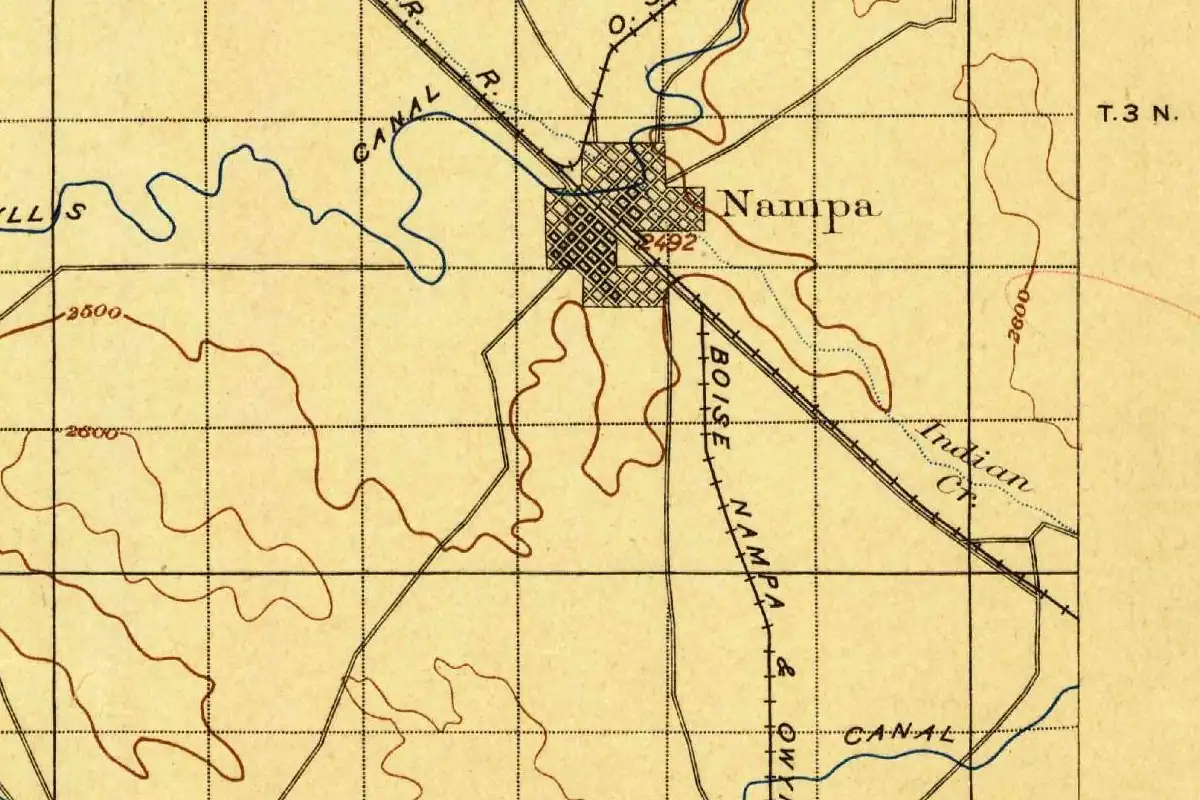
Nampa, Idaho, started as a railroad station in 1883, and its name has two explanations on record: a Shoshone word for foot, or a chief called Big Foot. One of them got a big boost from a 1919 festival stunt.
A station first, a town later
The Oregon Short Line’s main line came through in 1883, and James H. Hawley’s 1920 History of Idaho says “a small station was established at Nampa.” The town itself didn’t start until two years later, when Alexander Duffes, passing through on his way to Canada, took up 160 acres near the station and platted lots. He and his family moved into the first house on November 11, 1885. Railroad branches to Boise and beyond later earned it the nickname “Junction City,” Hawley says.
So the name was there before the people. And the people soon wanted to know what it meant.
The footprint explanation
The Idaho State Historical Society looked into it in a 1966 report by Annie Laurie Bird. Around 1904, a Nampa man named F. G. Cottingham was told by an Indian agent that the word meant “moccasin.” He wrote to the U.S. Indian agents at Ross Fork and at Owyhee, Nevada, two places where Shoshone people lived, and printed their answers in 1911. Evan W. Estep at Ross Fork wasn’t sure, but said the Indians seemed to think it was Shoshone, and that “Namb, a word very similar in sound, means moccasin.” George B. Haggett at Owyhee asked around and reported that it “primarily means ‘footprints’ as the imprint of the moccasin in the sand or earth.”
Bird adds the strongest piece. Sven Liljeblad, who studied the Shoshone language, reported that a Shoshone word for foot, pronounced “nambe” or “nambuh,” “corresponds quite closely with the name ‘Nampa,’” and supports Cottingham’s account. If you want the version with a linguist behind it, that’s the one.
The Big Foot explanation
The other story has a giant in it. The Idaho guide written by the Federal Writers’ Project in 1937 says Nampa “takes its name from a leader of the western Shoshonis,” a man called Nampuh who was so big that the vest of John McLoughlin, “himself a giant of 315 pounds,” came up fifteen inches short around him. The guide’s list of place names translates Nampa as two Shoshone words meaning “bigfoot.”
Bird traces where much of that came from. In 1919, organizers of the Nampa Harvest Festival decided to “seek out and find Chief Nam-Puh.” Fred G. Mock, author of A Romance of the Sawtooth, took on the search under the name “Ogal Alla” and named the chief “War Chief, Big Foot Nampa,” and the “great War Chief” then turned up for a parade and a speech. Bird says the “fanciful tale” stuck, and people came to believe the town was named for him. So you’ll still see both explanations, but only the footprint version is backed by a linguist.
Quick answers
What does Nampa mean?
There isn’t full agreement. The Idaho State Historical Society (1966) says it comes from a Shoshone word for foot or footprint, which linguist Sven Liljeblad supported; the 1937 WPA guide says it means “bigfoot,” after a Shoshone leader.
Was Nampa named after Chief Big Foot?
That’s what the 1937 Idaho guide says. The historical society’s 1966 report says the chief story spread after a 1919 Harvest Festival stunt and favors the Shoshone word for foot.
When was Nampa founded?
The railroad station dates from 1883. The town was started in 1885, when Alexander Duffes platted lots and built the first house, according to Hawley (1920).
Key dates
- 1883The Oregon Short Line's main line is built through, and a small station is set up at Nampa.
- 1885November 11: Alexander Duffes and his family move into the first house in the new town.
- 1911Cottingham prints the answers of two Indian agents on the meaning of the name.
- 1919A Harvest Festival publicity stunt introduces "War Chief, Big Foot Nampa."
Getting there
Open Nampa in Google Maps
Opens in a new tab. The pin is the center of Nampa in the USGS place-name record.
The closest airports, Amtrak stations and intercity bus stops, measured in a straight line from the center of Nampa.
Airports
- Boise Air Trml/Gowen Field (BOI) 17 mi 28 km
- Friedman Memorial (SUN) Hailey 114 mi 183 km
Intercity buses
- Northwestern Stage Lines Nampa 4 mi 6 km
- Greyhound Boise (Chevron) 17 mi 27 km
- Salt Lake Express Boise (Airport) 17 mi 28 km
Distances are as the crow flies, not by road. We don't list schedules or fares because they change; check with the airline, Amtrak or the bus company before you go. Official data (FAA commercial service airports (2025), FAA airport locations, Amtrak stations and Intercity Bus Atlas) from the FAA and the U.S. Bureau of Transportation Statistics, checked Nov 6, 2026.
Sponsored
Staying in Nampa?
Compare hotels in Nampa, Idaho, on Expedia.
See hotels in NampaWe may earn a commission if you buy through this link. It never changes what we write. Read our affiliate disclosure
Historical Sources & References
- Annie Laurie Bird, The Origin of the Name Nampa, Idaho State Historical Society Reference Series no. 39 (1966). Cottingham’s inquiry and the letters of Estep and Haggett, published in 1911; the 1919 “War Chief, Big Foot Nampa” stunt; Liljeblad’s “nambe” or “nambuh.”
- Federal Writers’ Project, Idaho: A Guide in Word and Picture (1937). Nampa named for Nampuh, “a leader of the western Shoshonis” (p. 260); “Two Shoshoni words namp and puh meaning bigfoot” (p. 410).
- James H. Hawley, ed., History of Idaho, vol. 1 (1920), p. 744. The station of 1883, Alexander Duffes and the first house of November 11, 1885, and the “Junction City” nickname.
- GNIS feature 396943 (U.S. Geological Survey). The official national listing and coordinates for Nampa, in Canyon County, incorporated in 1890.
Spot something wrong, or know more? Tell us here. You can also email us or use our contact page. Corrections are noted here with their date, never made silently.