How Hastings, Nebraska Got Its Name (A Railroad Builder's Last Name)
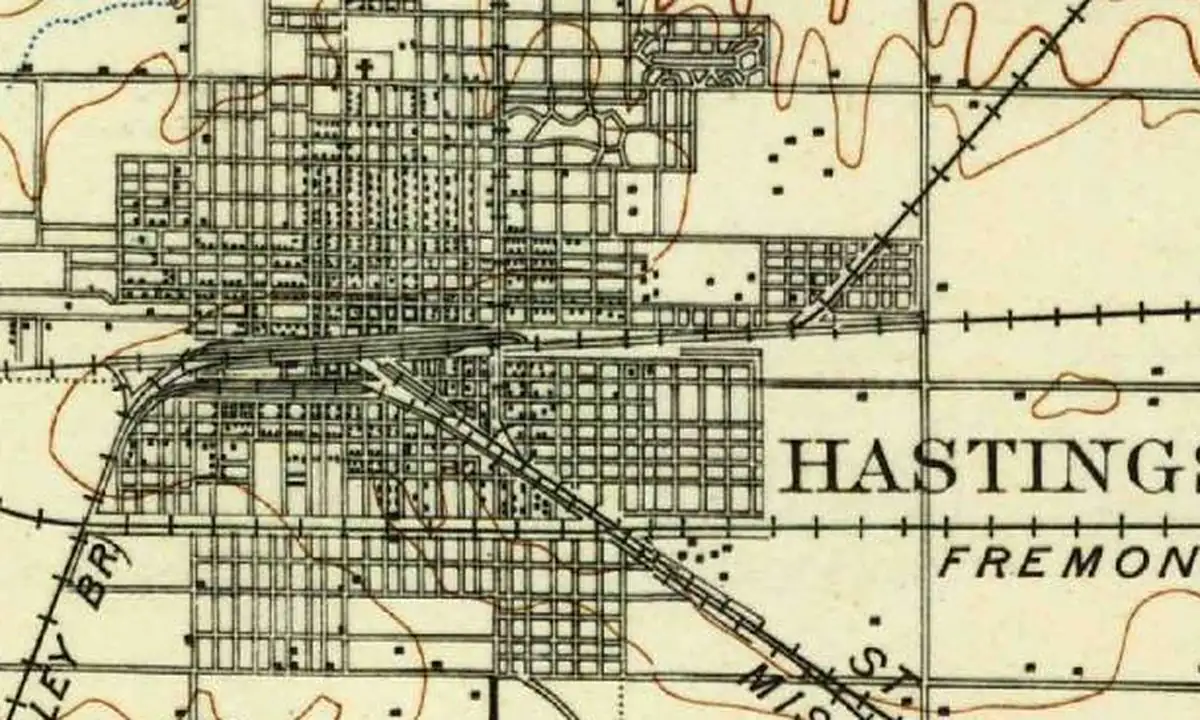
Hastings, Nebraska, is named for Colonel Thomas D. Hastings, who helped build the railroad that met the Burlington line there in 1872. Old sources can’t even agree on the order of his initials.
Where the name comes from
The City of Hastings says the town was named for Colonel Thomas D. Hastings, a contractor for the St. Joseph and Denver City Railroad. The city dates the start of Hastings to 1872, when the Burlington and Missouri River Railroad reached the spot. That’s where the two lines crossed, and a town grew up at the junction.
A 1925 study of Nebraska place names tells the same story, with a twist. It says the city “was named in honor of Colonel D. T. Hastings of the Saint Joseph and Grand Island railroad” and that he “was instrumental in having the railroad built through the vicinity.”
D. T. or T. D.?
The 1925 study noticed the problem itself. Right after giving the colonel’s initials as D. T., it says that in Henry Gannett’s national book of place names “his initials are given as T. D.” The city’s history goes with Thomas D., so we do too.
The railroad’s name isn’t really a contradiction. Legends of Kansas, a history site, traces the line’s names: the St. Joseph and Denver City was reorganized as the St. Joseph and Western in 1875, and in 1885 it became the St. Joseph and Grand Island. The 1925 study just used the later name.
From junction to county seat
The U.S. Geological Survey’s record says Hastings was founded in 1872, incorporated in 1874 and became the county seat of Adams County in 1878.
Sources & further reading
- City of Hastings, “History.” Named for Colonel Thomas D. Hastings, a contractor for the St. Joseph and Denver City Railroad; the Burlington arrives in 1872.
- Lilian Linder Fitzpatrick, Nebraska Place-Names (University of Nebraska, 1925). A public-domain study of the state’s place names, county by county. “Colonel D. T. Hastings” and the note that Gannett gives “T. D.”
- Legends of Kansas, “St. Joseph & Denver City Railway.” The line’s later names: St. Joseph and Western (1875) and St. Joseph and Grand Island (1885).
- GNIS feature 829848 (U.S. Geological Survey). The federal record for Hastings. Founded 1872; incorporated 1874; county seat 1878.
Spot something wrong? Corrections are noted here with their date, never made silently.