District of Columbia: How Washington, D.C. Got Two Names
Washington, D.C. is the nation's federal district, not a state. It has its own page here, like the states.
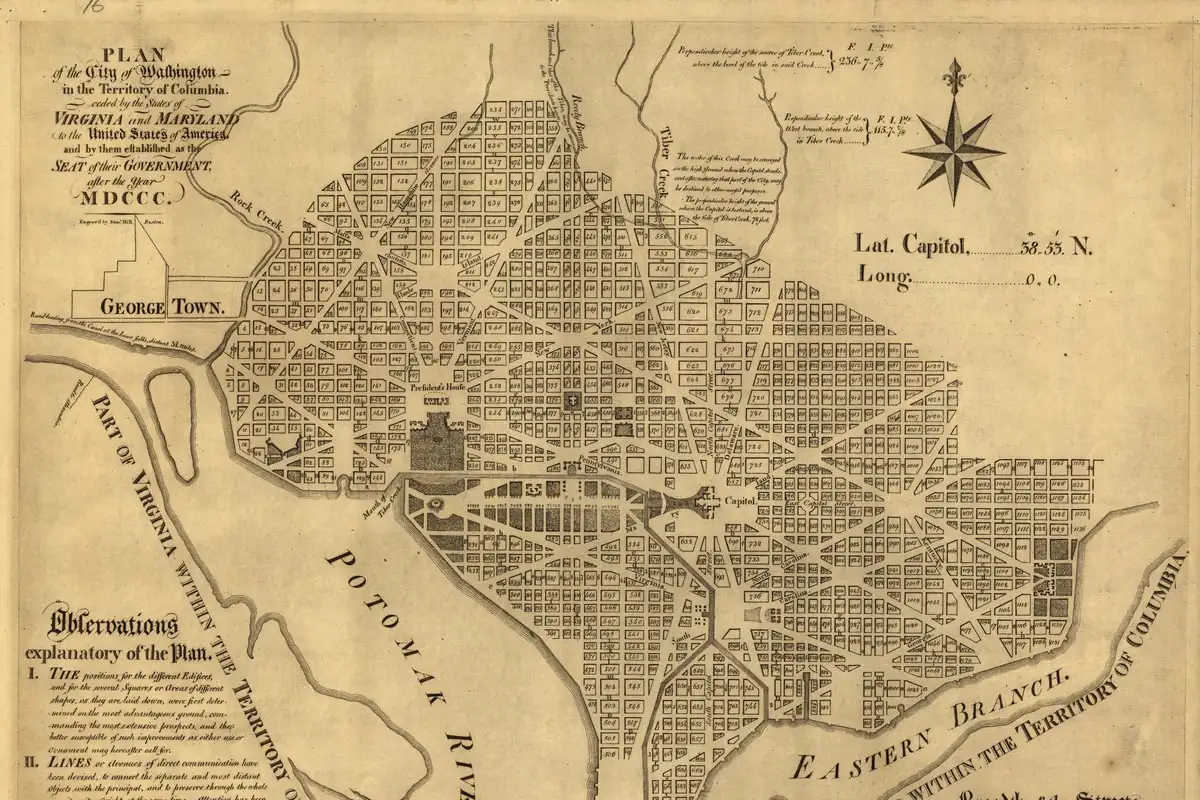
Washington, D.C., has two names because it started out as two places: a city named for George Washington, and the Territory of Columbia around it. Columbia was an old poetic name for the United States, taken from Christopher Columbus. Put them together and you get the city of Washington in the District of Columbia.
First, the basics, since it trips a lot of people up. D.C. isn’t a state. It’s a federal district, a piece of land that Maryland and Virginia handed over to the United States to be the seat of the national government. (Virginia later took its share back.) The 1792 map at the top of this page says it right in its title: “ceded by the States of Virginia and Maryland to the United States of America, and by them established as the seat of their government.”
A capital with no name
When Congress settled the question of where the capital would go, it didn’t bother to name the place. The law of July 16, 1790, which Wilhelmus Bryan’s 1914 history of the capital calls the residence bill, simply accepted “a district of territory, not exceeding ten miles square,” to be located “on the river Potomac, at some place between the mouths of the Eastern Branch and Connogochegue,” as “the permanent seat of the government of the United States.” That’s it. No name for the district and none for a city.
The land had to come from the states on either side of the river. Bryan points to Virginia’s cession law of December 3, 1789, and Maryland’s law of December 19, 1791, ratifying its own cession. George Washington picked the exact spot, announced it in January 1791, and appointed three commissioners to run things: Thomas Johnson and Daniel Carroll of Maryland and Dr. David Stuart of Virginia.
The “Grand Columbian Federal City”
The word Columbia was floating around before anybody made it official. In October 1790, when Washington set out from Georgetown to look over the ground, a newspaper, the Times and Patowmack Packet, reported that he’d gone “to view the country adjacent to the river Patowmack in order to fix on a proper selection for the Grand Columbian Federal City.” Bryan calls that editor “the only chronicler” of the trip.
So nearly a year before the name was settled, a newspaper editor was already calling the future capital “Columbian.”
The letter of September 9, 1791
The names show up in writing on September 9, 1791. Just before that, Thomas Jefferson and James Madison had met with the commissioners in Georgetown to pass along what had been agreed at a conference with the president in Philadelphia. Jefferson reported on the meeting in a letter dated September 8. The next day, the commissioners wrote to Pierre L’Enfant, the man drawing the plan of the new city, who was getting a copy ready for the engraver.
According to Bryan, they told him that, having named the city and the District, “the title of the map will therefore be a map of the city of Washington in the Territory of Columbia.”
The letter itself, signed by all three commissioners, is printed in full in a 1946 National Park Service collection of documents on Jefferson and the capital, edited by Saul Padover, and it’s even plainer: “We have agreed that the federal District shall be called ‘The Territory of Columbia,’ and the federal City ‘The City of Washington.’”
You’ll notice what’s missing. The letter says the commissioners agreed on the names, but not whose idea they were or why they were picked. Their minutes of the meeting with Jefferson and Madison don’t explain it either. They just record “Name of the City and Territory — City of Washington & Territory of Columbia.” So we’re not going to guess.
Why Washington, and why Columbia
The city half is the easy one. Henry Gannett’s 1905 place-name book for the U.S. Geological Survey says Washington, “city in the District of Columbia, the capital of the United States,” was “named for George Washington, first President of the United States.” It’s the same man behind the state of Washington on the other side of the country, which Gannett lists on the same page.
Columbia takes a little more digging. The Century Cyclopedia of Names (1894) traces the word to Columbus and defines it as “a poetical name of the United States, or of the New World.” Funny enough, Gannett’s own book isn’t much help here. Look up “District of Columbia” and it sends you to “Columbia,” and that entry only talks about counties and the Columbia River, which Captain Gray named for his ship. If you want a city that went with the explorer’s own name instead of the poetic one, there’s Columbus, Ohio. On the same page, Gannett counts a county and 26 places called Columbus, “Named for Christopher Columbus.”
The new name went into stone, too. Bryan writes that in June 1794 a large stone at Jones Point, just south of Alexandria, was carved “The beginning of the Territory of Columbia.” The mile markers along the boundary read “Jurisdiction of the United States” on one side and “Maryland” or “Virginia” on the other.
From territory to district
“Territory” didn’t last. By February 27, 1801, when Congress passed what Bryan calls the outcome of its first look at the District’s affairs, the title was “An Act concerning the District of Columbia.” The sources we read don’t say why the wording changed, only that it did.
For a long time, though, the District was more than one town. It held the city of Washington, Georgetown and Alexandria, plus the county land outside them. Alexandria was the first piece to go. In September 1846, voters in Alexandria County chose 763 to 222 to go back to Virginia, Bryan writes in his second volume.
Then Congress started folding the rest together. The law of February 21, 1871, made “all that part of the territory of the United States included within the limits of the District of Columbia” into one government “by the name of the District of Columbia,” and repealed the separate charters of Washington and Georgetown. But it kept the old names on the map: the city’s part of the District “shall continue to be known as the city of Washington,” and Georgetown’s would stay Georgetown.
Georgetown’s turn came on February 11, 1895, in a law titled “An Act Changing the name of Georgetown.” From then on, it “shall no longer be known by the name and title in law of the city of Georgetown,” but as part of “the city of Washington, the Federal Capital.” The same law ordered Georgetown’s streets renamed to match Washington’s.
Letters one way, numbers the other
Here’s a detail that’s easy to miss. That same letter of September 9, 1791, the one that named the city and the territory, also told L’Enfant how to name the streets: “alphabetically one way, and numerically the other; the former divided into North and South letters, the latter into East and West numbers from the Capitol.” So the day the capital got its two names, it also got the plan for its lettered and numbered streets.
Quick answers
Why is it called Washington, D.C.?
It’s the city of Washington in the District of Columbia. In 1791 the commissioners in charge of the new capital named the city of Washington and the Territory of Columbia around it, and by 1801 Congress was calling the territory the District of Columbia.
What does D.C. stand for?
District of Columbia. It’s a federal district, not a state: land that Maryland and Virginia ceded to the United States for the seat of government.
Who named Washington, D.C.?
The three commissioners for the federal district, Thomas Johnson, Daniel Carroll and David Stuart. Their letter to Pierre L’Enfant of September 9, 1791, says “We have agreed” on both names, but it doesn’t say whose idea they were.
Is the District of Columbia named after Christopher Columbus?
Indirectly. The Century Cyclopedia of Names (1894) traces Columbia to Columbus and calls it “a poetical name of the United States, or of the New World.” The 1791 letter that announced the name doesn’t explain the choice.
Key dates
- 1789December 3: Virginia passes its law ceding land on the Potomac for the seat of government.
- 1790July 16: Congress accepts a district up to ten miles square on the Potomac. The law gives it no name.
- 1790October: A newspaper reports the president is out choosing a site for the "Grand Columbian Federal City."
- 1791September 9: The commissioners tell L'Enfant the map's title will be "the city of Washington in the Territory of Columbia."
- 1791December 19: Maryland passes its law ratifying the cession.
- 1794June: A stone at Jones Point is carved "The beginning of the Territory of Columbia."
- 1801February 27: Congress passes "An Act concerning the District of Columbia."
- 1846September: Alexandria County votes 763 to 222 to go back to Virginia.
- 1871February 21: The whole district becomes one government "by the name of the District of Columbia."
- 1895February 11: Georgetown stops being a separate city and becomes part of the city of Washington.

Historical Sources & References
- Wilhelmus Bogart Bryan, A History of the National Capital, vol. 1 (1914). The core of this story. Quotes the commissioners’ letter of September 9, 1791, on the “city of Washington in the Territory of Columbia” and the lettered and numbered streets (pp. 154–155); the 1790 newspaper’s “Grand Columbian Federal City” (pp. 108–109); the three commissioners (p. 120); the Jones Point stone (p. 143); the Virginia and Maryland cession laws (p. 39); and the 1801 act (pp. 399–400).
- Wilhelmus Bogart Bryan, A History of the National Capital, vol. 2 (1916), p. 262. Alexandria County’s return to Virginia and the 1846 vote, 763 to 222.
- Saul K. Padover, ed., Thomas Jefferson and the National Capital (National Park Service, 1946), pp. 70–75. The commissioners’ letter to L’Enfant of September 9, 1791, in full, with all three signatures (“We have agreed that the federal District shall be called ‘The Territory of Columbia’”), and their minutes of the meeting with Jefferson and Madison.
- Residence Act, July 16, 1790 (1 Stat. 130), Library of Congress. The law that accepted a district “not exceeding ten miles square” on the Potomac without naming it.
- An Act concerning the District of Columbia, February 27, 1801 (2 Stat. 103), Library of Congress. The District of Columbia name in the title of Congress’s 1801 law.
- An Act to provide a Government for the District of Columbia, February 21, 1871 (16 Stat. 419), Library of Congress. One government “by the name of the District of Columbia” (sec. 1), the end of the separate city charters, and the city of Washington keeping its name (sec. 40, p. 428).
- An Act Changing the name of Georgetown, February 11, 1895 (28 Stat. 650), Library of Congress. Georgetown becomes part of “the city of Washington, the Federal Capital.”
- Andrew Ellicott, Plan of the City of Washington in the Territory of Columbia (1792), Library of Congress. The engraved plan at the top of this page, with the Territory of Columbia in its title.
- Henry Gannett, The Origin of Certain Place Names in the United States (USGS, 1905). The city of Washington “named for George Washington” (p. 316), and the “Columbia” entry that doesn’t explain the District’s name (pp. 88, 106).
- The Century Cyclopedia of Names (1894), p. 269. Columbia, from Columbus: “a poetical name of the United States, or of the New World.”
- U.S. Census Bureau, state codes (2020). Lists the District of Columbia’s permanent federal place-name record number (GNIS 1702382).
Spot something wrong, or know more? Tell us here. You can also email us or use our contact page. Corrections are noted here with their date, never made silently.