Columbus, Ohio: The Capital That Almost Became Ohio City
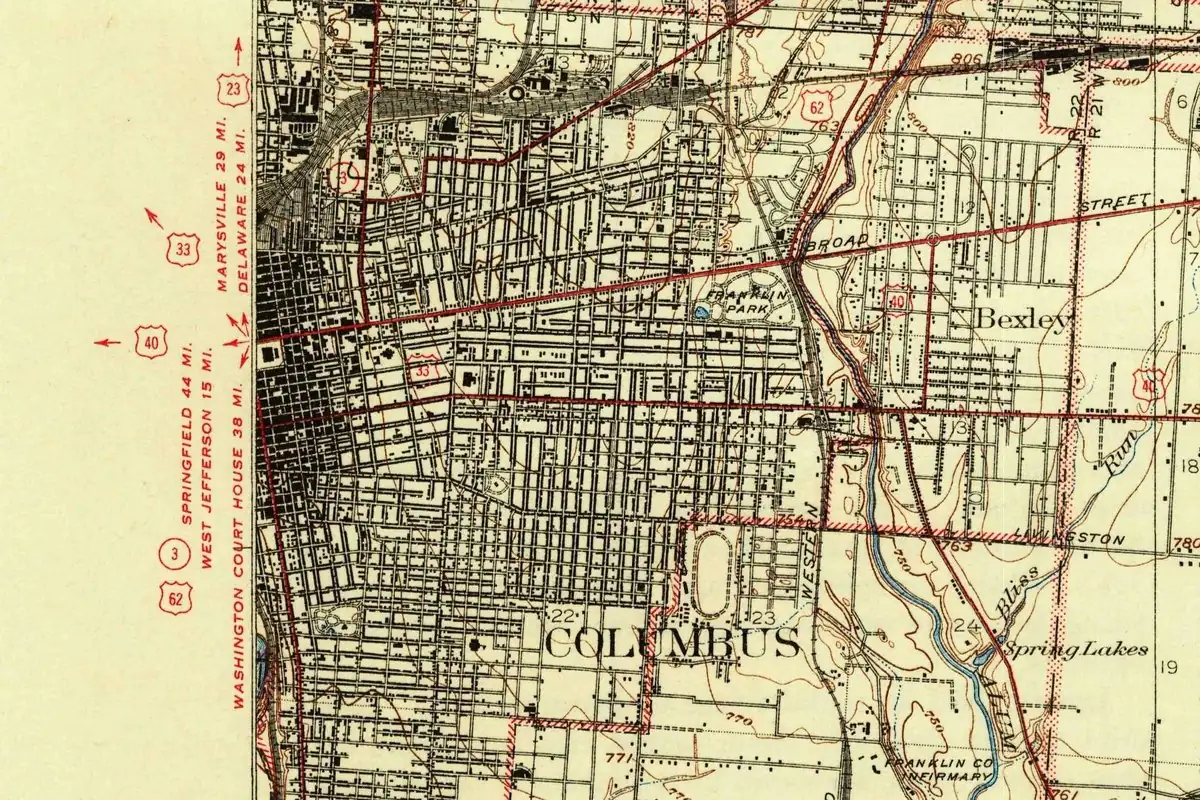
In 1812, Ohio lawmakers turned down the name Ohio City for their new capital and named it Columbus instead, after Christopher Columbus. The vote on Ohio City was close, and the man said to have suggested Columbus ran a tavern across the river.
A capital with no town yet
For its first years as a state, Ohio didn’t have a permanent capital. Henry Howe’s Historical Collections of Ohio (1891 edition) says the legislature met at Chillicothe until 1810, then moved to Zanesville for two sessions. While it was in Zanesville, four men from the village of Franklinton, led by Lyne Starling, formed a company to put the capital “on the high bank of the Scioto river opposite Franklinton.”
Their offer was hard to beat. They’d give the state one ten-acre lot for a State House and another for a penitentiary, and build both. Howe couldn’t resist a joke about that: the founders, he wrote, realized “that equal and immediate quarters should be provided alike for the law makers and the law breakers.” Osman Castle Hooper’s 1920 history of the city says the offer had plenty of competition, from Worthington, Delaware, Lancaster, Chillicothe and others, and the legislature accepted it in February 1812.
Ohio City loses, 22 to 19
That’s where it gets interesting. The site still needed a name. Hooper says that on February 21, 1812, both houses adopted a resolution naming it Columbus. In the House, the name Ohio City had already been voted down, 22 to 19. Columbus, “which is said to have been suggested by Joseph Foos,” passed the Senate without a recorded vote and the House by 24 to 10.
You’ll notice Hooper hedges: “is said to have been.” He doesn’t quote Foos or a record of the suggestion, so treat that part as tradition. Foos himself was a local figure. Hooper says he ran the first hotel in Franklinton, owned a share of the first ferry over the Scioto, and served in the legislature for twenty-five sessions, rising from captain to brigadier general in the War of 1812.
Named for the explorer
Hooper and Howe don’t stop to say who the city was named for. Henry Gannett’s 1905 book of place names for the U.S. Geological Survey does it in one line: the name belongs to a county in North Carolina “and 26 places in the country. Named for Christopher Columbus.” The federal place-names database adds the one detail that sets this Columbus apart from the others: “Capital of State of Ohio.”
A name before a town
If you like coincidences, Howe has one. The town was laid out on June 18, 1812, “the same day Congress declared war on Great Britain,” on a site that was “then an unbroken forest.” So the capital had its name for about four months before the town was even laid out, and the people voting on it had picked an explorer’s name over their own state’s.
Sources & further reading
- Osman Castle Hooper, History of the City of Columbus, Ohio (1920), pp. 20-21 and 26-27. The rival sites, the resolution of February 21, 1812, the 22-to-19 vote against Ohio City, the 24-to-10 vote for Columbus, Foos as the man “said to have” suggested it, and his life in Franklinton.
- Henry Howe, Historical Collections of Ohio, Ohio Centennial Edition, vol. 1 (1891), p. 619. The legislature’s wanderings, the Franklinton company’s offer, the “law makers and the law breakers,” and the town laid out on June 18, 1812.
- Henry Gannett, The Origin of Certain Place Names in the United States, 2nd ed. (USGS Bulletin 258, 1905). Columbus, “Named for Christopher Columbus.”
- GNIS feature 1080996 (U.S. Geological Survey). The federal record for Columbus, “Capital of State of Ohio.”
Spot something wrong, or know more? Tell us here. You can also email us or use our contact page. Corrections are noted here with their date, never made silently.