Cleveland, Ohio: The City That Lost the A in Cleaveland
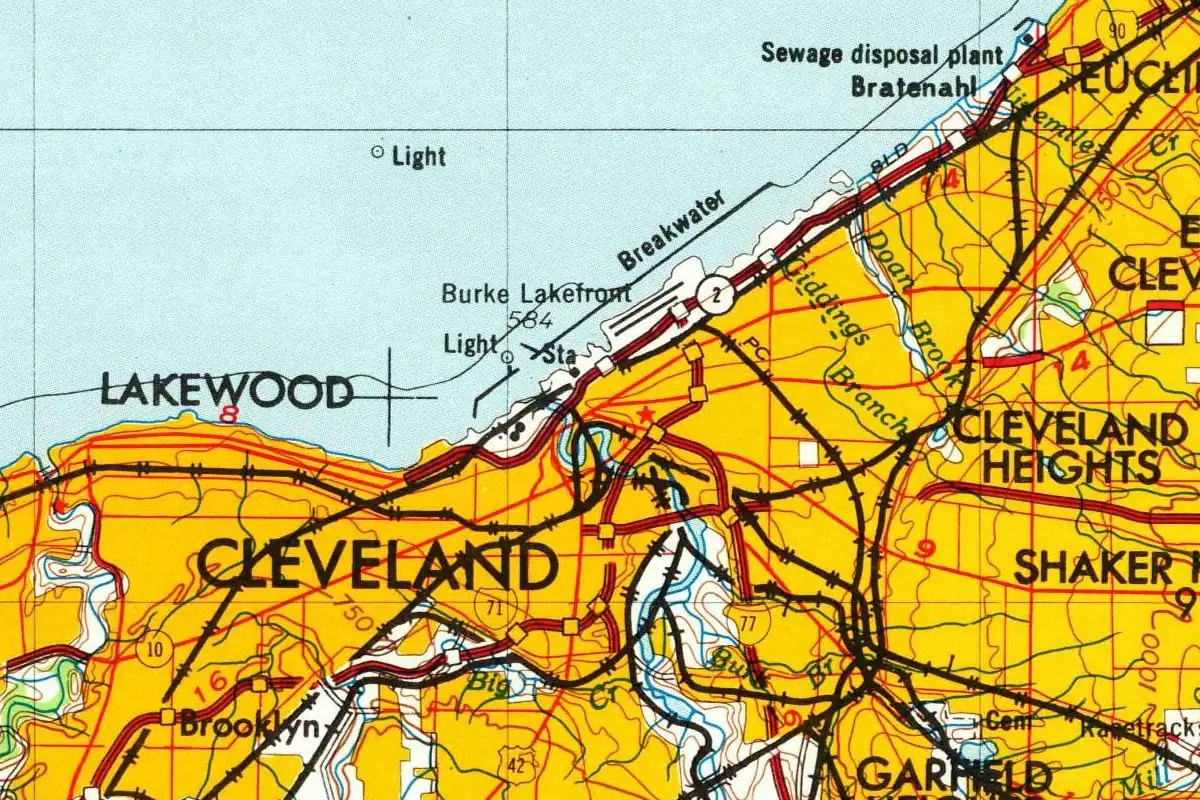
Cleveland, Ohio, is missing a letter: the surveyor it’s named for, Moses Cleaveland, spelled his name with an a. How the city lost it depends on which old story you believe, and there are at least three of them.
A surveying party at the mouth of the Cuyahoga
In 1796, Connecticut sold most of its Western Reserve lands in Ohio to a group of its citizens who organized as the Connecticut Land Company. Henry Howe’s Historical Collections of Ohio says the company made General Moses Cleaveland, a lawyer from Canterbury, Connecticut, its general agent, and put him in charge of a big surveying party that spring. They chose the high plateau at the mouth of the Cuyahoga River for a capital town, and in September 1796 the future city was “surveyed, mapped, and named in honor of their chief by his associates.”
It could easily have been called something else. Samuel P. Orth, in his 1910 history of the city, says the first idea was to name it Cuyahoga, but the surveyors didn’t care for it and urged the general to give the town his own name. Back home, Cleaveland wrote, “I laid out a town on the banks of Lake Erie which was called by my name.” According to Howe, he never returned to the settlement and died in Connecticut in 1806.
Three stories about one letter
Here’s the thing about that missing a: the old books can’t agree on who dropped it.
Howe’s 1891 edition says the town was spelled Cleaveland “until the Cleveland Advertiser was issued in 1830, when the editor, finding the type of his headline too large to extend across his page, dropped the first ‘a’ and made it Cleveland.”
Two volumes later, Howe gives the credit to someone else. In a sketch of Calvin L. Noble, a printer who had founded a Democratic newspaper in Cleveland, he writes: “As the type was too wide for his display head-line he left out one letter and changed the spelling from ‘Cleaveland’ to ‘Cleveland,’ and the public adopted the change.”
Orth passes along a third version, told by A. J. Williams to the city’s early settlers’ association: in 1832 the Herald lost the a because a “sheep’s foot” struck the letter in the heading “and obliterated it.” Williams also quoted a General Sanford as saying the Advertiser’s sheets were simply too narrow one day to fit the whole word.
What the paperwork shows
Orth didn’t think much of any of them. “Whatever the newspaper stories may be,” he wrote, “the truth is that the ‘a’ was not at all generally used by outsiders.” Cleaveland himself always kept it, in his letters and on his tomb. But as Orth points out, the very first field map, drawn by Amos Spafford, is labeled “original plan of the town and village of Cleveland, Ohio, October 1, 1796,” with no a at all, while Spafford’s second map, from 1801, spells it “Cleaveland.” Orth adds that the 1814 act incorporating the village spells it Cleveland, and so do the gazetteers and travel books he checked from 1810 on. The federal place-names database lists the same incorporation year, 1814.
So if you want the short version, the a was slipping away long before any editor ran out of room. A printer’s headline makes a better story, though, and you can see why it stuck.
The founder’s spelling, on a statue
Even Henry Gannett’s 1905 book of place names for the U.S. Geological Survey leaves the letter out. It says the city was “named for Gen. Moses Cleveland, of the Connecticut Land Company, who surveyed it.” His statue went the other way. When a bronze figure of the founder was unveiled on the public square in July 1888, on the anniversary of his arrival, Howe says the base read “General Moses Cleaveland, Founder of the City,” with the a right where he’d always put it.
Sources & further reading
- Henry Howe, Historical Collections of Ohio, Ohio Centennial Edition, vol. 1 (1891), pp. 502-503 and 508. The Connecticut Land Company, Cleaveland as general agent, the naming in September 1796, his death in 1806, the Advertiser story and the 1888 statue.
- Henry Howe, Historical Collections of Ohio, vol. 3 (1891), p. 33. The Calvin L. Noble version of the dropped letter.
- Samuel P. Orth, A History of Cleveland, Ohio, vol. 1 (1910), p. 96. The rejected name Cuyahoga, Cleaveland’s own words, the Spafford maps, the Herald and Advertiser stories, and the 1814 act.
- Henry Gannett, The Origin of Certain Place Names in the United States, 2nd ed. (USGS Bulletin 258, 1905). “Named for Gen. Moses Cleveland,” spelled without the a.
- GNIS feature 1066654 (U.S. Geological Survey). The federal record for Cleveland: incorporated 1814.
Spot something wrong, or know more? Tell us here. You can also email us or use our contact page. Corrections are noted here with their date, never made silently.