Dayton, Ohio: The Town That Was Almost Venice on the Tiber
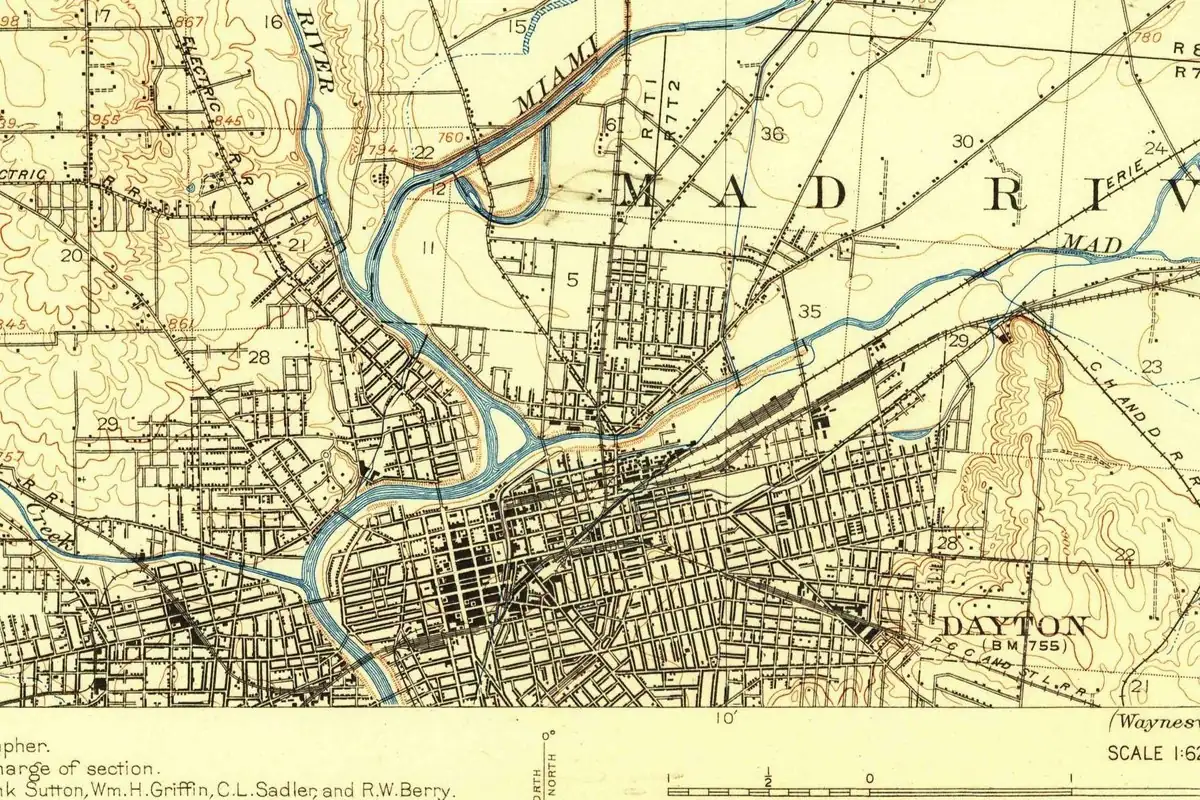
Before Dayton, Ohio, existed, land buyers planned a town called Venice on the same spot, and they meant to rename Mad River the Tiber. That plan fell through, and the town that did get built took the name of Jonathan Dayton, one of its four owners.
Venice, on paper
In June 1789, Major Benjamin Stites and two partners, John Stites Gano and Judge William Goforth, agreed to buy a big tract from John Cleves Symmes that took in the land at the mouth of Mad River. Augustus Waldo Drury’s 1909 history of Dayton describes what they had in mind: “A town by the name of Venice was to occupy the present site of Dayton. Mad river was to be called the Tiber.”
They even drew it up. Drury says the plan had two main streets, each six rods wide, crossing at right angles in the middle, with a four-acre public square that could never have a building on it. The partners came from a mostly Baptist community, so a whole block went to the First Baptist church, and a half-acre lot was promised to “each denomination of pious and well and religiously disposed people who worship the God of Israel.” Three more lots were saved for “a capitol, a courthouse and a gaol.”
None of it happened. Drury blames “prolonged Indian hostilities, and possibly, somewhat” uncertainty over land titles. Harvey W. Crew’s 1889 history adds Symmes’s troubles with the federal government. Maskell E. Curwen, writing in 1850, summed up the result in four words: “we escaped being Venitians.”
Four owners and the best-sounding name
The next try came after Wayne’s Treaty at Greenville in 1795. Curwen says that seventeen days after it was signed, four men contracted with Symmes for the land between Mad River and the Little Miami: Arthur St. Clair, the territorial governor; Jonathan Dayton of New Jersey; General James Wilkinson; and Colonel Israel Ludlow, the same surveyor who laid out Cincinnati. Henry Howe’s Historical Collections of Ohio says they laid out the town on November 4, 1795, and the first families moved in on April 1, 1796.
If you’re wondering why Dayton and not St. Clair or Ludlow, Drury passes along the local answer, with a careful “it is said”: the name “was selected as being the most pleasing among the names of the proprietors.” Henry Gannett’s federal list of place names from 1905 says simply that the city was named “for Jonathan Dayton, one of the original proprietors.”
The other three didn’t go home empty-handed. Crew says the town and three of its streets were named for the original proprietors, who were Federalists, “and as a compromise one of the streets was called Jefferson.” If you look at Crew’s description of the first town limits, you’ll find St. Clair, Ludlow, Wilkinson and Jefferson streets all on the boundary.
The man behind the name
Jonathan Dayton was a serious figure. Drury says he helped frame and signed the U.S. Constitution in 1787, served as Speaker of the House from 1795 to 1799 and then went to the Senate. Then it gets messier. In 1807 he was arrested on charges tied to Aaron Burr’s conspiracy, though he was never tried, and Drury says “his land ventures were not successful,” which he thought probably had something to do with Dayton tying himself to Burr. So the town kept the name its founders liked best, and it outlasted the trouble that followed the man who carried it.
Sources & further reading
- Augustus Waldo Drury, History of the City of Dayton and Montgomery County, Ohio, vol. 1 (1909), pp. 39 and 65. The Venice plan and the Tiber, why it failed, Jonathan Dayton’s career and the “most pleasing” name.
- Harvey W. Crew, History of Dayton, Ohio (1889), pp. 34 and 56. The Venice partners, Symmes’s troubles, the town and streets named for the proprietors, and the Jefferson Street compromise.
- Maskell E. Curwen, A Sketch of the History of the City of Dayton (1850), p. 7. “We escaped being Venitians,” and the 1795 purchase by St. Clair, Dayton, Wilkinson and Ludlow.
- Henry Howe, Historical Collections of Ohio, Ohio Centennial Edition, vol. 2 (1891), pp. 546-547. The town laid out on November 4, 1795, and the first families on April 1, 1796.
- Henry Gannett, The Origin of Certain Place Names in the United States, 2nd ed. (USGS Bulletin 258, 1905). Named for Jonathan Dayton, “one of the original proprietors.”
- GNIS feature 1064514 (U.S. Geological Survey). The federal record for Dayton: incorporated 1805.
Spot something wrong, or know more? Tell us here. You can also email us or use our contact page. Corrections are noted here with their date, never made silently.