Akron, Ohio: A Greek Name Picked to Beat a Pun
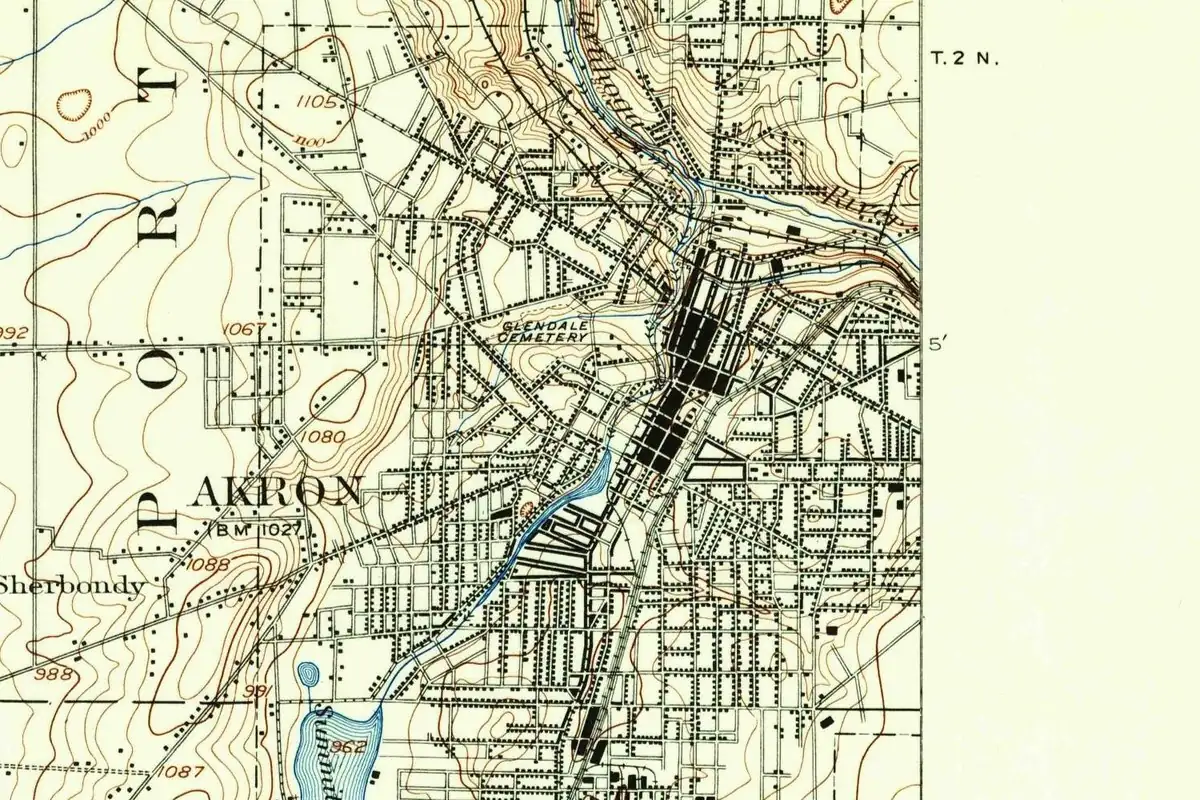
General Simon Perkins wanted a name for his new canal town that a punning neighbor couldn’t joke about, and Akron, Ohio, got a Greek word for high. It didn’t quite work: the neighbor found a pun anyway.
The high point of the Ohio Canal
Akron was laid out in 1825 on the Portage summit of the Ohio Canal, the stretch where the new canal between Lake Erie and the Ohio River reached its highest ground. That’s how Henry Howe described it in his Historical Collections of Ohio, adding that the name “is derived from a Greek word signifying an elevation.”
Samuel A. Lane, the county historian, filled in who chose it. In his 1892 book Fifty Years and Over of Akron and Summit County, he wrote that the new village “was named ‘Akron’ at the suggestion of Charles Olcott, Esq., of Medina, from a Greek word signifying ‘high,’ this being the highest point of land on the line of the canal between Lake Erie and the Ohio River.” Henry Gannett, who compiled place-name origins for the U.S. Geological Survey in 1905, translates it a little differently, as “summit” or “peak.” You’ll find all three versions in the old books, and they point to the same idea: a town on top of the canal.
Judge Pease gets his pun anyway
Lane also tells why Perkins wanted a careful name. Back home in Warren, his neighbors teased him for laying out a town in what they thought was a forbidding spot, and suggested “many ludicrous names.” One of the most persistent teasers was Judge Calvin Pease, “a fine scholar,” who had suggested a number of classical names “with the most ridiculous definitions.” So when Perkins consulted Olcott, Lane says, he asked for a name that would describe where the town sat “but one, also, that Judge Pease could not perpetrate a pun upon.”
According to Lane, it lasted about one conversation. When Perkins got back to Warren, the judge asked if he’d named his village yet. “We’ve named it Akron,” the general told him. Pease turned it over, repeating “Ach-e-ron” to himself, decided it meant a “river in hell,” and called it “a very appropriate name indeed.”
Lane was writing nearly seventy years after the fact, so take the exact words as a well-told local story rather than a transcript. He clearly enjoyed it, though. People who knew the original “lay o’ the land” around Akron, he wrote, “will at once see the aptness of this retort.”
Not the top of Ohio
The name has led to one popular mix-up, and Lane went out of his way to correct it. The spot was the high point of the canal, but “it is not, however, as is popularly supposed, the highest land in the State.” Gannett’s wording is more modest, too: Akron “occupies the highest ground in the northern part of the State.”
What Lane did brag about was the water. If you follow the outflows of Summit Lake, which Howe placed two miles south of town, Lane says part of it reaches the ocean through the Cuyahoga River, Lake Erie and the St. Lawrence, and part through the Tuscarawas, Muskingum, Ohio and Mississippi rivers to the Gulf of Mexico. Howe made the same point in fewer words. That’s the summit in the town’s name: a lake that drains both ways off the high ground.
Sources & further reading
- Samuel A. Lane, Fifty Years and Over of Akron and Summit County (1892), pp. 35-36. Charles Olcott’s suggestion, “high,” the canal’s high point, the correction about the state’s highest land, Summit Lake’s two outflows, and the Pease anecdote.
- Henry Howe, Historical Collections of Ohio, Ohio Centennial Edition, vol. 3 (1891), p. 313. Reprinting his 1847 text: the Portage summit, “a Greek word signifying an elevation,” the town laid out in 1825 and Summit Lake.
- Henry Gannett, The Origin of Certain Place Names in the United States, 2nd ed. (USGS Bulletin 258, 1905). “A Greek word meaning ‘summit’ or ‘peak,’” and the highest ground in northern Ohio.
- GNIS feature 1064305 (U.S. Geological Survey). The federal record for Akron: incorporated 1836.
Spot something wrong, or know more? Tell us here. You can also email us or use our contact page. Corrections are noted here with their date, never made silently.