How Cincinnati, Ohio Got Its Name (It Was Almost Losantiville)
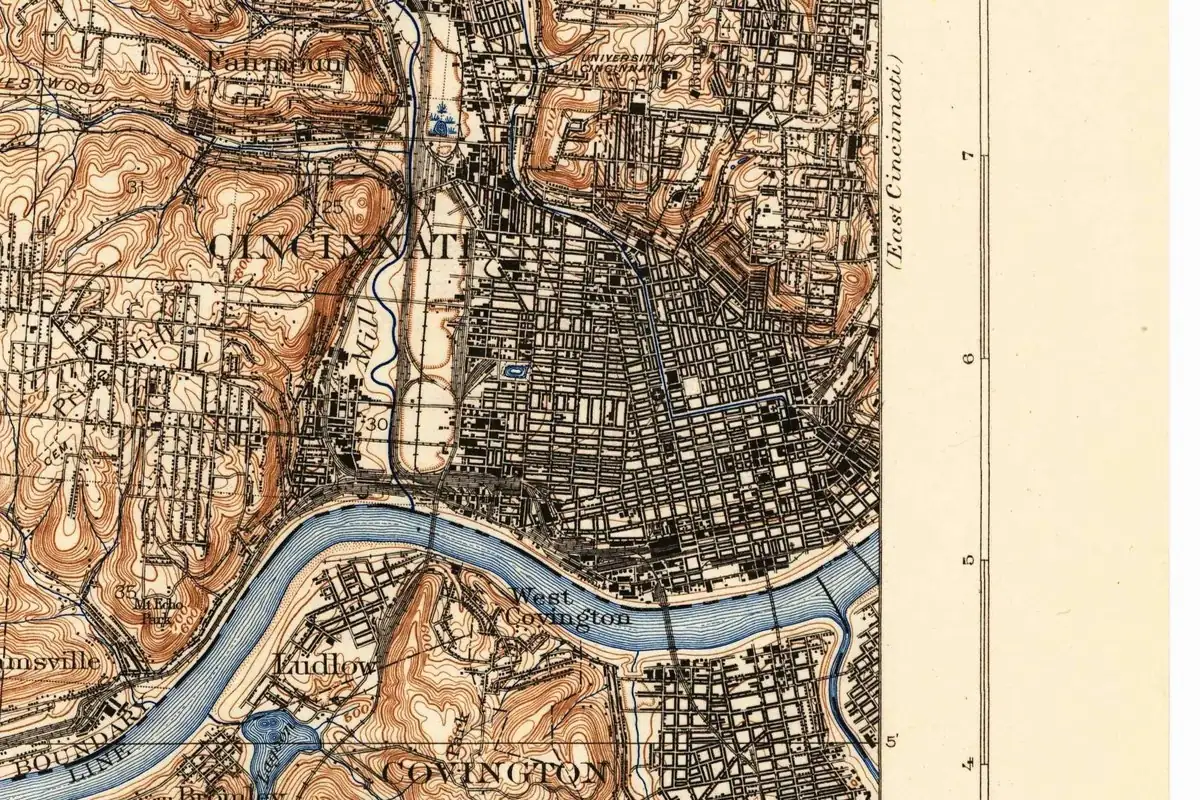
Cincinnati, Ohio, started out with a made-up name, Losantiville, before it took the name of a society of Revolutionary War officers. That society was named for Cincinnatus, the Roman, and the old books still argue over who made the switch.
A name built from three languages
The town began as a real estate deal. Henry Howe’s 1891 Historical Collections of Ohio says that in the winter of 1787-1788 Matthias Denman of New Jersey bought 740 acres on the Ohio side of the river, opposite the mouth of the Licking River, meaning to lay out a town and run a ferry. He took on two partners from Lexington, Kentucky: Colonel Robert Patterson and John Filson, a schoolmaster, surveyor and author of a 1784 book on Kentucky.
Filson was supposed to survey the town, and he named it too. According to Howe, he “called the proposed town Losantiville, a name formed by him from the Latin ‘os,’ mouth, the Greek ‘anti,’ opposite, and the French ‘ville,’ city, from its position opposite the mouth of the Licking river.” If you read it slowly, you can hear the pieces: the town opposite the mouth.
Not everyone admired it. Howe’s first edition, from 1847, quotes the Notes of Judge Burnet, who said the name “had been manufactured by a pedantic foreigner, whose name, fortunately, has been forgotten.” Burnet gives the coiner’s own breakdown, “Le os ante ville,” meaning “the village opposite the mouth,” and then adds, dryly: “Logicians may decide whether the words might not be rendered more correctly, the mouth before the village.”
The surveyor who never came back
Filson didn’t get to lay out his town. In 1788 he went exploring with Judge Symmes and a party of about sixty men, got separated from them, and “was never more heard of,” as Howe’s 1891 edition puts it, “having doubtless been killed by the Indians.” Burnet says the same. Israel Ludlow took over Filson’s share and his job, and the first settlers came down the river from Limestone in late December 1788.
Ludlow or the governor?
As it turns out, Howe’s books tell two different stories about the new name.
The 1891 edition says Losantiville lasted “until the advent of Gov. St. Clair, January 2, 1790, who, being a member of the old Revolutionary army Society of Cincinnatus, expressed a desire the name should be changed to Cincinnati, when his wish was complied with.”
Burnet, in the 1847 edition, calls that version a “very general belief” and says it was “nevertheless incorrect.” St. Clair, he points out, was busy negotiating a treaty at Marietta at the time. In Burnet’s account, Filson’s death ended his contract, Denman signed a new one with Patterson and Ludlow, and with the new town plan “the whimsical name” was “repudiated, and Cincinnati selected.” Even Burnet admits he can’t say who suggested it: “It is impossible to say what influence operated on the minds of the proprietors.”
Henry Gannett’s 1905 list of place names for the U.S. Geological Survey sides with the Ludlow version. It says Cincinnati was “laid out and named by Col. Israel Ludlow, from an organization of officers formed after the Revolutionary war and named in honor of Cincinnatus, the Roman patriot.”
So which story holds up better? On what these books show, Burnet’s. He lays out a sequence (Filson dies, a new contract, a new plan, a new name) and gives a reason to doubt the governor had a hand in it, while the 1891 edition states St. Clair’s wish without saying where that came from. Still, Burnet himself can’t say who first proposed Cincinnati, so the question stays open.
The part nobody disputes
Whoever picked it, the accounts that explain the name point the same way: to the officers’ society and, behind it, Cincinnatus. So the city on the Ohio traded a word built from three languages for a Roman’s name, and by either account, Losantiville didn’t last much more than a year.
Sources & further reading
- Henry Howe, Historical Collections of Ohio, Ohio Centennial Edition, vol. 2 (1891), pp. 24-25. Denman, Patterson and Filson; Filson’s Latin, Greek and French breakdown of Losantiville; his disappearance; Ludlow taking over; St. Clair and the change on January 2, 1790.
- Henry Howe, Historical Collections of Ohio (1847; 1850 printing), pp. 206-207. Howe’s first edition quoting Burnet’s Notes: the “pedantic foreigner,” “Le os ante ville,” why the St. Clair story is “incorrect,” and the new contract with Ludlow.
- Henry Gannett, The Origin of Certain Place Names in the United States, 2nd ed. (USGS Bulletin 258, 1905). Named by Israel Ludlow for the officers’ society named in honor of Cincinnatus.
Spot something wrong, or know more? Tell us here. You can also email us or use our contact page. Corrections are noted here with their date, never made silently.