Frankfort, Kentucky: A Capital Named for a Pioneer Killed There
Frankfort, Kentucky’s capital, is named for Stephen Frank, a pioneer killed on the Kentucky River in 1780. Two old accounts tell his death differently, and one of them doesn’t even give his name.
A salt run that went wrong
The fullest version comes from Lewis and Richard H. Collins’s 1874 History of Kentucky. In 1780, they write, a group that included William Bryan, Nicholas Tomlin and Stephen Frank was headed from Bryan’s Station and the fort at Lexington to Mann’s Salt Licks, in what’s now Jefferson County, to get salt. They camped on the bank of the Kentucky River “where the town of Frankfort now stands,” and Indians attacked. “Frank was instantly killed, Tomlin and Bryan both wounded; the rest of the company escaped unhurt.”
Then comes the line the whole story hangs on: “From this circumstance — the killing of Frank — it is said the place was called Frankfort.” Notice the “it is said.” Even the Collinses were passing along what people told, not quoting a record.
The version with a river crossing
The federal list of place names Henry Gannett put together for the U.S. Geological Survey in 1905 tells it differently. His Frankfort is “named for one of a band of pioneers, who alone succeeded in fording the Kentucky River, and was killed by Indians on reaching the opposite bank.” No camp, no salt, no name. In Gannett, he’s one man who made it across and died on the far side.
You might expect one of them to say the town started out as “Frank’s ford.” Neither book does. Both agree on the part that matters, though: a pioneer was killed by Indians at this spot on the river, and the town is named for him.
From riverbank to capital
It took a while for a town to grow there. The Collinses say Virginia’s legislature “established” Frankfort in 1786. C. E. James, in a short county history he read at a Fourth of July picnic in 1876, picks up from there. After Kentucky became a state in 1792, five commissioners toured the towns that wanted the government, including Louisville, Lexington and nearby Leestown. On December 5, 1792, they decided “that Frankfort was the most proper place for the seat of government.” James says the people of Frankfort and Franklin County sweetened the deal with $3,000 in gold and the first State House.
The town next door that didn’t make it
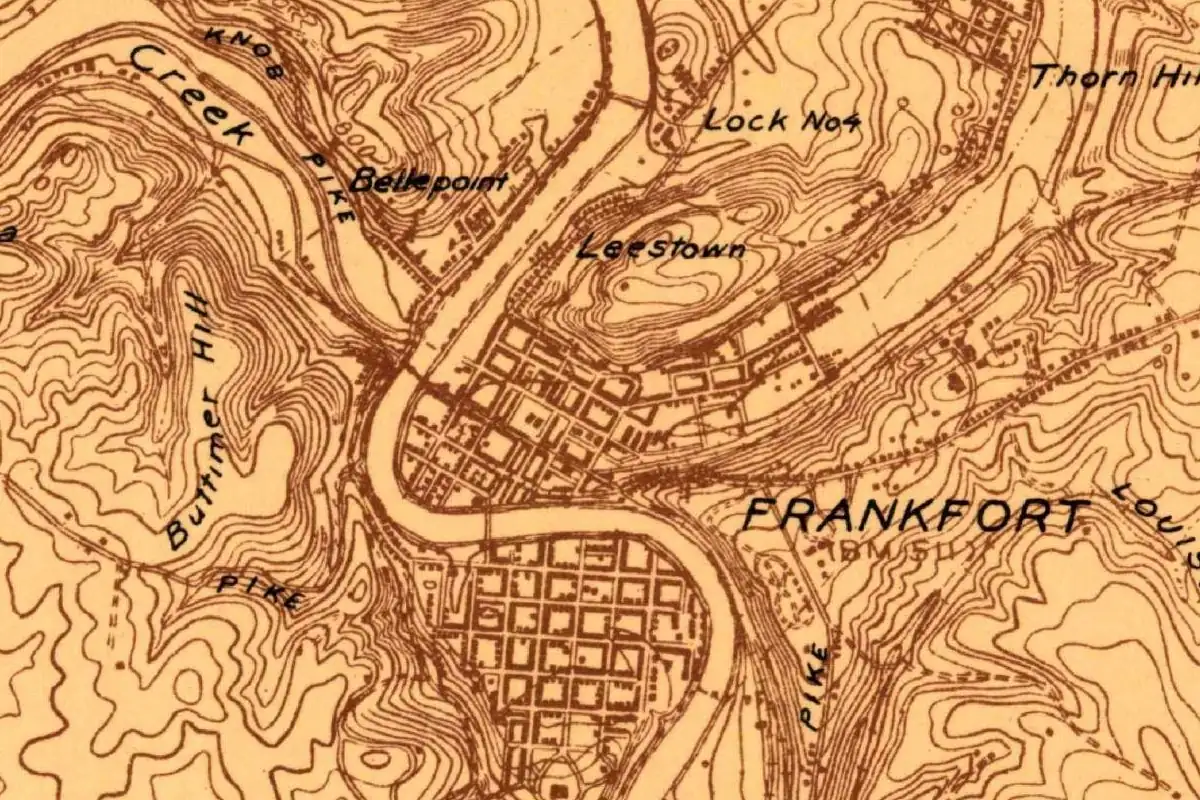
Here’s a twist you can still see on old maps. Leestown, a mile below Frankfort, was the first spot settled, the Collinses write, and travelers used it as a stopping place as early as 1775. In March 1789 the geographer Jedidiah Morse described Leestown as “flourishing” and predicted its river crossing would help it grow. “Dr. Morse does not even name Frankfurt,” the Collinses note, though it had been established three years before. By the end of 1792, Frankfort had been picked as the seat of government of the new state, and Leestown, they add, “never increased much.”
Sources & further reading
- Lewis Collins and Richard H. Collins, History of Kentucky, vol. 2 (1874), Franklin County. The 1780 attack, Stephen Frank and “it is said the place was called Frankfort” (pp. 211–212); Leestown, Morse’s 1789 description and the 1786 establishment of Frankfort (p. 212).
- Henry Gannett, The Origin of Certain Place Names in the United States (USGS, 1905). The version in which an unnamed pioneer alone forded the river and was killed on the opposite bank.
- C. E. James, A Short History of Franklin County, Kentucky (1876). The 1786 establishment, the commissioners’ choice of December 5, 1792, and the $3,000 in gold.
- GNIS feature 517517 (U.S. Geological Survey). The federal record, which lists Frankfort as the capital of the Commonwealth of Kentucky.
Spot something wrong, or know more? Tell us here. You can also email us or use our contact page. Corrections are noted here with their date, never made silently.