How Louisville, Kentucky Got a French King's Name
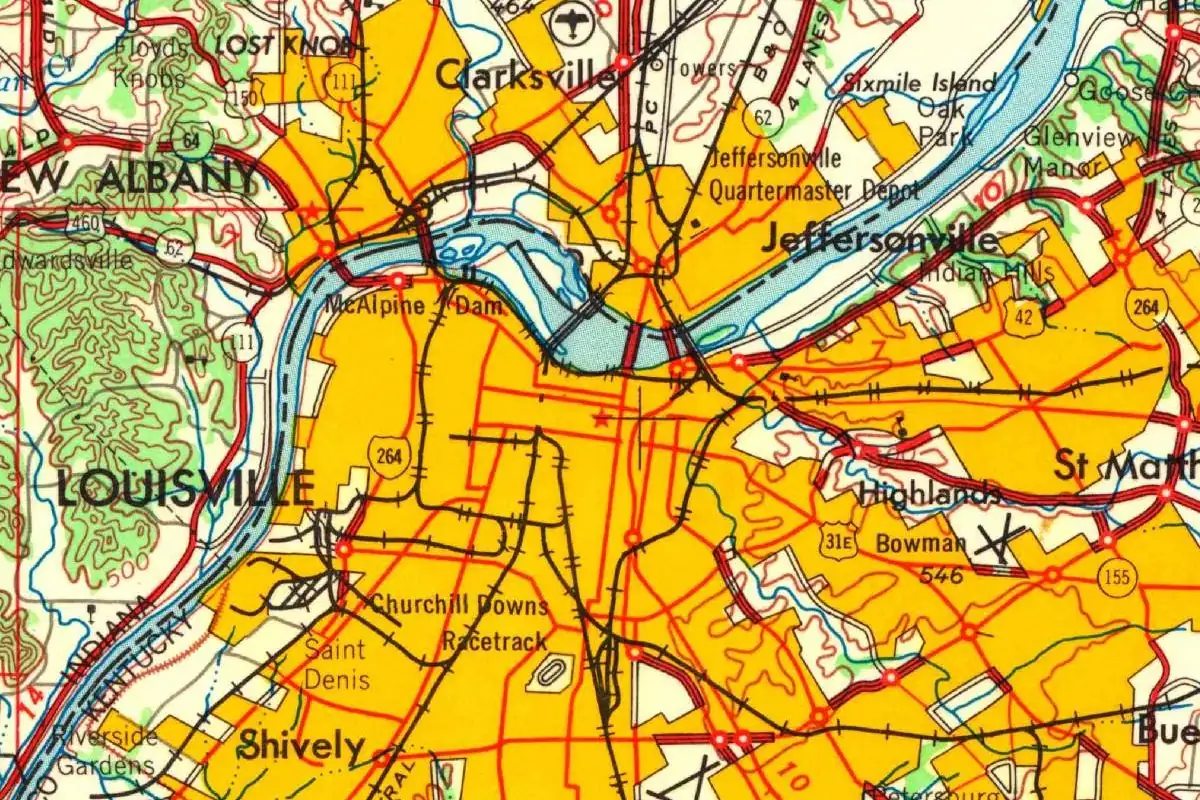
Louisville, Kentucky, carries the name of a French king, Louis XVI. It became official in 1780, when Virginia made the settlement at the Falls of the Ohio a town. The settlers, though, had been using the name for about a year by then.
One line from 1905
Henry Gannett’s 1905 list of American place names for the U.S. Geological Survey gives the answer in one line: Louisville, “named for Louis XVI of France.” That’s the whole entry. It doesn’t say who picked the name or why.
For the who, the best lead comes from a 1914 book written for children, Fannie Casseday Duncan’s The Child’s Story of the Making of Louisville. While the town was being legally set up, she writes, “Colonel Clark asked that it be named after Louis XVI, King of France.” That’s George Rogers Clark, who had brought the first families to the Falls in the spring of 1778. It’s a friendly little book, though, and it doesn’t say where that detail came from, so you should take it as a lead rather than proof.
What the 1780 law actually says
The law itself is more modest. Ben Casseday reprinted Virginia’s “Act for establishing the town of Louisville at the Falls of Ohio” in his 1852 history of the city. It hands 1,000 acres, the forfeited land of John Connolly, to a list of trustees and declares that land “established a town by the name of Louisville.” It never explains the choice. If you were hoping for a line thanking the king, you won’t find one: the act, as Casseday prints it, never mentions France or Louis.
Before it was Louisville
At first the settlement mostly went by its location. Reuben T. Durrett, in The Centenary of Louisville, a paper he read in 1880 and the Filson Club published in 1893, describes the first church, school and cabins going up while the place “went by the name of ‘Falls of Ohio.’” Duncan says its only name back then was the Beargrass Settlement. But Durrett also found that the name came before the law. In the same paper he says there was already a settlement “known as Louisville,” and he describes a meeting on April 17, 1779, where trustees picked by the settlers “agreed upon a plan of the town to be called Louisville” and set April 24 for everyone to draw a half-acre lot. He doesn’t say who came up with the name. The Collinses, in their 1874 History of Kentucky, add an earlier wrinkle: a Capt. Thomas Bullitt laid out a town here in August 1773, but “no record of the plan or survey has been preserved.”
The island that came first
The first settlers didn’t start on the Kentucky shore at all. The Collinses say the families who came with Clark in the spring of 1778 were left on an island near the bank, and they explain its name too. It’s Corn Island, and the name “is supposed to have been derived from the circumstance that the settlers planted their first Indian corn on this island.” That fall they moved to the mainland, and by the next spring they were drawing lots in a town called Louisville.
Sources & further reading
- Henry Gannett, The Origin of Certain Place Names in the United States (USGS, 1905). “Named for Louis XVI of France.”
- Ben Casseday, The History of Louisville (1852), pp. 44–47. The full text of Virginia’s 1780 act, with the Connolly land, the trustees and “a town by the name of Louisville.”
- Fannie Casseday Duncan, The Child’s Story of the Making of Louisville (1914). The Beargrass Settlement (p. 11) and Clark asking for the name of Louis XVI (p. 36).
- Reuben T. Durrett, The Centenary of Louisville (Filson Club, 1893). A settlement “known as Louisville” before the 1780 act (p. 7); the settlement “while it went by the name of ‘Falls of Ohio’” (p. 32); the trustees’ meeting of April 17, 1779, and “a plan of the town to be called Louisville” (pp. 33–34).
- Lewis Collins and Richard H. Collins, History of Kentucky, vol. 2 (1874). Bullitt’s 1773 plan (p. 360); Corn Island, the 1778 families and the move to the mainland (p. 371); Louisville at the Falls (p. 355).
- GNIS feature 509453 (U.S. Geological Survey). The federal record for Louisville.
Spot something wrong, or know more? Tell us here. You can also email us or use our contact page. Corrections are noted here with their date, never made silently.