Indianapolis, Indiana: The Name That Got a Laugh in 1821
When Jeremiah Sullivan proposed the name Indianapolis for Indiana’s new capital in 1821, the House laughed. Then it voted yes. The name is just the state’s own name with a Greek ending stuck on, and a Vincennes newspaper announced it as one of the most “ludicrous” acts of the lawmakers at Corydon.
A blank in the bill
The legislature was meeting in Corydon, the old capital, and the law that confirmed the site for a new seat of government also had to name it. Jacob Piatt Dunn’s 1910 history, Greater Indianapolis, says the name came only “after a prolonged discussion by the House.” Dunn lets Sullivan tell how it went. Dunn calls him a judge of the state Supreme Court, and in 1821 he was a member of the legislature.
The bill had a blank where the town’s name should go, Sullivan recalled, and it took “two or three days” to fill it. General Marston G. Clark of Washington County pushed hard for Tecumseh and then tried other Indian names. They all lost. Somebody proposed “Suwarrow,” which “met with no favor.” In Sullivan’s words, other names were “proposed, discussed, laughed at, and voted down.”
Sullivan’s idea, Merrill’s second
Sullivan says he’d come to Corydon already planning to suggest Indianapolis. He told Samuel Merrill, the representative from Switzerland County, who agreed to back it, and the two of them went to see Governor Jennings, who let them know he liked it. When Sullivan made the motion, “The name created quite a laugh. Mr. Merrill, however, seconded the motion.”
If you’ve ever wondered why Indiana’s capital ends in Greek, this was the pitch. What won people over, Sullivan was sure, was the argument “that the Greek termination would indicate to all the world the locality of the town.” The law was approved on January 6, 1821. Dunn adds that the Merrill family had its own tradition, that Merrill came up with the name first, though he “never cared to insist on his claim.”
“Pronounce it as you please”
Not everybody was impressed. Dunn quotes the Indiana Centinel in Vincennes, which had wanted Tecumseh. On January 15, 1821, it announced the new name as “One of the most ludicrous acts, however, of the sojourners at Corydon.” The paper spelled the word out letter by letter and told readers, “Pronounce it as you please, gentle readers.” There was, it promised, “no danger of violating any system or rule.” A week later it printed a letter that read the name backward as “SILOPANA IDNI” and claimed it meant “A HEAD WITHOUT BRAINS.”
Here’s the thing: Dunn didn’t think the joke held up. Once you get used to it, he wrote, the name “is no more stilted than ‘Philadelphia.’” There were older American examples like Annapolis and Gallipolis, and later ones like Minneapolis. Dunn spells out the meaning, “City of Indiana,” and the state’s own name has a story of its own, which we tell in How Indiana Got Its Name.
The name before the name
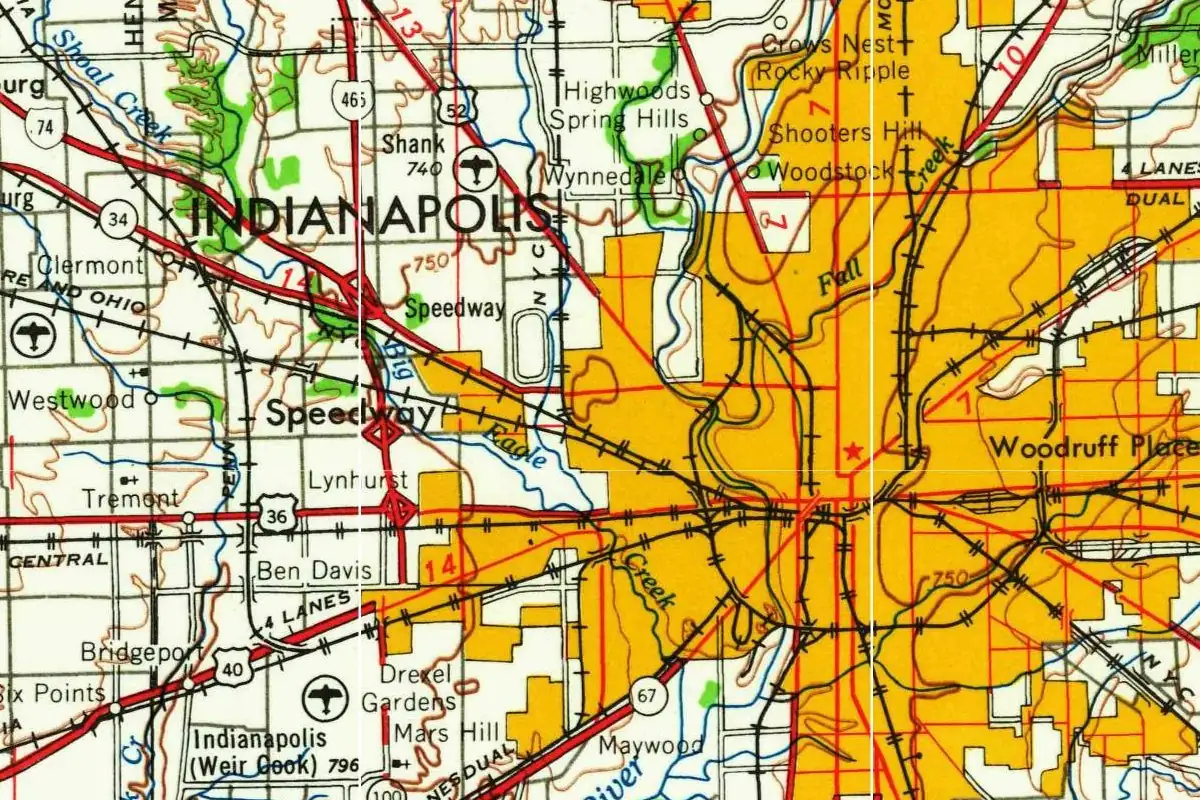
The spot already had a name in Miami. Dunn’s 1909 glossary of Indiana Indian names says the Miamis called the site Chank’-tun-oon’-gi, because it sat at the mouth of Fall Creek, and that it means “Makes a Noise Place.” In his city history he admits Indianapolis “may not be so suggestive.” He also notes that other towns in Texas, Colorado, Iowa, and Oklahoma borrowed the name, and mail kept going to the wrong place until the post office got all but the Oklahoma one dropped. So the name a Vincennes paper laughed at turned out to be one other towns wanted for themselves.
Sources & further reading
- Jacob Piatt Dunn, Greater Indianapolis, vol. 1 (1910), pp. 26-27. The act of January 6, 1821; Sullivan’s account of the debate, Tecumseh, “Suwarrow,” Merrill and Governor Jennings; the Merrill family tradition; the Indiana Centinel items of January 1821; Dunn’s comparison with Philadelphia and the other Indianapolis post offices.
- Jacob Piatt Dunn, True Indian Stories, with Glossary of Indiana Indian Names (1909), p. 266. The Miami name for the site at the mouth of Fall Creek, “Makes a Noise Place.”
- GNIS feature 452890 (U.S. Geological Survey). Lists Indianapolis as the capital of Indiana and gives 1825 as the year it became the state capital.
Spot something wrong, or know more? Tell us here. You can also email us or use our contact page. Corrections are noted here with their date, never made silently.