Kokomo, Indiana: Black Walnut, Young Grandmother, or The Diver?
Kokomo, Indiana, carries the name of a Miami man, but the old books give at least three meanings for it and agree on none. One says Black Walnut, one says Young Grandmother, and one says The Diver. The one who went to Miami speakers for an answer threw out the first two.
A village before a town
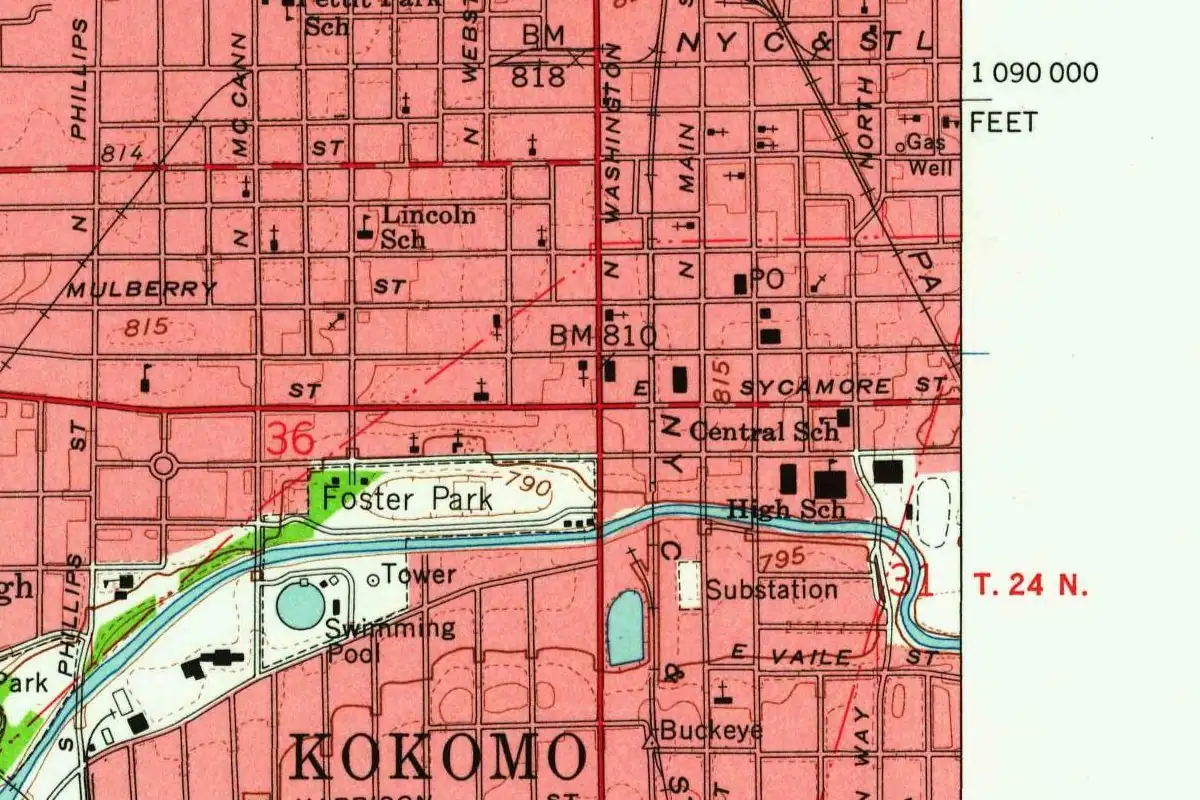
Before there was a town, there was a Miami village. Jackson Morrow’s 1909 History of Howard County says the most important Miami settlement in the county around 1840 was “the Indian village, Kokomo, on the south side of Wildcat,” where South Kokomo is now. The county was organized in 1844 under a different name, Richardville, and commissioners went looking for a county seat. They picked Kokomo. Morrow says the only thing there was David Foster’s log house, his barn, and a small clearing, with a few Indian huts across the creek.
The commissioners wanted the south bank. Foster, who was donating the land, refused. The story, as Morrow tells it with another “it is said,” is that he called the south side dry, fertile, and better for a farm, while the north side was swampy. After two days of trying to change his mind, they gave in and took his 40 acres on the north side. If you want to find that donation today, Morrow gives its first boundaries: Taylor, Union, High, and Washington streets.
Black Walnut, son of Richardville
Morrow’s own story about the name comes with a hedge built in. “It is said,” he writes, that the Miami chief Pee-jee-wah, or Richardville, had four sons, and that one was “Kokomoko, shortened to Kokomo (Black Walnut).” Kokomoko, “from whom the city of Kokomo was named, is said to have been born about 1775,” and “according to the most authentic reports he died in 1838.” Morrow says his remains were buried in the old cemetery at Kokomo.
Henry Gannett’s first edition of his place-name list for the U.S. Geological Survey, in 1902, had a different answer: Kokomo was “An Indian word, meaning ‘young grandmother.’” When Gannett put out the second edition in 1905, the Kokomo entry wasn’t in it.
Dunn’s “Diver”
Jacob Piatt Dunn went to Miami speakers. He wrote that he got most of his Miami names from Gabriel Godfrey, whom he called “the best Miami interpreter in Indiana,” and from Kilsokwa, “the oldest of the Indiana Miamis.” His 1909 glossary says Kokomo is “Said to have been the name of a Miami chief of the Thorntown band, but there is no such name signed to any treaty unless it be ‘Co-come-wah,’” a signer of an 1834 treaty.
Then he takes on the translations. Kokomo, Dunn says, “has been translated ‘Black Walnut,’ ‘Bear Chief,’ and ‘Young Grandmother,’ for none of which is there any basis.” Both of his informants told him there was a Thorntown Indian named Ko-kah’-mah and that the city’s name refers to him. Godfrey said it means “He Goes Under,” as in diving, which could be put as “Something Diving” or “The Diver.” By 1919, in his history Indiana and Indianans, Dunn wrote it more simply: Kokomo was “Named for a Thorntown Indian, whose name was Ko-ka’-ma, or The Diver.”
Who was Kokomo?
That leaves two different men. Morrow’s Kokomoko is a son of Richardville, which happens to be the name the county started out with. Dunn’s Ko-kah’-mah is from the Thorntown band, and Dunn doesn’t call him Richardville’s son. If you go by the evidence each one cites, Dunn wins on the meaning: he names his Miami sources, while Morrow passes along what “is said.” Even then, “The Diver” rests on Godfrey’s word alone; Dunn cites Kilsokwa only for the man. But nobody in these books found a treaty or a record that settles who the man was. Even Dunn’s best match, Co-come-wah, comes with an “unless.”
Sources & further reading
- Jacob Piatt Dunn, True Indian Stories, with Glossary of Indiana Indian Names (1909), pp. 271-272. The Thorntown band; “Co-come-wah” on the 1834 treaty; “Black Walnut,” “Bear Chief,” and “Young Grandmother,” “for none of which is there any basis”; Ko-kah’-mah, “He Goes Under,” “The Diver.” His informants, Gabriel Godfrey and Kilsokwa, are named in the book’s opening chapter.
- Jacob Piatt Dunn, Indiana and Indianans, vol. 1 (1919), p. 90. Dunn’s later, shorter entry: “Ko-ka’-ma, or The Diver.”
- Jackson Morrow, History of Howard County, Indiana, vol. 1 (1909). The Miami village on Wildcat Creek and the “said to” story of Kokomoko, son of Richardville, “Black Walnut” (pp. 47-48); Richardville County, David Foster’s cabin and the fight over which bank (pp. 55-56); the first boundaries of Foster’s donation (p. 319).
- Henry Gannett, The Origin of Certain Place Names in the United States, 1st ed. (USGS, 1902), p. 154. “An Indian word, meaning ‘young grandmother.’”
- Henry Gannett, same title, 2nd ed. (USGS, 1905), p. 177. The place where the Kokomo entry would go, between Knoxville and Konkapot. It’s not there.
- GNIS feature 437425 (U.S. Geological Survey). Its only history note: “First settled in 1844.”
Spot something wrong, or know more? Tell us here. You can also email us or use our contact page. Corrections are noted here with their date, never made silently.