Terre Haute, Indiana: The High Land Named Before the Town
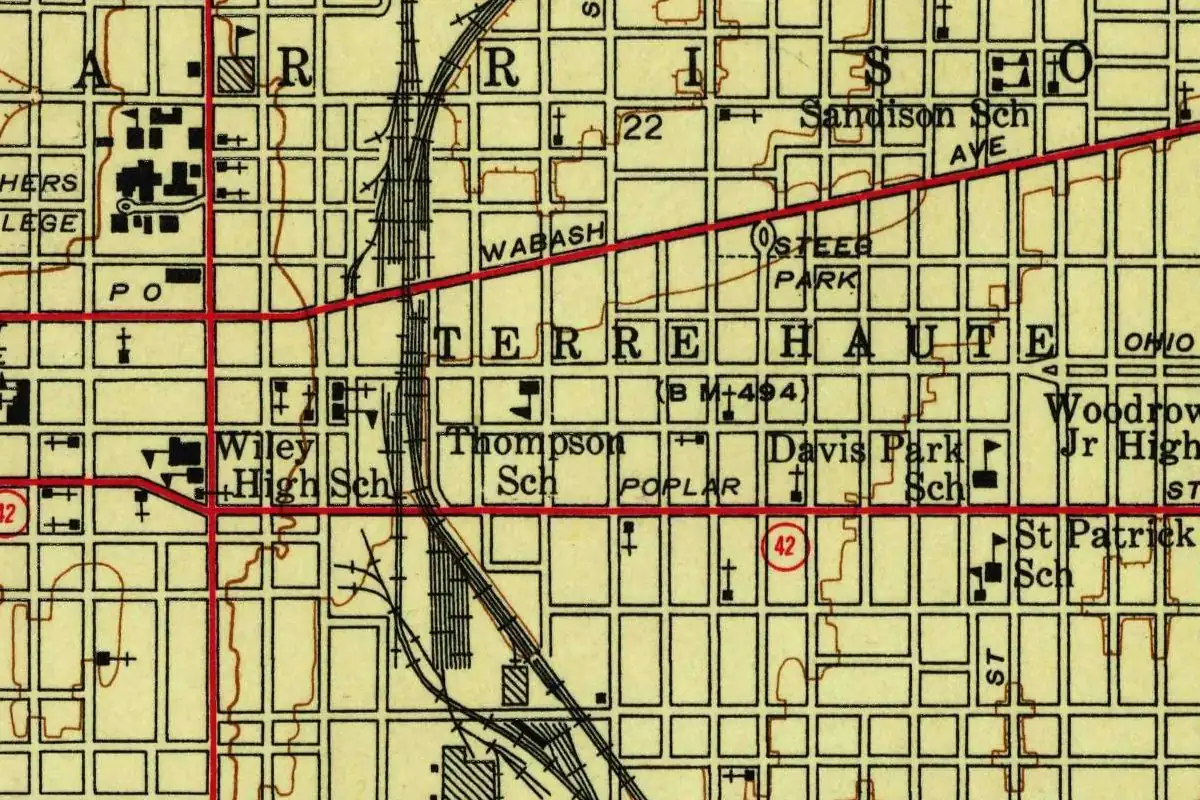
Terre Haute means “high land,” and the name sat on this stretch of the Wabash long before anyone laid out Terre Haute, Indiana. H. C. Bradsby’s 1891 history of Vigo County says the name “had been given to it nearly one hundred years before it was platted and christened Terre Haute.” So the town didn’t pick a name. It moved into one.
The Highlands of the Wabash
The name is French, from the years when France claimed this country, including what’s now Indiana. Charles Oakey’s 1908 history of the city says that back then, the dividing point between the French governments of Canada and Louisiana was Terre Haute, “the Highlands of the Wabash.” Bradsby describes it as a natural gathering place: an Indian village, then the French woodsmen and fur traders who used it as a meeting spot, then soldiers.
You can see the name in use before the town in an Army journal. In October 1811, during the march that ended at Tippecanoe, John Tipton wrote that his unit “came to tare holt,” which Oakey prints as Terre Haute, “an old Indian village on the east side of Wabash on high land near a large prairie.” Oakey says he quoted the journal “without its bad spelling,” but he left that one in. High land, in so many words.
Three sites and a Quaker’s doubt
By 1816 settlers had three places to choose from: the area around Fort Harrison, a spot farther down the river called Old Terre Haute, and a stretch in between. A group of investors bought land in September 1816 and recorded the plat of the town of Terre Haute on October 25, Oakey says, in the Knox County recorder’s office, since Vigo was still part of Knox County.
Bradsby tells how the middle site won, as James Boord remembered it in his old age. William Hoggatt, the surveyor the company sent ahead, picked it. One of the partners, a Quaker named Jonathan Lindley, wasn’t convinced: “William, don’t thee think that thee hast made a mistake? Don’t thee think that thee should have selected Old Terre Haute or Fort Harrison?” Hoggatt explained that at both of those places the river bends away to the west, while at his spot it runs straight and the land rises from the water. “Well, well,” the Quaker said, “William, thee is an engineer and thee should know.”
Which high land?
That’s where it gets interesting. Bradsby says Old Terre Haute “stands on a high bluff,” and it would be easy to assume the name came from that bluff. Oakey didn’t think the name came from a bluff at all. In a statement he gave the newspapers a few days before he died, describing his coming book, he promised to show “that the old town never was French, that it did not get its name from a bluff.” We searched the text of his first volume and didn’t find that argument spelled out, so if you’re looking for his answer, you’re left with the promise.
Henry Gannett’s book on the origins of American place names, in both its 1902 and 1905 editions, kept it simple. He described the city as “built upon a bank 60 feet above the river” and gave the meaning as “high land,” without saying which piece of high ground the name first belonged to.
The federal government didn’t help with the spelling, either. On October 26, 1818, Oakey writes, Curtis Gilbert, the postmaster at Fort Harrison, got notice from Postmaster General Meigs to move his office to “Terry Haut.” The town kept the French spelling anyway. The post office’s version lives on as a line in Oakey’s book.
Sources & further reading
- H. C. Bradsby, History of Vigo County, Indiana (1891), pp. 417-418. Terre Haute as “high land,” a name nearly a hundred years older than the town; Old Terre Haute on “a high bluff”; James Boord’s story of William Hoggatt and the Quaker partner.
- C. C. Oakey, Greater Terre Haute and Vigo County, vol. 1 (1908). Oakey’s statement to the press, printed as the preface; “the Highlands of the Wabash” as the line between Canada and Louisiana (p. 2); John Tipton’s 1811 journal (p. 13); the three rival sites, the land purchase and the plat of October 25, 1816 (pp. 34-35); the “Terry Haut” post office order of 1818 (p. 48).
- Henry Gannett, The Origin of Certain Place Names in the United States, 1st ed. (USGS, 1902), p. 251, and 2nd ed. (1905), p. 298. Terre Haute “built upon a bank 60 feet above the river,” with the meaning “high land”; both editions say the same thing.
- GNIS feature 444648 (U.S. Geological Survey). The federal record for Terre Haute, in Vigo County. It has no note on the name.
Spot something wrong, or know more? Tell us here. You can also email us or use our contact page. Corrections are noted here with their date, never made silently.