Fort Wayne, Indiana: A Name Fired Off in 15 Cannon Rounds
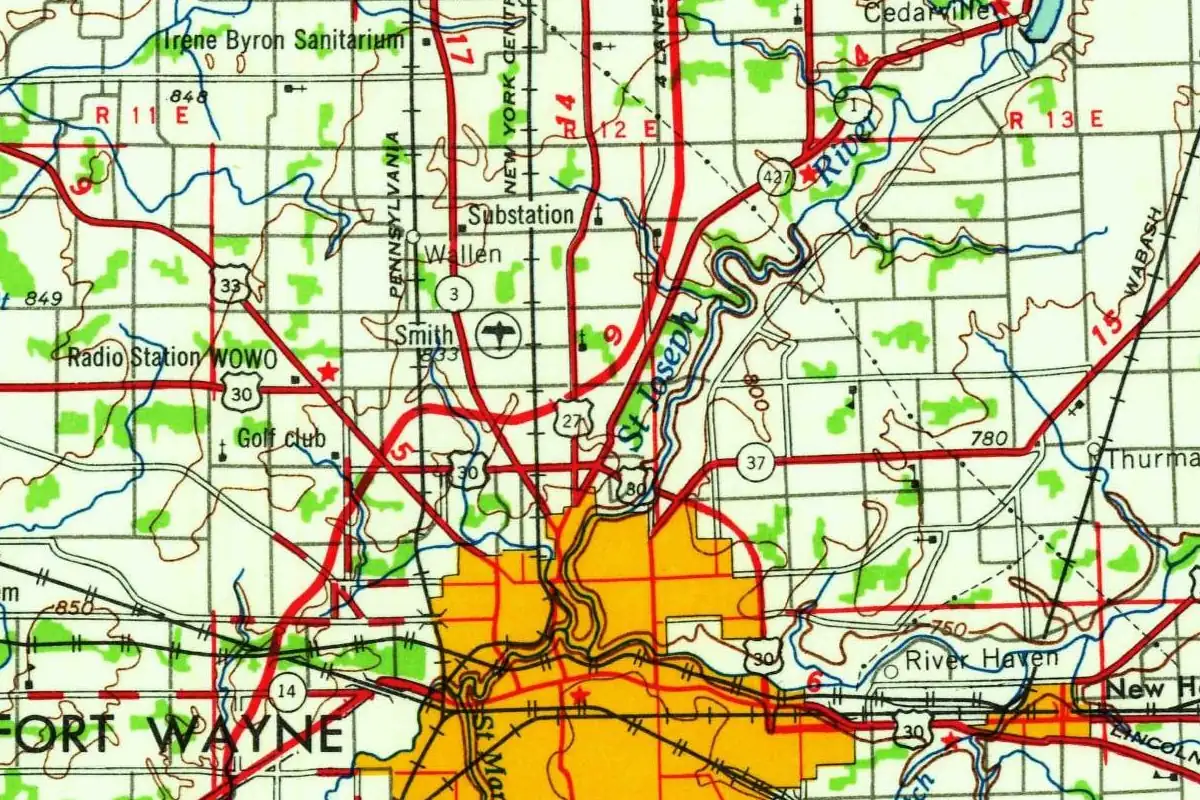
Fort Wayne, Indiana, is named for General Anthony Wayne, whose officer named the Army’s new fort there for him in 1794, after 15 rounds of cannon fire. The soldiers who were there agreed on the name and the cannon. They didn’t agree on what time of day it happened.
October 22, 1794
Wayne’s army reached the spot in mid-September 1794, on high ground above the place where the St. Marys and the St. Joseph join to form the Maumee, and spent the next weeks building a fort. B. J. Griswold’s 1917 Pictorial History of Fort Wayne quotes a letter Wayne wrote to Secretary Knox on September 27, calling it and Fort Defiance “the most respectable now in the occupancy of the United States.” The dedication came on October 22, which Griswold points out was the fourth anniversary of the battle at Harmar’s Ford, fought near the same spot.
Two officers kept journals, and Griswold quotes both. Lieutenant Boyer wrote that at 7 o’clock that morning, “after firing fifteen rounds of cannon, Colonel Hamtramck gave it the name of Fort Wayne.” Lieutenant William Clark put it at 8 and said Colonel Hamtramck “took charge of the fort, after naming it after His Excellency, firing fifteen rounds and giving three cheers.” The federal place-names list of 1905 says the same thing in one line: the city is “named from a fort built by Lieutenant-Colonel Hamtramck in 1794, named for Gen. Anthony Wayne.”
A sunset that may not have happened
As it turns out, Griswold had a third witness, and he tells it differently. A private named Bryant remembered putting up the flagstaff “as the sun was declining beneath the golden horizon,” then the drums and fifes, a speech from Wayne, and the flag going up in “the twilight breeze.” “The fort was then, by Colonel Hamtramck, named ‘Wayne,’ after our noble commander-in-chief,” Bryant said. “That night we got something to wet our throats.”
Griswold weighed the two versions and sided with the journals. It “appears certain,” he wrote, that the ceremony took place around 7 or 8 in the morning, not in the twilight. He left Bryant a way out, too: “Possibly, however, Private Bryant has been misquoted.” So if you’ve heard the sunset version, you’ve heard the one the officers’ journals don’t back up.
What the Miamis called it
The fort went up at a place that already had a well-known name. Jacob Piatt Dunn, who gathered Indiana’s Native place names in 1909 with the help of Miami speakers, says the town there was known as Kekionga, and that the Miamis still called Fort Wayne Ke’-ki-oon’-gi in his day. He traces it to Kiskakon, the name of a division of the Ottawas who lived there before the Miamis, and translates that as “clipped hair,” after the way they cut their hair.
Not everyone reads the word that way. Griswold’s notes cite the historian Reuben G. Thwaites, who thought it meant “to cut” and referred to the short tail of the bear the clan was named for. Dunn added that the Miamis’ form “would mean ‘cut place’ if it meant anything,” but that the Miamis and the Delawares both said they didn’t know what it meant. The fort’s name, by contrast, came with a date, a commander, and 15 cannon shots, so you’d think the paperwork would settle every detail. It settled all of them except the hour.
Sources & further reading
- B. J. Griswold, The Pictorial History of Fort Wayne, Indiana, vol. 1 (1917), pp. 140, 146-148. The arrival at the forks in September 1794; Wayne’s September 27 letter to Knox; the dedication on the anniversary of Harmar’s Ford; the journals of Lieutenants Boyer and Clark; Private Bryant’s sunset account and Griswold’s verdict. His notes on chapter 1 give Thwaites’s reading of Kekionga.
- Henry Gannett, The Origin of Certain Place Names in the United States (USGS, 1905), p. 130. The one-line federal entry: Hamtramck’s fort of 1794, named for Gen. Anthony Wayne.
- Jacob Piatt Dunn, True Indian Stories, with Glossary of Indiana Indian Names (1909), pp. 17, 265, 267-268. Kekionga, Kiskakon, “clipped hair,” and the “cut place” and “old place” readings that both tribes disclaimed.
- GNIS feature 434689 (U.S. Geological Survey). The federal record: “Named for General Anthony Wayne.”
Spot something wrong, or know more? Tell us here. You can also email us or use our contact page. Corrections are noted here with their date, never made silently.