How Kalamazoo, Michigan Got Its Name (It Used to Be Bronson)
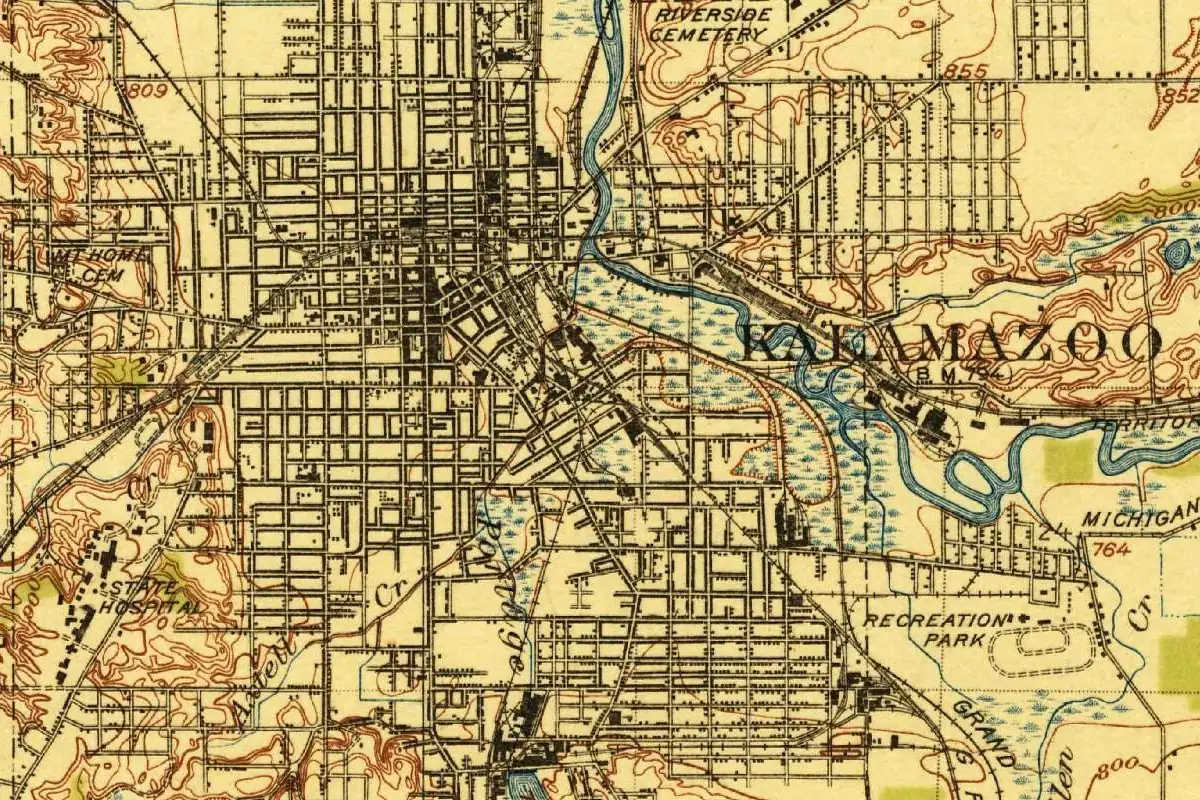
Kalamazoo, Michigan, was called Bronson, after its first settler, until the Legislature swapped his name for the river’s in 1836. What the river’s name means is still up for debate, and you can take your pick from at least half a dozen answers.
Potato Bronson’s village
Samuel Durant’s 1880 history of Kalamazoo County calls Titus Bronson “an eccentric pioneer” and says he was the first white settler on the site, in June 1829. A settler who reached Michigan that same spring wrote that he was “commonly called ‘Potato Bronson.’” He and his brother-in-law, Stephen H. Richardson, laid out the village, and when the governor’s commissioners picked it for the county seat in January 1831, the place “then first received the name of ‘Bronson.’” The plat of the “Village of Bronson” was recorded on March 12, 1831.
The swap
A few years later, in the winter of 1835–36, some of the villagers started pushing to change the name. Durant names three men as the main movers, and he doesn’t say why they wanted it. He only offers “for some good reason, we presume.” The Legislature went along. The act, as Durant prints it, says that after March 31, 1836, “the name of the village of Bronson shall be changed and hereafter known and called Kalamazoo.” The township of Arcadia got the same new name.
Bronson took it hard. He “felt that he had been deeply wronged,” Durant says, and he left not long after. By 1880, Durant wrote, the park was about the only thing in town that remembered him, and “not even a street bears his name.” Durant even admitted that Kalamazoo was “more musical and pleasing than Bronson,” but said that changing it was “doing him an injustice.”
What Kalamazoo means
That depends on who you ask. The name belonged to the river and the county first; the village borrowed it. The federal place-names database gives five possible meanings in one breath: “mirage,” “reflecting river,” “place where the water boils,” “stones seen in the water from which reflection looks like otters,” or “the rapids at the river crossing.”
Henry Gannett’s 1905 bulletin for the U.S. Geological Survey has a different set. One authority, he says, traces it to the word negikanamazo, “ottertail,” and other translations are “beautiful water,” “boiling water” and “stones like otters.” Durant’s own footnote calls it a Potawatomi word, Ke-Kenamazoo, meaning “the boiling-pot, or where the water boils like a pot.”
The boiling pot also comes with a story. A local history from 1867, quoted by Durant, says someone once bet that an Indian couldn’t run to a point on the river and back before a little pot of boiling water boiled dry. The race was run, and the river got its name. It’s a legend, and the man who passed it along said he had asked the Indians about it. None of these sources is a language scholar’s study, so the honest answer is that the river kept a name we can’t fully translate, and the village gave up its founder’s name to take it.
Sources & further reading
- Samuel W. Durant, History of Kalamazoo County, Michigan (1880). The footnote on Ke-Kenamazoo, “the boiling-pot,” and the race legend quoted from George Torrey’s 1867 history (pp. 56–57); the village named Bronson and the change of names in March 1836 (pp. 100–101); Titus Bronson as “an eccentric pioneer,” “Potato Bronson,” the county seat in January 1831 and the plat of March 12, 1831 (pp. 209–211); the act of 1836 and Bronson feeling “deeply wronged” (pp. 220–221).
- Henry Gannett, The Origin of Certain Place Names in the United States (USGS, 1905), p. 171. Negikanamazo, “ottertail,” plus “beautiful water,” “boiling water” and “stones like otters.”
- GNIS feature 629439 (U.S. Geological Survey). The federal record: settled in 1829, first named Bronson, renamed in 1836, and five reported meanings of the name.
Spot something wrong, or know more? Tell us here. You can also email us or use our contact page. Corrections are noted here with their date, never made silently.