Detroit, Michigan: A City Named After Its River
Detroit, Michigan, took its name from the river, and the river got it from French explorers who called it a détroit, a strait. The city came second. The water came first.
A strait, not a city
Henry Gannett’s 1905 government bulletin on American place names explains it in one entry. Detroit is “a French word, meaning ‘strait,’ or ‘narrow passage,’ given to the river by the early French explorers because it is a short, narrow river connecting Lake St. Clair with Lake Erie.”
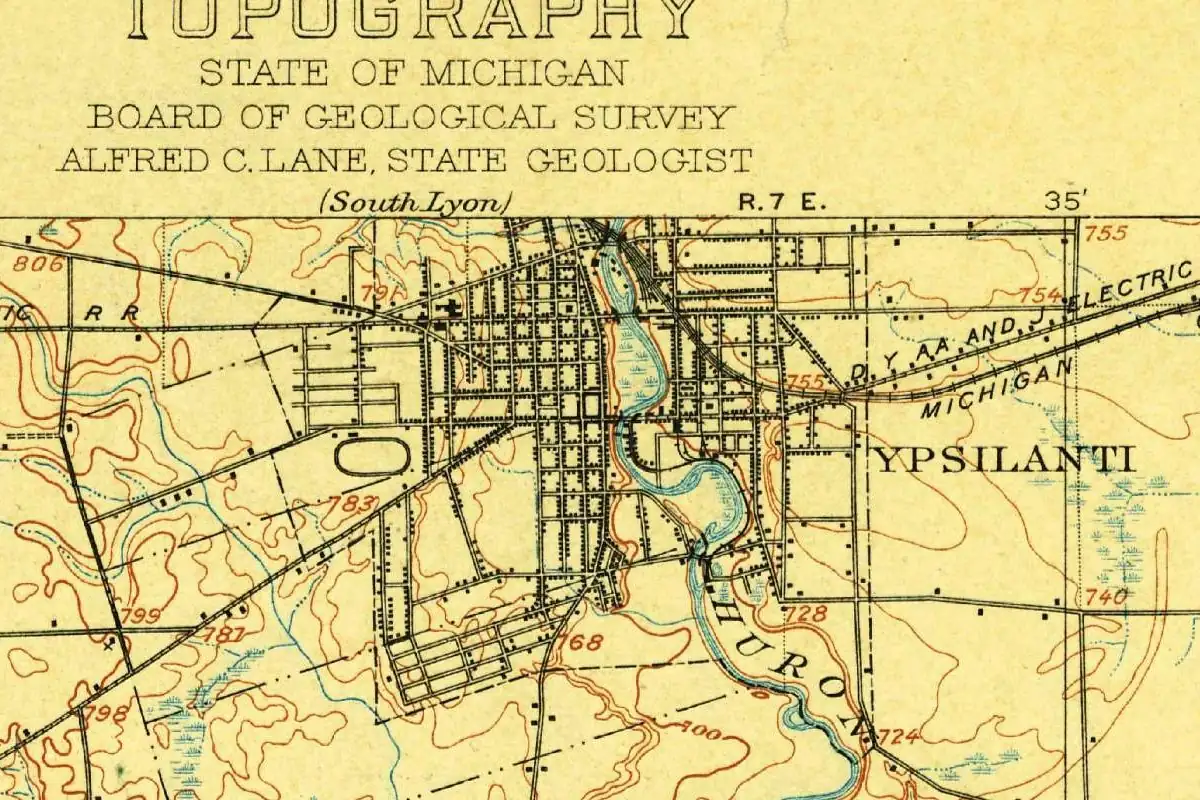
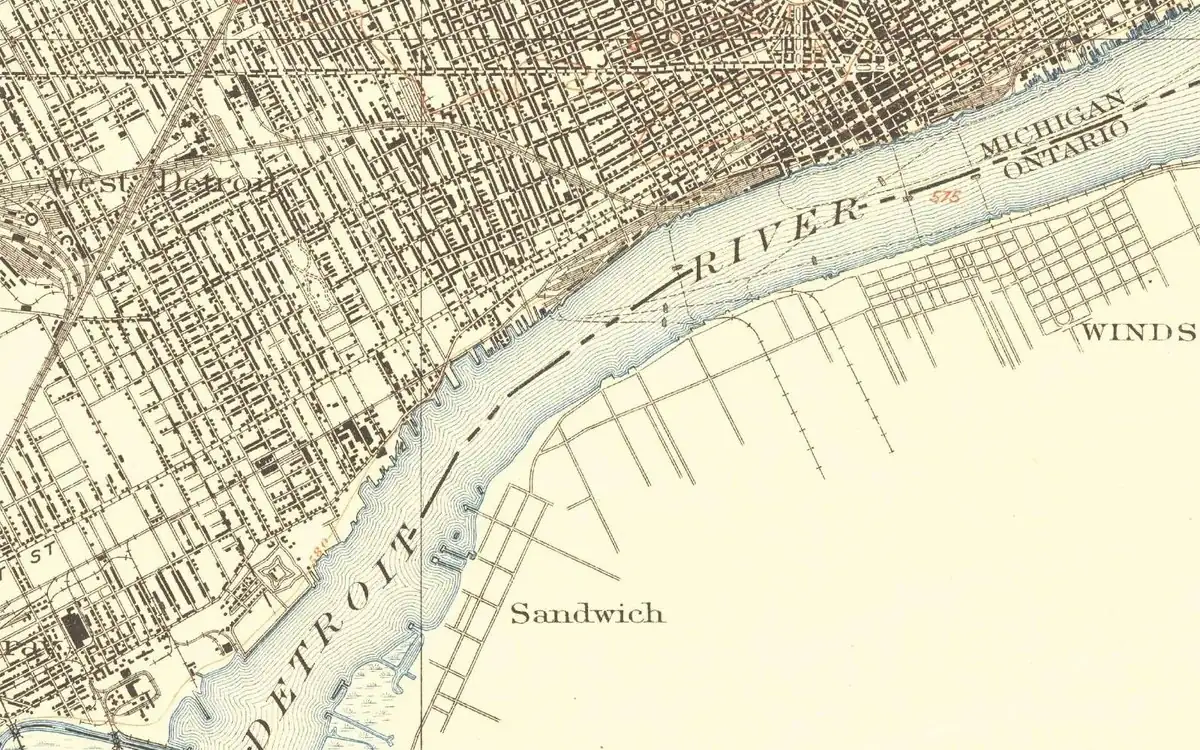
So when you say Detroit, you’re really describing a stretch of water. Look at the old map above and you can see the idea: a short channel squeezed between two shores, which is just what the French word means.
First it was Fort Pontchartrain
Silas Farmer, who wrote an enormous history of the city in 1884, says Antoine de la Mothe Cadillac’s party came down by way of the Ottawa River and Lake Huron and arrived on July 24, 1701. The post they built didn’t start out as Detroit. It “received the name of Fort Pontchartrain, in honor of Count Pontchartrain, the then French Colonial Minister of Marine.”
As it turns out, the minister’s name didn’t stick. Farmer says that as the settlement grew into a village, “it received its present name from the word détroit, or strait.” The early French used the word loosely. They called the settlements on both banks Detroit, and Farmer notes that early travelers used the word for all of the water between Lakes Erie and Huron. He also points out where the nickname “the City of the Straits” comes from.
Older names for the same spot
The French weren’t the first to name this place. The federal place-names database lists a Mohawk name for Detroit, Tsi kiohsahrón:ta, which it translates as “bays or mouths stream along it.” Farmer also collected several older names from Algonquin, Wyandot and Huron traditions, along with his own translations of them, but he didn’t say who gave him those meanings. We’re leaving them out until a language source backs them up.
A judge’s cobweb of streets
The town got its official titles later. Farmer lists them: the “Town of Detroit” by an act of 1802, then the “City of Detroit” by an act of 1815. Augustus B. Woodward, appointed a judge of Michigan Territory in 1805, drew up a street plan for the city. The 1881 History of Washtenaw County says he laid it out “in the form of a cobweb,” with “a grand circus” and avenues “radiating in every direction.” Woodward shows up again farther west, in Washtenaw County, where he gave Ypsilanti its Greek name.
One more thing Farmer noticed: Quebec, “the place from which Cadillac and the first settlers came,” has a name he traced to an Algonquin word “signifying a strait.” If he’s right, both cities are named for a narrow spot in the water.
Sources & further reading
- Henry Gannett, The Origin of Certain Place Names in the United States (USGS, 1905), p. 105. Détroit as “strait” or “narrow passage,” given first to the river between Lake St. Clair and Lake Erie.
- Silas Farmer, The History of Detroit and Michigan (1884). Fort Pontchartrain, the name détroit, the “City of the Straits,” the corporate names of 1802 and 1815, and the note on Quebec (ch. I); Fort Pontchartrain named for the French minister (ch. XXXVI); Cadillac’s arrival on July 24, 1701 (ch. XLVII).
- History of Washtenaw County, Michigan (Chas. C. Chapman & Co., 1881), pp. 63–64, 70. Woodward’s appointment as a territorial judge in 1805 and his “cobweb” plan for Detroit.
- GNIS feature 1617959 (U.S. Geological Survey). The federal record for Detroit, including the Mohawk name Tsi kiohsahrón:ta and its translation.
Spot something wrong, or know more? Tell us here. You can also email us or use our contact page. Corrections are noted here with their date, never made silently.