Who Named Toledo, Ohio? Four Claims, One Spanish City
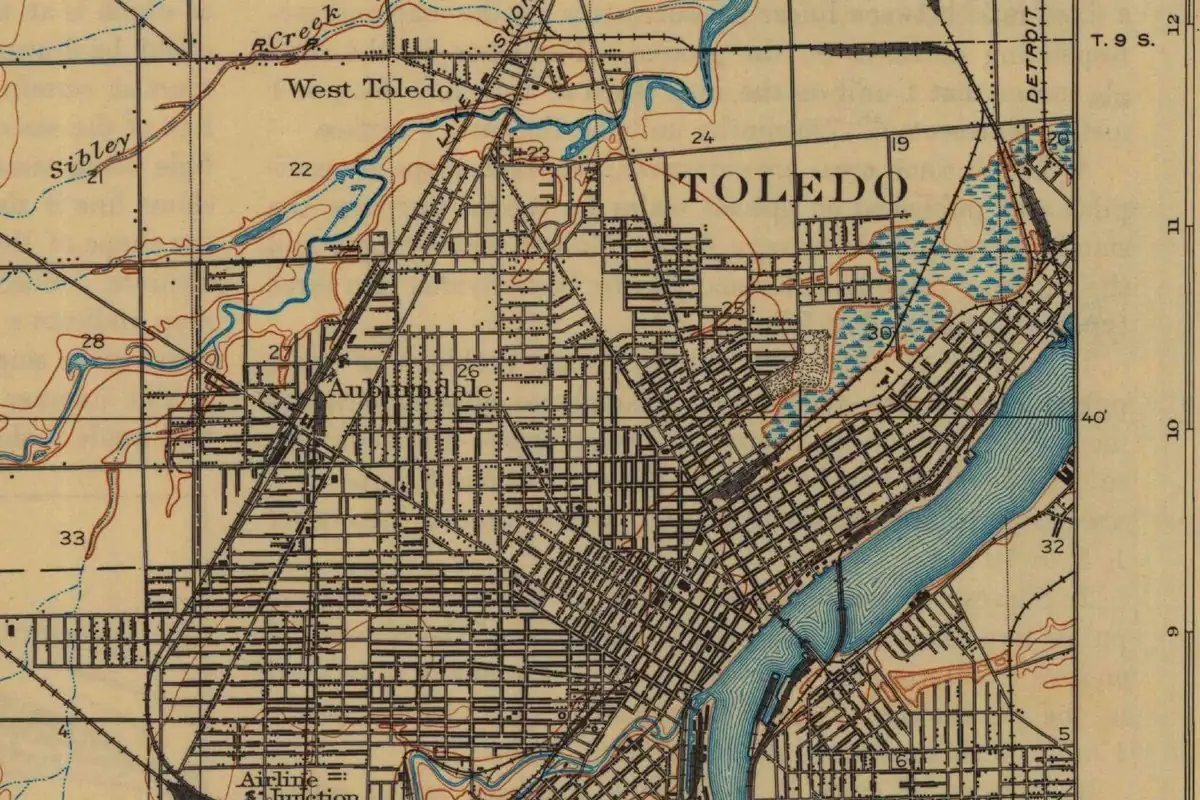
Toledo, Ohio, is named for the old city in Spain, but at least four people have been credited with suggesting it, and the books don’t agree on who. One of the four, if you believe the story, was in Spain at the time.
Two rival towns on the Maumee
Before there was a Toledo, there were two towns on the Maumee River. Henry Howe’s Historical Collections of Ohio calls them “two distinct settlements,” the upper one Port Lawrence and the lower one Vistula. Harvey Scribner’s 1910 Memoirs of Lucas County says the two were “inwardly consumed with the jealousy of bitter rivalry,” but outside competition from other river towns pushed them to unite in 1833.
That left a problem. In John M. Killits’s 1923 history of Toledo and Lucas County, some Port Lawrence people wouldn’t accept the name Vistula, and some Vistula people wouldn’t accept Port Lawrence. So “it became necessary to choose a new name.”
Four people, one name
Killits lays out the candidates, and he’s frank about it: “Various stories have been told as to how the name ‘Toledo’ was selected and several persons have been credited with the honor of being the first to propose it.”
James Irvine Browne. Clark Waggoner’s 1888 history passes along, in a footnote, Andrew Palmer’s memory that at a meeting about the merger “James Irvine Browne suggested Toledo, and it was adopted. Many other names had been proposed.” Killits doubts it, because Browne “did not come to Toledo until in May, 1834, several months after the name had been chosen.” Waggoner himself records Browne arriving that May.
Two Stickney. The second son of B. F. Stickney was studying geography, Killits says, “and found the name on a map of Spain.” He liked the sound and urged his father to push for it.
Willard J. Daniels. Killits and Scribner both quote a 1903 Toledo Blade article by S. S. Knabenshue, which says a Vistula merchant named Daniels, who “had been reading Spanish history,” proposed it. Daniels’s argument, as Knabenshue told it, was “that the word is easily pronounced, is pleasant in sound, and that there was no place of that name on the western continent.”
Washington Irving. This one comes from E. O. Fallis, a Toledo architect, who said he came across it while designing a Spanish-style building in 1893. In his version, Irving had a brother involved in a land company in the area, Irving himself “was then in Toledo, Spain, writing ‘The Alhambra,’” and when his brother wrote asking for a name, he suggested the city he was staying in.
So who was it?
Nobody’s quite sure, and you should be a little wary of all four. Knabenshue was writing seventy years after the 1833 meeting, and the Irving story rests on something an architect said he found sixty years after it. Killits gives his own verdict carefully: “The preponderance of evidence, as the lawyer says, seems to be in favor of the Willard J. Daniels story.”
What Killits, Scribner and Gannett all agree on is the source. Killits: “there is no doubt that the name was inspired by that of the ancient Spanish city.” Scribner says the same and adds that the name “therefore has no local significance.” Henry Gannett’s 1905 federal list of place names puts it in six words: “named from the city in Spain.” So the town got a name chosen because it belonged to neither of the rivals, from a city an ocean away.
Sources & further reading
- John M. Killits, ed., Toledo and Lucas County, Ohio, 1623-1923, vol. 1 (1923), pp. 273-274. The deadlock over the old names, all four claims, the problem with Browne’s dates, and the verdict for Daniels.
- Harvey Scribner, ed., Memoirs of Lucas County and the City of Toledo, vol. 1 (1910), pp. 217-218. The rivalry, the union in 1833, the Browne, Stickney and Daniels versions, and “no local significance.”
- Clark Waggoner, History of the City of Toledo and Lucas County, Ohio (1888), p. 377 and the “Public Press” chapter. Andrew Palmer’s account crediting James Irvine Browne, and Browne’s arrival in May 1834.
- Henry Howe, Historical Collections of Ohio, Ohio Centennial Edition, vol. 2 (1891), p. 405. Port Lawrence and Vistula as the two original settlements.
- Henry Gannett, The Origin of Certain Place Names in the United States, 2nd ed. (USGS Bulletin 258, 1905). “Named from the city in Spain.”
Spot something wrong, or know more? Tell us here. You can also email us or use our contact page. Corrections are noted here with their date, never made silently.