Lansing, Michigan: The Capital Once Called Michigan
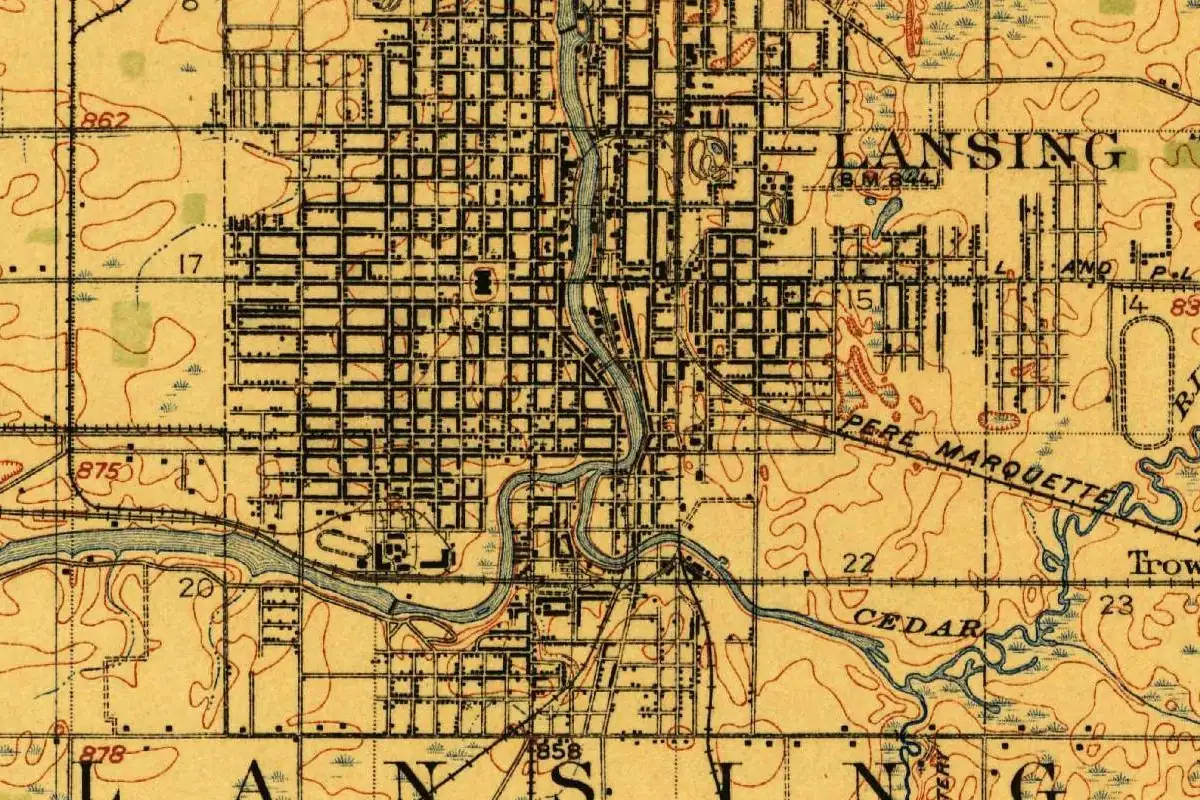
For its first months as the capital, Lansing, Michigan, was officially the Town of Michigan. The name Lansing came from a town in New York, and it got to Michigan by way of a town that didn’t exist.
Biddle City, the town on paper
In the winter of 1836, two young men went around the town of Lansing, in Tompkins County, New York, selling lots in a place called Biddle City. They said it was already well started, at the spot where the Cedar River meets the Grand in central Michigan. That’s the story D. W. Buck told the Lansing Journal in 1904, and Albert Cowles reprinted it in his 1905 history of Lansing. Cowles calls Biddle City “a paper city,” platted in 1836 and “calculated to deceive” buyers who lived too far away to look at it.
The New York farmers formed a company and sent 16 men west to check on their purchase. Nobody in Detroit had heard of Biddle City. Nobody in Pontiac had either. When the group finally found a settler named William Gilkey near the meeting of the two rivers, he walked them through the woods and pointed across the Cedar to some low ground under water. “There, gentlemen, is Biddle City.”
Named after the old hometown
You’d think that would send everyone home. Some gave up, but Joseph E. North and Daniel Buck decided to buy land anyway, south of the future city. North moved his family out from New York in 1839. When the area was organized into townships, Cowles says, the men who stayed near Biddle City “called theirs ‘Lansing,’ which eventually gave the name to the city itself.”
Samuel Durant’s 1880 history of Ingham and Eaton counties has the same answer from North’s son, Henry H. North. In December 1841, he says, a few neighbors met at his father’s house to draw up petitions for two new townships. For the first, only one name came up, “that of Lansing, my father saying he wanted it named after our old town of Lansing, in New York.”
A capital called Michigan
Then came 1847. The Legislature decided to move the capital out of Detroit, and the law approved on March 16, 1847, put the seat of government “in the Township of Lansing in the County of Ingham.” There was no town there yet, just woods. Cowles says many names were proposed for the new town, and “finally, the ‘Town of Michigan’ was decided upon.”
That’s where it gets interesting. A capital called Michigan, in the state of Michigan, didn’t last. Durant says the name “does not seem to have been very satisfactory.” Joseph North, he writes, “is said to have felt not a little disappointed,” and the change came “owing somewhat to his remonstrances.” Act No. 237, approved April 3, 1848, renamed the Town of Michigan “Lansing,” as Cowles records it.
So if you’re keeping score, the capital took the name of a township, which took the name of a town in New York, whose farmers came west chasing lots in a city that turned out to be low ground under water.
Sources & further reading
- Albert E. Cowles, Past and Present of the City of Lansing and Ingham County, Michigan (1905). The capital law of March 16, 1847, and its text (p. 59); the names proposed, the Town of Michigan and Act No. 237, approved April 3, 1848 (p. 60); Biddle City as “a paper city,” D. W. Buck’s story from the Lansing Journal of November 24, 1904, North’s move in 1839, and the township named Lansing (pp. 113–115).
- Samuel W. Durant, History of Ingham and Eaton Counties, Michigan (1880). The Town of Michigan plat of June 1847, the act changing the name to Lansing, and Joseph E. North’s disappointment (pp. 129–130); Henry H. North’s account of naming Lansing township in December 1841 (p. 192).
- GNIS feature 1625035 (U.S. Geological Survey). The federal record for Lansing, “Capital of State of Michigan.”
Spot something wrong, or know more? Tell us here. You can also email us or use our contact page. Corrections are noted here with their date, never made silently.