Chicago, Illinois: Named for Wild Garlic, or for a Skunk?
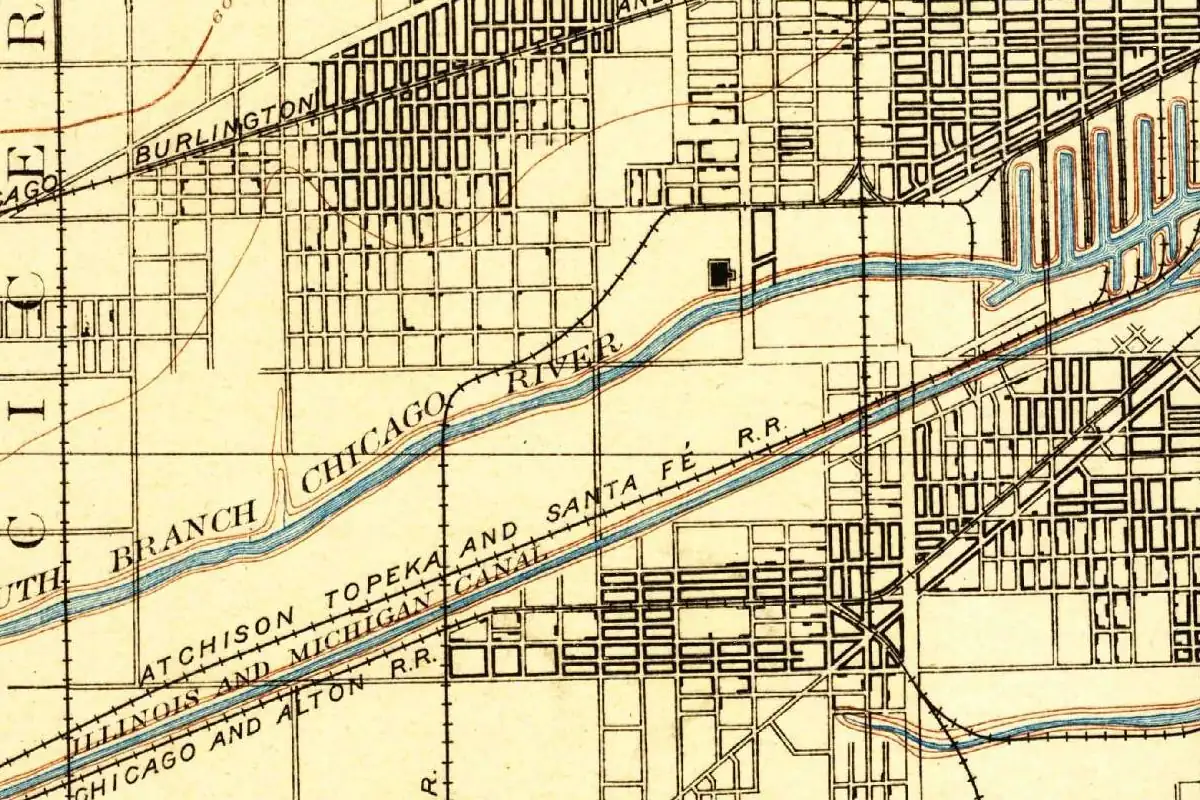
Chicago, Illinois, takes its name from a Native word for its river, and the oldest records tie that word to the wild garlic that grew there. The catch is that the same root also turns up as the word for skunk, and people have argued over what it really means since at least the 1880s.
A river called Chicagou
The name belonged to the water long before there was a city. French travelers in the 1680s wrote it as Checagou, Chicagou and plenty of other ways, for the river and for the portage that led from Lake Michigan toward the Illinois country. The Handbook of American Indians, published by the Smithsonian’s Bureau of American Ethnology, lists Checagou in a French record from 1681 and notes that Louis Joliet and Father Marquette passed through on their way back from the Mississippi. (You can read how Joliet’s name ended up on another Illinois city too.)
The oldest explanation in these books comes from a French officer. In 1695, La Mothe Cadillac wrote that “the post of Chicagou comes next. This word signifies ‘the River of Garlic,’ because it produces naturally without any cultivation a very large quantity of it.” W. H. Stennett, who compiled the place names along the Chicago & North Western Railway in 1908, quotes the line and gives the French source.
A few years earlier, in the spring of 1688, bad weather kept Henri Joutel, a member of La Salle’s last expedition, stuck at Chicagou. The English translation of his journal doesn’t explain the name, but it does say what he ate: “In the Woods we found a Sort of Garlick, not so strong as ours, and small Onions very like ours in Taste.”
Garlic Creek and Wild Onion River
The plant stuck to the name in English, too. A. T. Andreas, in his big 1884 history of the city, quotes a 1773 land deed that ran “up the Illinois to Chicagou or Garlick Creek.” Stennett adds an American army colonel who visited Fort Dearborn in 1817 and called it “the River Chicago,” or in English, “Wild Onion River.”
Henry Gannett’s 1905 survey of American place names for the U.S. Geological Survey gives the word in its Ojibwa form, she-kag-ong, meaning “wild onion place,” “from a root form implying a ‘bad smell.’”
So where does the skunk come in?
The smell is the link. The word lists the old books lean on put the plant and the animal side by side. John Tanner, who spent 30 years as a captive among the Ojibwa, gave she-gahg for skunk and she-gau-ga-winzhe for onion, which Stennett and Andreas both translate as “skunk weed.”
The Smithsonian handbook goes the other way. It gives the name as Sauk, Fox and Kickapoo for “skunk” and “place of the skunk,” which it calls an old name for the southern part of Lake Michigan, and passes along a story, “it is said,” about a large skunk that lived along the south shore until a hunting party killed it in the lake. That’s a legend, and the handbook tells it as one.
The Myaamia Center, which publishes on the language of the Miami people, puts the plant first. It says that in the Miami-Illinois language šikaakwa is the wild leek, Allium tricoccum, and that the Chicago River was the Šikaakwa Siipiiwi, the Wild Leek River. The handbook also says a Miami village stood on the site in the years of the earliest French exploration, about 1670 to 1700.
The theories that faded
Not everyone bought the garlic story. Andreas quotes William Barry, the first secretary of the Chicago Historical Society, who thought that in practical use the word “probably denotes strong or great.” Stennett, borrowing from the writer E. M. Haines, lists still more matches: a Sauk chief named Che-ca-gua, “he that stands by the tree,” and a Potawatomi word meaning “destitute.” As Stennett sums up Haines, the verdict was blunt: what the word means, “or, if it has any particular meaning, is in dispute.”
Andreas split the difference. He thought the name first meant the “great river” of the Illinois people, and that after other nations moved in, the river “in all probability, meant skunk-weed, garlic, or wild-onion river.” Cadillac, the 1773 deed and the Myaamia Center all point to the plant, and the skunk is less a rival than a relative: in those old word lists, the plant is the “skunk weed.”
If you ever misspell Chicago, you’re in good company. Stennett printed a list of spellings from old documents, including Cheggego, Tzstchago, Shikkago, Schenkakko and Ztschaggo.
Sources & further reading
- Henry Gannett, The Origin of Certain Place Names in the United States (USGS, 1905). The Ojibwa form she-kag-ong, “wild onion place,” and the root meaning “bad smell.”
- W. H. Stennett, A History of the Origin of the Place Names along the Chicago & North Western (1908), pp. 55-56. Cadillac’s 1695 “River of Garlic,” the 1817 “Wild Onion River” letter, Tanner’s skunk and onion words, the rival theories and the list of old spellings.
- A. T. Andreas, History of Chicago, vol. 1 (1884), pp. 37-38. The 1773 “Chicagou or Garlick Creek” deed, Barry’s “strong or great” theory and Andreas’s own two-step answer.
- Frederick Webb Hodge, ed., Handbook of American Indians North of Mexico, Part 1, pp. 258-259. The Sauk, Fox and Kickapoo “skunk” reading, the skunk legend, the Miami village and the 1681 spelling Checagou.
- Joutel’s Journal of La Salle’s Last Voyage (1714 translation; 1906 reprint), p. 198. Wild garlic and onions in the woods at Chicagou in 1688.
- Myaamia Center, “What does the word Chicago mean?” The Miami-Illinois word šikaakwa for the wild leek and the river’s Myaamia name.
- GNIS feature 423587 (U.S. Geological Survey). The federal record for the city.
Spot something wrong, or know more? Tell us here. You can also email us or use our contact page. Corrections are noted here with their date, never made silently.