Joliet, Illinois: The City That Was Called Juliet Until 1845
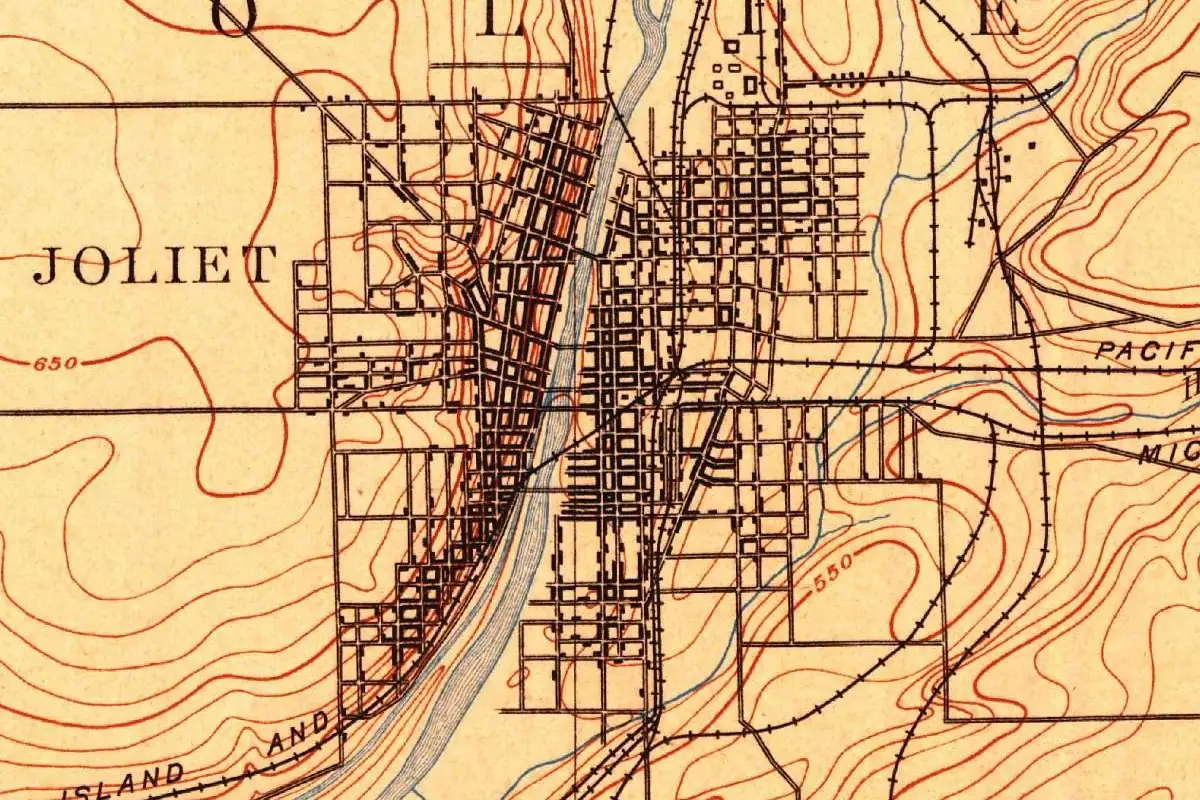
Joliet, Illinois, was recorded in 1834 as Juliet, and a paper town called Romeo was laid out nearby to match it. In 1845 the legislature changed Juliet to Joliet, the name of the French explorer Louis Joliet, which a big hill outside town already carried.
Juliet, but which Juliet?
James B. Campbell laid out the town on the east side of the Des Plaines River. The 1878 History of Will County says the plat was recorded on June 10, 1834, and the town “christened” Juliet, “for Campbell’s daughter, it is said.” Henry Gannett, in his 1905 book of U.S. place names, goes further and calls her Juliet Campbell.
The same county history isn’t so sure in another chapter. There, the writer says Juliet was chosen “whether after Shakespeare’s heroine, or his own daughter, or by mistake for Joliet, the writer cannot determine. There are various theories; take your choice.” So you can pick from a daughter, a play or a spelling slip.
Romeo, the town that never was
Here’s the part that gives the Shakespeare theory some company. Not far away, the 1878 history says, “one of the paper cities of the county was early laid off and called Romeo, to match Juliet.” August Maue’s 1928 county history calls it “a companion town” and adds that promoters platted it and sold lots, but “nothing came of it.” When Juliet became Joliet, Maue writes, the change “destroyed the companionship of the two places and Romeo was no more.”
The hill with the explorer’s name
The explorer came through long before the town. In 1673, Louis Joliet, a French trader, and Father Marquette, a Jesuit missionary, came back from the Mississippi by way of the Illinois and Des Plaines rivers. “Tradition says that they encamped upon the mound below Joliet,” the 1878 history says. “However this may be, it has borne the name of Joliet Mound from earliest times.” The same book describes the mound as a quarter of a mile long and 60 feet high.
So for years you had a town called Juliet sitting next to a landmark called Joliet. According to the 1878 history, President Martin Van Buren and his secretary of the Navy, Mr. Paulding, stopped in Juliet on a trip west, noticed “the difference in the name of the city and of Joliet Mound,” and urged people to change the town’s name to match. The act was approved on February 26, 1845. Another chapter of the same book credits the push to S. W. Bowen “and others,” with the bill introduced by D. L. Gregg. The book doesn’t try to square the two.
Mind the spelling
The 1878 writer had strong feelings about the new name. “Please do not waste so many l’s and t’s and e’s when you write it,” the book says, “and although we are a jolly people, please do not pronounce it Jolly-ett, but Zho-liet; accent on first syllable.”
The mound didn’t fare as well as the name. The 1878 history says its shape had been partly destroyed by the canal and then by the Joliet Mound Tile Company, which shipped off its gravel and used its clay for tile and brick. An account from the Joliet News in 1913, reprinted by Maue, says “a great part” of the gravel was shipped in boats on the Illinois and Michigan Canal to Chicago, “where it was used to build streets.” So the town kept the explorer’s name, while a good share of the hill that carried the name first ended up under the streets of Chicago.
Sources & further reading
- The History of Will County, Illinois (Wm. Le Baron, Jr., & Co., 1878). Joliet Mound’s size and its partial destruction (p. 228); Joliet and Marquette in 1673 and the mound’s name “from earliest times” (p. 230); the paper town of Romeo (p. 246); the “take your choice” passage, Bowen and Gregg, and the spelling plea (p. 274); the 1834 plat, Van Buren’s visit and the act of February 26, 1845 (p. 380).
- August Maue, History of Will County, Illinois, vol. 1 (1928). Romeo as Juliet’s “companion town” (p. 196) and the 1913 account of the mound’s gravel shipped to Chicago (pp. 266-268).
- Henry Gannett, The Origin of Certain Place Names in the United States (USGS, 1905). First called Juliet, for Juliet Campbell; changed by the General Assembly to the explorer’s name.
- GNIS feature 411192 (U.S. Geological Survey). The federal record for the city.
Spot something wrong, or know more? Tell us here. You can also email us or use our contact page. Corrections are noted here with their date, never made silently.