Beloit, Wisconsin: A Made-Up Name That Rhymes With Detroit
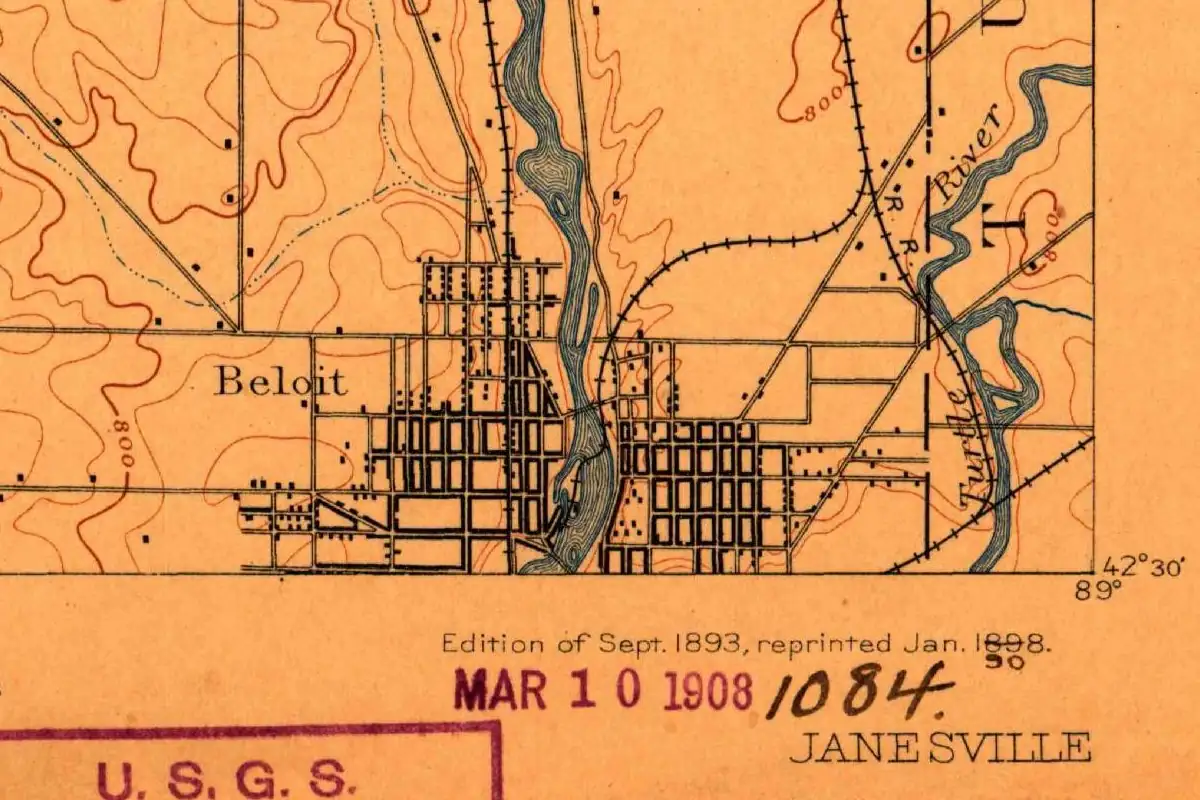
Beloit, Wisconsin, has a name that means nothing in any language. Settlers made it up around 1838, and they never agreed on who did. The man who presented it to the town meeting later admitted, with a laugh, that it was “no more French than it was Hebrew.”
Turtle was too slow, New Albany too fast
The spot where Turtle Creek meets the Rock River had names before it had a good one. Caleb Blodgett, the Vermonter who bought out the trader Thiebault’s claim there in 1836, called the place New Albany, and the 1879 county history says that name “had never been acceptable to the majority of the settlers.” Somebody proposed Waterloo. That went nowhere too.
A 1908 county history, edited by William Fiske Brown, puts it neatly: the villagers disliked “the Indian name, Turtle, as too slow, and Blodgett’s name for the settlement, New Albany, as too fast.” So in the fall of 1838 they held public meetings to find something better, couldn’t agree, and handed the job to a committee of three.
The joke on the French scholars
The 1879 history tells Major Charles Johnson’s side. The committee came back and Johnson, its chairman, announced a name built from French words that meant, in English, “beautiful and the junction of two streams.” The meeting loved it. A few days later a settler named John Hackett told Johnson how much he liked the new name, and Johnson burst out laughing.
He explained the joke. He didn’t know any French. He had puzzled out the word Beloit himself, and as far as he knew it was “utterly devoid of any meaning whatever, except that it was now the name of a village in Wisconsin.” The joke, he said, was on the “two or three French scholars” who were there when the name was proposed and adopted.
Or was it Fisher, and Detroit?
That isn’t the only version, and you’ll find the other one in more of the old books. The 1908 history cites a letter from L. G. Fisher, published in the Beloit Journal in 1878, saying the committee was Johnson, Horace Hobart and Fisher himself. In Fisher’s telling, Johnson suggested Ballote, “hinting that it was the French for beautiful,” and Fisher, knowing many settlers remembered Detroit fondly, wanted a name that sounded like it. He said the words “Balloit, Beloit,” and the committee took the second.
Even the committee’s members are in dispute. R. P. Crane wrote that it was Johnson, Hobart and Crane, while the 1879 history lists Johnson, Blodgett and a Mr. Allen. The 1908 history suggests there may have been two committees. Henry Whitney, a Beloit College professor speaking to the State Historical Society in 1899, simply credited Fisher, “starting with Belle and Detroit.” Henry Gannett’s federal list of name origins sides with the Detroit story too: “a coined name, selected by a committee, to whom it was suggested by the name Detroit.”
What everyone agrees on
Strip away the arguments and the core holds up. Beloit is an invented word, nobody imported it from France, and a committee of settlers picked it to replace Turtle and New Albany. The year wobbles a little: the Chicago & North Western officer’s 1908 book says 1837, while both county histories say the fall of 1838. If you want a single answer to “who named Beloit,” the honest one is that Johnson and Fisher each have a claim, and the record can’t settle it.
Sources & further reading
- The History of Rock County, Wisconsin (1879), pp. 614-615. New Albany, Waterloo, the committee of Johnson, Blodgett and Allen, and Johnson’s admission to John Hackett.
- William Fiske Brown, ed., Rock County, Wisconsin (1908), vol. 1, pp. 140-141. “Too slow” and “too fast,” the fall 1838 meetings, Crane’s and Fisher’s letters to the Beloit Journal, Ballote, and “Balloit, Beloit.”
- Henry M. Whitney, The Settlement of Beloit (1899). Blodgett’s purchase of Thiebault’s claim in 1836, and Fisher building the name from “Belle and Detroit.”
- Henry Gannett, The Origin of Certain Place Names in the United States (USGS Bulletin 197, 1902). A coined name suggested by Detroit.
- Chicago & North Western place-names book (1908), p. 43. Turtle Creek and New Albany as earlier names, and 1837 as the year.
- GNIS feature 1561548 (U.S. Geological Survey). The federal record and map location for Beloit.
Spot something wrong, or know more? Tell us here. You can also email us or use our contact page. Corrections are noted here with their date, never made silently.