Kenosha, Wisconsin: Pike, Then Southport, Then Kenosha
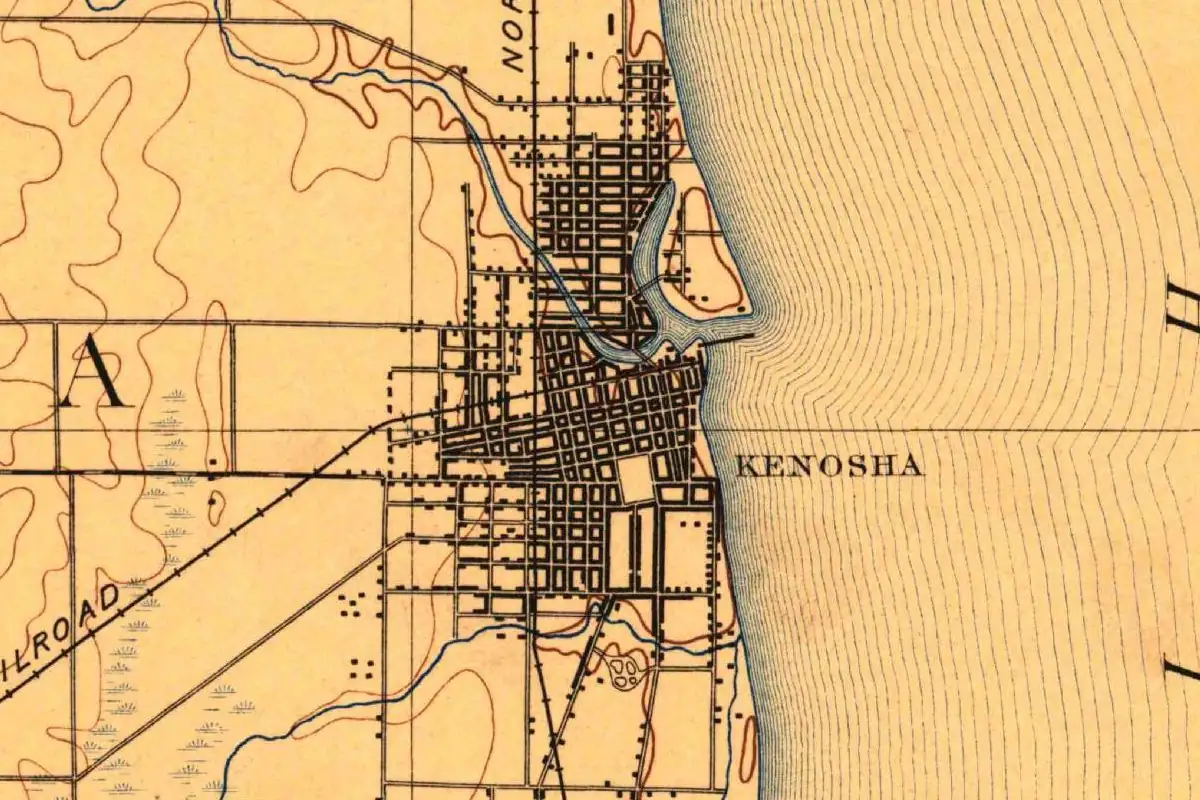
Kenosha, Wisconsin, went by Pike and then Southport for 15 years before it took the Indian name of its creek, a word said to mean pike. If that translation is right, the town ended up where it started, just in a different language.
Settlers from Hannibal find Pike Creek
The 1879 history of Racine and Kenosha counties tells how it began. The Western Emigration Company, organized in Hannibal, New York, in February 1835, sent men west to find a town site on Lake Michigan. They first tried to buy the claim at the mouth of the Root River, where Racine now stands, but the deal fell apart. On June 6, 1835, an exploring party led by the company’s agent, John Bullen Jr., reached Pike Creek instead. The federal place-name database gives the same year: “Founded in 1835.”
The creek’s name was already old by then. According to the 1879 history, it “was known to the Indian traders and early adventurers on Lake Michigan.” The settlement was first called Pike, after the post office set up there in 1836, and people also said Pike’s Creek.
Why Southport
In 1837 the inhabitants held a meeting and adopted the name Southport, “the place being the southernmost port on the lake, in Wisconsin.” The village was incorporated as Southport in February 1841, and the name stuck through the 1840s.
Kenosia, Kenozia, Kenozha
Not everyone was happy with it, though. A long account of the town’s early years, quoted in the 1879 history, says “a portion of the inhabitants desired at all times to call the place after the Indian name of the stream.” Nobody could agree on how to spell that name. You’d see it as “Kenosia,” “Kenozia” and “Kenozha,” and only some people wrote “Kenosha,” which the writer thought gave the Indian sound best. In 1850, Kenosha County was organized as a county of its own, and the town was incorporated as a city under the name Kenosha.
What “Kenosha” means
Every old source says the word has to do with fish, and most say pike. The 1879 history says “Kenosha, in the Indian, signifies Pike, and ce-pee, creek.” Henry Gannett’s 1902 book of place-name origins gives “fish,” “pickerel,” “pike.” A 1908 book compiled by a Chicago & North Western officer adds a fourth option, “the place where fish are plentiful,” and Henry Legler’s 1898 state history says “a long fish, a pike; from Kenose, long.” None of these writers names the language the word comes from, and none of them was a linguist, so treat the exact translation with some care. If you want the short version, “pike” is the answer they agree on most, and it’s also what the creek was called in English all along.
Sources & further reading
- The History of Racine and Kenosha Counties, Wisconsin (1879). The Western Emigration Company of Hannibal, John Bullen Jr., Pike Creek on June 6, 1835, Pike, Southport, and the change to Kenosha in 1850 (pp. 331-333); Pike’s Creek or Pike until 1837 and Southport until 1850 (p. 340); the spellings Kenosia, Kenozia and Kenozha, the 1841 village charter, and “ce-pee, creek” (p. 504); the new county and the city charter in 1850 (p. 505).
- Henry Gannett, The Origin of Certain Place Names in the United States (USGS Bulletin 197, 1902). “Fish,” “pickerel,” “pike.”
- Chicago & North Western place-names book (1908), pp. 20, 89. “Pickerel,” “fish” or “pike,” and “the place where fish are plentiful.”
- Henry E. Legler, Leading Events of Wisconsin History (1898), p. 27. “A long fish, a pike; from Kenose, long.”
- GNIS feature 1567416 (U.S. Geological Survey). The federal record for Kenosha: “Founded in 1835.”
Spot something wrong, or know more? Tell us here. You can also email us or use our contact page. Corrections are noted here with their date, never made silently.