How Oshkosh, Wisconsin Got Its Name (It Used to Be Athens)
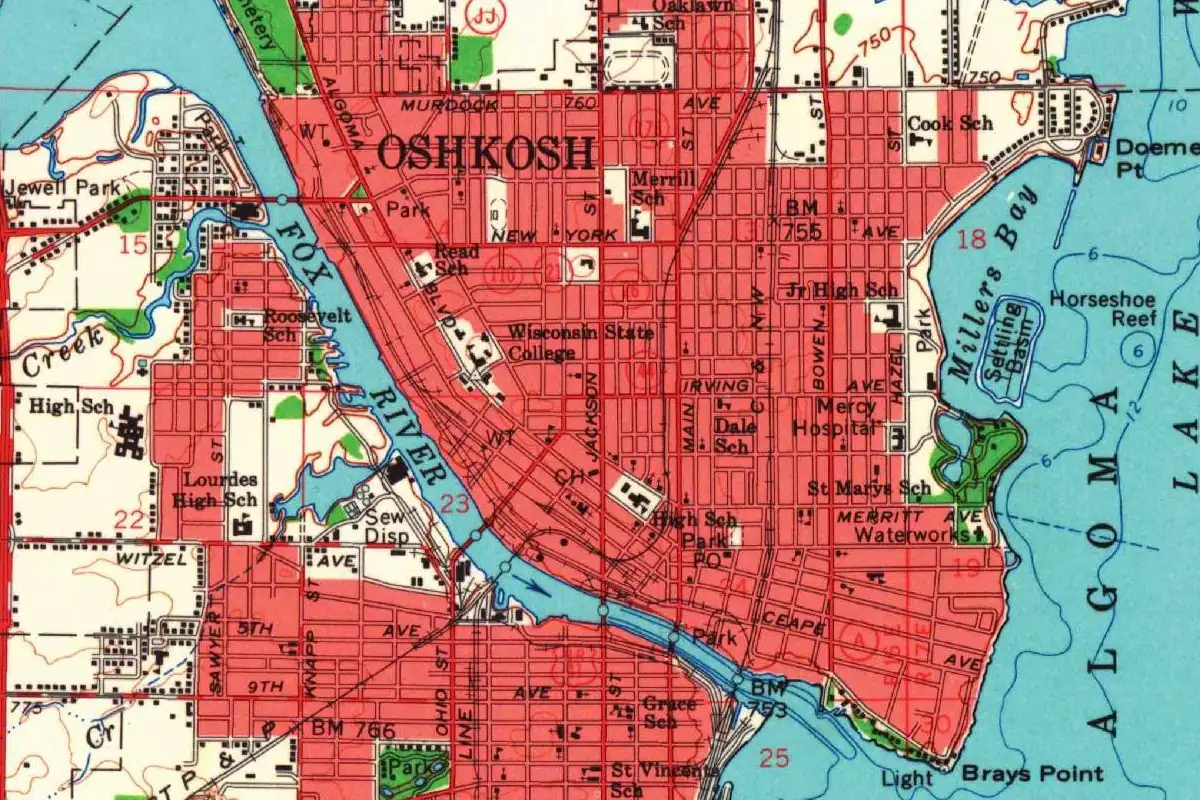
Oshkosh, Wisconsin, was called Athens until a smoky town meeting voted to name it for Oshkosh, a Menominee chief. One of the first settlers, who was there, said the room was so thick with tobacco smoke “that you could not recognize a person across the room.”
Athens on the Fox River
In October 1836, two families started building log houses at the mouth of the Fox River, on ground that’s now inside the city. Henry A. Gallup was there, and his account, printed in Richard Harney’s 1880 history of Winnebago County, says they gave the spot “the name of ‘Athens,’” and that goods shipped from Green Bay were marked that way. The Green Bay papers used it too, in a wedding notice dated “At Athens, March 8, 1838.” Harney calls the name “rather more classical than the present name.”
The vote at George Wright’s house
Then came a meeting at the house of George Wright, one of the early settlers, to choose a name for good. Harney lists the choices: Athens, Fairview, Oceola, Stanford and Oshkosh. The families who’d called it Athens didn’t carry the vote. Robert Grignon, a French trader, and his associates from up the river at Butte des Morts “were the strong party,” and they carried the name of the Menominee chief.
Gallup had his doubts about who got a say. He wrote that the meeting drew people “from as far up the river as Butte des Morts, and who, in fact, had no interest in the place or its name.” Still, he admitted, “it came nearer to universal suffrage than any election I ever attended.” The smoke was plug tobacco and kinnikinick, which he describes as the bark of a bush, mixed “in about equal quantities.” His verdict: “Such was the christening of Oshkosh.” The railroad’s 1908 place-name book tells a shorter version of the same story, with the name “adopted by the vote of Grignon’s Indians.”
Os-kosh, with the accent at the end
Harney adds a detail that’s easy to miss if you only know the name from a map. The spelling, he says, “by some mischance” changed. The chief’s name “was pronounced without the ‘h’ in the first syllable, and was accented on the last, Os-kosh.” He doesn’t say how the change happened, and none of the other sources explain it either.
Claw, hoof, or brave
What the chief’s name means is where the old books split, and none of them was written by a linguist of the Menominee language. Henry Gannett’s 1902 bulletin for the U.S. Geological Survey says the name is “said to mean ‘the nail, claw, or horny part of the foot of beasts,’” and the 1908 railroad book gives nearly the same words. Henry Legler’s 1898 state history says it “signifies brave; another meaning is a hoof.” Harney himself writes that there’s “a difference of opinion,” with “many claiming that it means brave.” So you can take your pick between claw and brave, but the safest thing to say is that the meaning was already disputed by 1880.
Sources & further reading
- Richard J. Harney, History of Winnebago County, Wisconsin (1880). Henry A. Gallup’s memoir of Athens, the wedding notice, and the smoky vote (pp. 101-102); the list of proposed names, Grignon’s party, the spelling and pronunciation, and “brave” (pp. 107-108).
- Henry Gannett, The Origin of Certain Place Names in the United States (USGS Bulletin 197, 1902). Named for an Indian chief; “nail, claw, or horny part of the foot of beasts.”
- Chicago & North Western place-names book (1908), p. 111. Named for the chief, suggested by Robert Grignon, settled by the vote of “Grignon’s Indians.”
- Henry E. Legler, Leading Events of Wisconsin History (1898), p. 27. A Menominee chief; “brave” or “a hoof.”
- GNIS feature 1570874 (U.S. Geological Survey). The federal record and map location for Oshkosh.
Spot something wrong, or know more? Tell us here. You can also email us or use our contact page. Corrections are noted here with their date, never made silently.