Elgin, Illinois: Named for a Hymn Tune or a Scottish Earl?
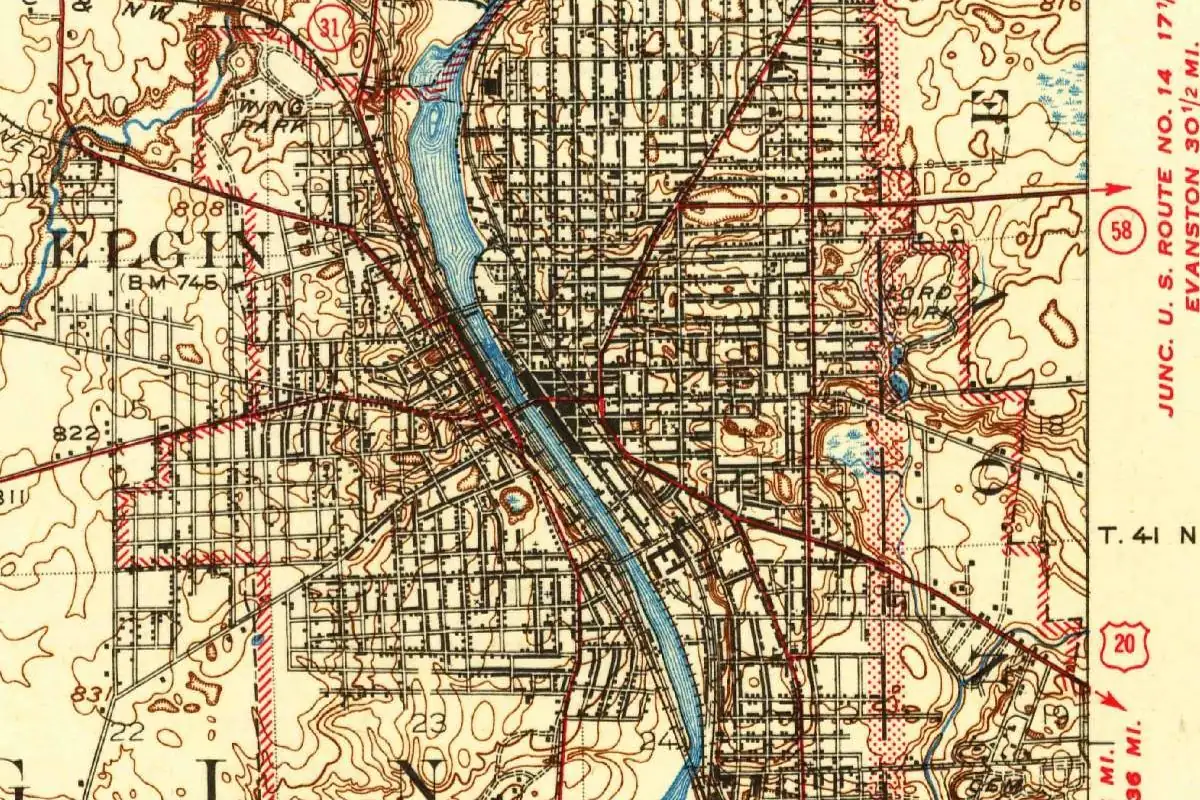
Elgin, Illinois, got its name from an old tune called “Elgin,” local accounts say, though a federal book of place names credits a Scottish earl. The man who chose it was James T. Gifford, the first owner of the town site. The question is what he had in mind.
“Where is the town?”
In 1834, James Gifford was living in Yates County, New York, and his brother Hezekiah in Oneida County. The History of Elgin, printed in Elgin in 1875, says the two brothers were the first settlers of the place, on the Fox River. Hezekiah was still living in Elgin when the book came out.
The same book, in its account of 1835, tells how the name came up, and it’s a good scene. James Gifford was sitting in his brother’s cabin one day when he asked, “What name shall we call the town?” His sister-in-law, Mrs. H. Gifford, wasn’t impressed. “Where is the town?” she replied. He laughed. “Well, never mind; I have a name for it, at any rate, an old Scotch one, too, and a short one. We’ll call it Elgin.”
She still had her doubts and asked her husband whether he ever expected to see stages running there. The book says that by 1837 she could stand at her cabin door and watch two stages a day roll into Elgin, horns blowing.
The tune
So what was the “old Scotch” name? The 1875 book has a second clue, in a chapter on the town’s doctors written by Dr. Joseph Tefft. “Elgin at this early day was only known as an old psalm tune,” he wrote, “and did not receive its name proper until the spring of 1836.” Notice the date. If you go by Tefft, the town got its name a few months later than the cabin story suggests.
W. H. Stennett’s 1908 book on the place names along the Chicago & North Western Railway is plainer still: Elgin “was named by James T. Gifford, the original owner of the town site, from the old hymn tune ‘Elgin.’”
The earl and the Scottish city
Henry Gannett’s 1905 book on U.S. place names, written for the U.S. Geological Survey, tells it differently. It says Elgin was “named for the Earl of Elgin,” and then adds: “Another authority states that the name is transferred from the city in Scotland.” Gannett doesn’t say who his authorities were, and neither version mentions a tune.
These stories aren’t as far apart as they look. Both of Gannett’s versions point to Scotland, and so does Gifford’s “old Scotch” name in the 1875 telling. The tune comes from Dr. Tefft, who arrived in Elgin in the fall of 1835, and Stennett states it outright, while Gannett was compiling names for the whole country and doesn’t say where his came from. That’s why the tune gets more weight here, even if you can’t rule out that Gifford also had the Scottish place in mind.
Sources & further reading
- The History of Elgin, Kane County, Illinois, 1835 to 1875 (Lord & Bradford, 1875). The Gifford brothers’ arrival (pp. 5-6), the cabin conversation and the stages of 1837 (pp. 10-11), and Dr. Joseph Tefft’s “old psalm tune” (p. 85).
- W. H. Stennett, A History of the Origin of the Place Names along the Chicago & North Western (1908), p. 68. Named by James T. Gifford “from the old hymn tune ‘Elgin.’”
- Henry Gannett, The Origin of Certain Place Names in the United States (USGS, 1905). The Earl of Elgin, or the city in Scotland.
- GNIS feature 407859 (U.S. Geological Survey). Elgin’s federal entry, with its location and county.
Spot something wrong, or know more? Tell us here. You can also email us or use our contact page. Corrections are noted here with their date, never made silently.