Springfield, Illinois: The Capital That Wouldn't Be Calhoun
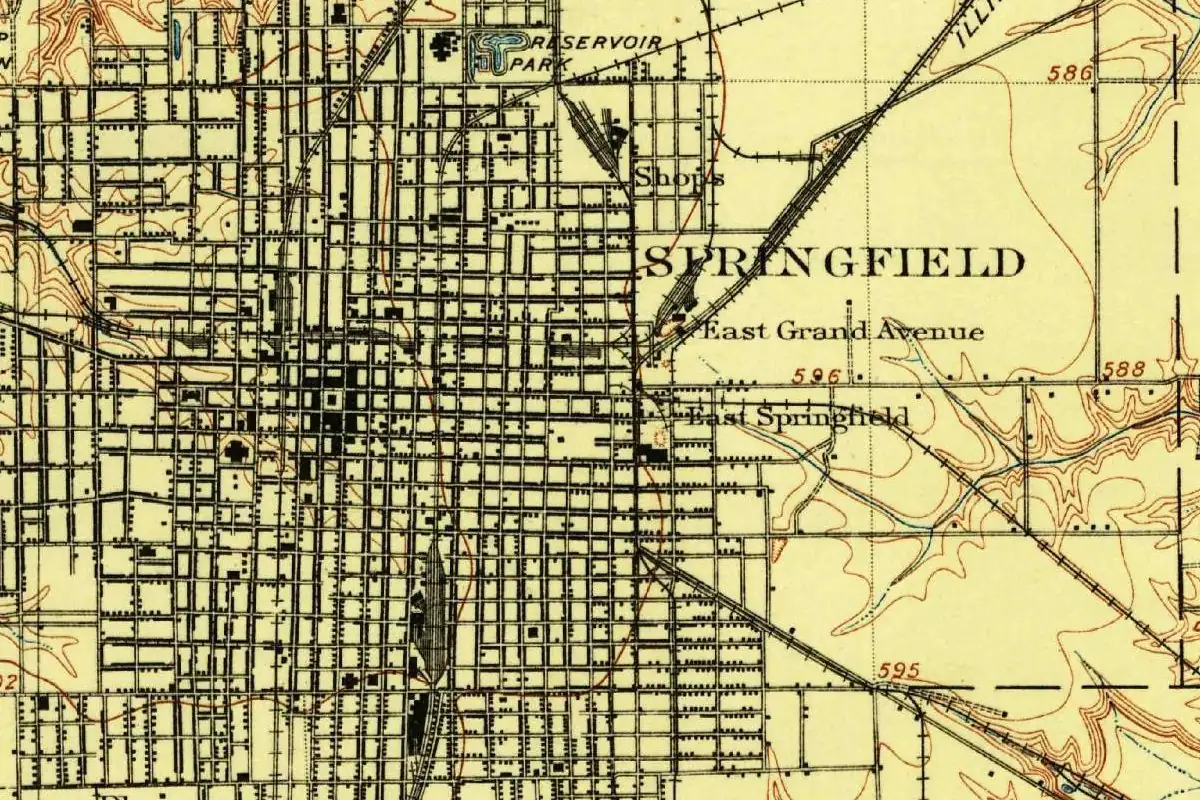
Springfield, Illinois, got its name from a county order in 1821, but for a while part of the town was platted as Calhoun, and many people refused to use it. The order put the new county seat “on the waters of Spring creek,” and Springfield is the name that won.
A stake in the prairie
On April 10, 1821, the commissioners of the brand-new Sangamon County had to pick a temporary seat of justice. John Carroll Power, who wrote a history of the county’s early settlers in 1876, copies their report word for word. They chose “a certain point in the prairie near John Kelley’s field, on the waters of Spring creek, at a stake marked Z. & D.,” and agreed “that the said county seat be called and known by the name of Springfield.”
The report was signed by Zachariah Peter and Wm. Drennan. Power guesses that the letters on the stake were one initial from each of the two commissioners who showed up. If you want to find the spot, he puts it near what was, in his day, the northwest corner of Second and Jefferson streets, where the county’s first courthouse went up.
The order never says why they picked the name. The Sangamon County Historical Society’s article on the subject says the name was “doubtless suggested by the adjacent creek,” and points out that Peter had spent years in Washington County, Kentucky, whose county seat is also a Springfield. That second idea is a possibility, not a record.
Why there, of all places
The spot itself was chosen for practical reasons. Power tells how Elisha Kelly, a bachelor who loved to hunt, came to Illinois from North Carolina around 1818 and found deer running up and down the ravines that drain into Spring Creek. He went home and brought back his father and four brothers, and other families followed. When the commissioners came, the Kelly settlement was the only place in the county with enough families close together to feed and house the court. John Kelly then agreed to build the first courthouse, a one-story log house, for $42.50.
Calhoun, the name nobody wanted
This is where it gets odd. In 1823, the first plat of what’s now the northwest part of the city was recorded under the name Calhoun. When the commissioners made the county seat permanent in 1825, the new lots were laid out with streets matching Calhoun’s, but the place kept the name Springfield.
Power, writing in 1876, says there was “great prejudice against the name of Calhoun,” the Calhoun who was “afterwards the great nullifier of South Carolina.” With “many refusing to recognize it,” Power says, the name “soon ceased to be used except in the conveyance of lots.” In 1832 the county even ordered a new survey to fix “the discrepancies between the plats of Calhoun and Springfield.” A speech printed in an 1881 county history puts it more simply: the town was laid out “and called Calhoun, but as the settlers came in that name was dropped and the name of Springfield adopted.”
The Long Nine and the capital
Springfield’s name was settled by the time it became the capital. Power describes Sangamon County’s delegation to the 1836-37 legislature, two senators and seven representatives known as the “Long Nine.” They were unusually tall, and Power says that together they measured exactly 54 feet. Abraham Lincoln was one of them, at “six feet, four inches, nearly.” They traded votes on other issues to get Springfield picked as the future capital in 1837.
So you can thank a hunter chasing deer for where the town sits, most likely a creek for its name, and a lot of stubborn settlers for the fact that you don’t mail letters to Calhoun, Illinois.
Sources & further reading
- John Carroll Power, History of the Early Settlers of Sangamon County, Illinois (1876). The commissioners’ report of April 10, 1821, the “Z. & D.” stake, Elisha Kelly and the courthouse contract (pp. 32-33); the Calhoun plat and the prejudice against the name (p. 44); the choice of Springfield as capital in 1837 (p. 37); the Long Nine (pp. 46-48).
- History of Sangamon County, Illinois (1881), p. 471. A one-line summary: the town “called Calhoun,” then the name dropped for Springfield.
- Sangamon County Historical Society, “Springfield, origin of.” The creek as the likely source of the name, and the Kentucky Springfield that Zachariah Peter knew.
- GNIS feature 426595 (U.S. Geological Survey). The federal record: “Capital of State of Illinois.”
Spot something wrong, or know more? Tell us here. You can also email us or use our contact page. Corrections are noted here with their date, never made silently.