Kirksville, Missouri: A Turkey Dinner, Some Whiskey, and a Name
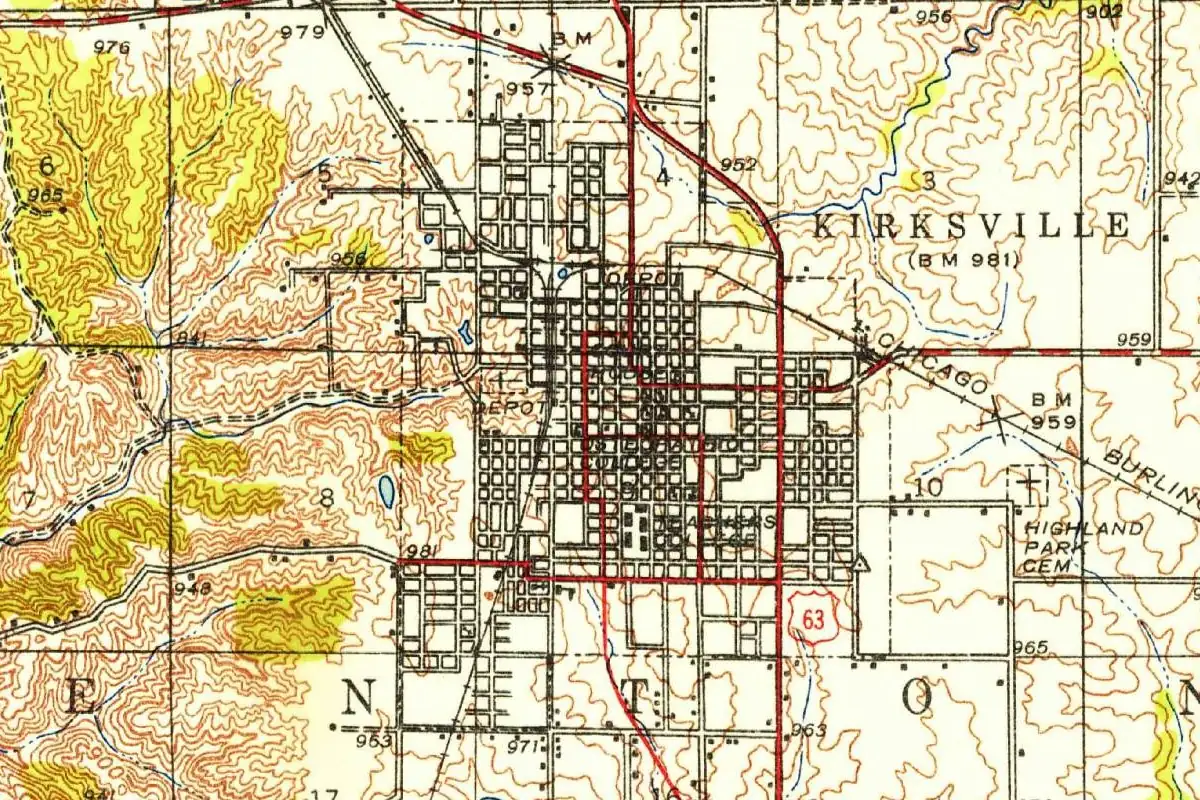
Tradition says Jesse Kirk got Kirksville, Missouri, named for himself by offering the surveyors a turkey dinner and a good supply of whiskey. The Kirk part is solid. The dinner comes down to us only as tradition.
The deal, as the story goes
When Adair County was organized in 1841, three commissioners were told to put the county seat within two and a half miles of the county’s geographic center. David W. Eaton, a U.S. Coast Survey man who spent years collecting the stories behind Missouri place names, picks it up from there in the Missouri Historical Review of 1916. The town “was named after Jesse Kirk who was living at that time in the vicinity of the newly laid out town.”
Then comes the good part. “According to tradition his wife was cooking a turkey dinner the day the surveyors completed their work and he offered them a good turkey dinner and a good supply of whiskey if they would name the town ‘Kirksville.’ The offer was accepted.” Eaton gives no source for it beyond “tradition,” so that’s how you should read it.
What the records say about Jesse Kirk
The name itself isn’t in doubt. Henry Gannett’s 1905 place-names book says Kirksville was “named for Jesse Kirk,” and GNIS, the government’s official list of place names, calls him “a local tavern owner.”
A county history from 1888 fills in the man. Before there was a town, the spot was called Long Point, a name still in use in 1840 and as late as 1841. The plat of Kirksville was acknowledged on May 18, 1842, and the county court met “at Jesse Kirk’s” that October. Kirk built a double log house and opened it as a tavern, and the book says it’s “generally conceded” he was the first postmaster, though the author had no record of the appointment. He died on August 31, 1846, and his headstone carried the oldest date in the town’s old burial ground.
A house that’s gone
If you go looking for Kirk’s tavern, you won’t find it. The 1888 history places his hotel two blocks northwest of the square and says “the old double log house was burned in 1862.” What’s left is the name, and a story about a dinner that may or may not have sealed the deal.
Sources & further reading
- David W. Eaton, “How Missouri Counties, Towns and Streams Were Named,” Missouri Historical Review, vol. 10 (1916), pp. 200–201. The 1841 county seat, the commissioners’ instructions, the town named after Jesse Kirk, and the turkey-and-whiskey tradition. Eaton’s U.S. Coast Survey job is in the volume’s list of contributors, and the editor’s note that he “spent years in gathering his data” is on p. 224.
- History of Adair, Sullivan, Putnam and Schuyler Counties, Missouri (Goodspeed, 1888). Long Point (p. 252); court at Jesse Kirk’s, October 8, 1842 (p. 257); the plat acknowledged May 18, 1842 (p. 321); the hotel and the fire of 1862 (p. 330); Kirk as first postmaster (p. 337); his death, his grave, and the tavern (p. 363).
- Henry Gannett, The Origin of Certain Place Names in the United States (USGS, 1905), p. 176. “Named for Jesse Kirk.”
- GNIS feature 735678 (U.S. Geological Survey). Established in 1841 and named for Jesse Kirk, “a local tavern owner.”
Spot something wrong, or know more? Tell us here. You can also email us or use our contact page. Corrections are noted here with their date, never made silently.