Des Moines, Iowa: The Capital That Was Almost Fort Raccoon
The Army captain who built the fort that became Des Moines, Iowa, named it Raccoon in 1843. General Scott ordered Fort Des Moines instead. That name came from the river, and what the river’s name first meant is still an open argument.
Captain Allen’s “Raccoon”
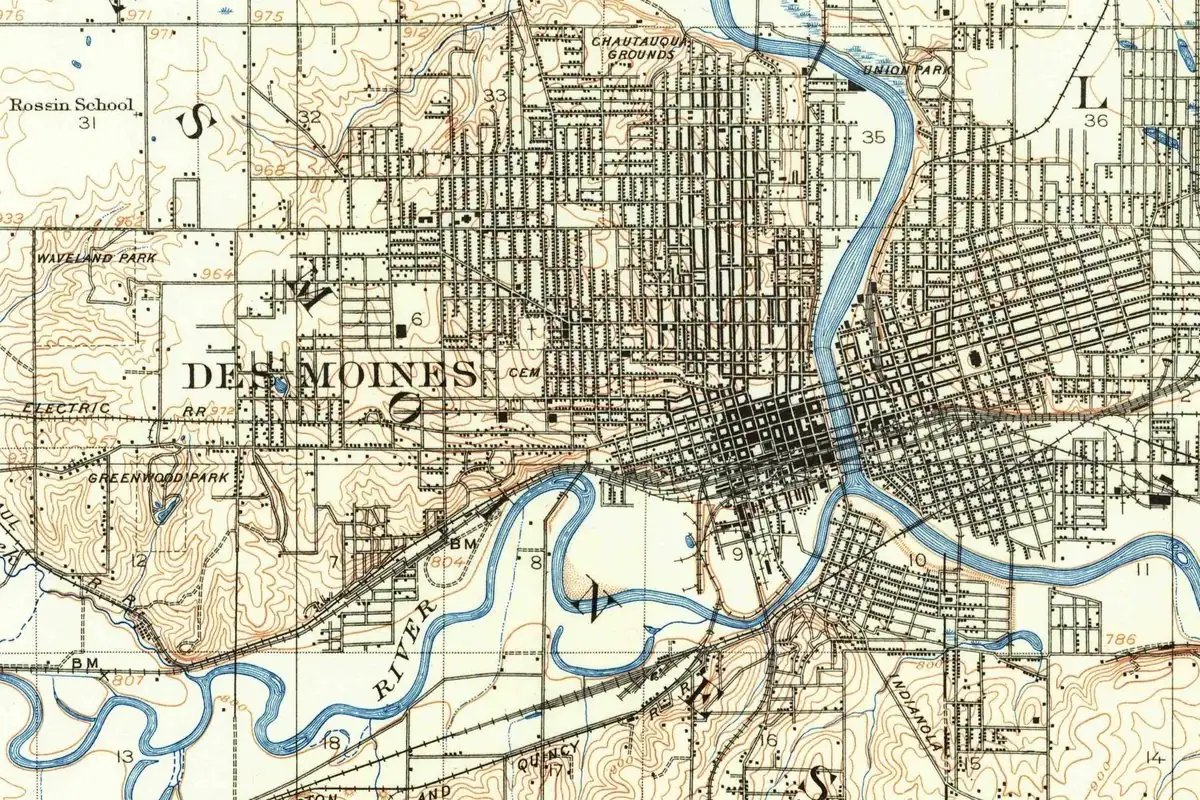
The fort went up where the Raccoon River runs into the Des Moines. Benjamin Gue’s 1903 History of Iowa says Captain James Allen got the job in March 1843, picked a site near the forks, and hauled in supplies by keelboat and wagon when the water got too low for steamers. “He named the fort ‘Raccoon,’” Gue writes. “General Scott did not approve of the name fortunately and ordered it changed to ‘Fort Des Moines.’” The 1880 History of Polk County dates the fort to May 9, 1843.
The raccoon didn’t vanish completely. The town grew up on the point of land between the two rivers, and in 1880 the county history noted that the original town plat was “still called ’Coon Point.”
Dropping the “Fort”
For years the town was Fort Des Moines, and not everybody liked it. In January 1852, a local paper picked up a suggestion from the Star to shorten the name. The change, it said, “would save much time; it looks better and sounds better, and, beside, ‘Fort’ is to one far off always suggestive of Indians and rudeness.” The same writer wanted it spelled Desmoines, as one word, because otherwise there’d always be two pronunciations: “the French, Day Moin, and the English.”
Spelling stayed a fight for a while. The Polk County history tells of a Mr. Dean who laid out a town on the east side of the river and called it Demoine. Asked about the spelling, he said “he didn’t care anything about them literary fellows on the West Side; he was going to have it as it was pronounced.” The town eventually dropped the “Fort,” but you’ll notice it kept the French spelling.
Monks, a road, or mounds
So where does Des Moines come from? The French called the river the rivière des Moines, and if you know a little French, that looks like “river of the monks.” Joseph Nicollet, the mapmaker who explored the upper Mississippi, said that reading came later. In his 1843 report to Congress, he traced the name to a village that Marquette and Joliet came across on their trip down the Mississippi, where the people told them they belonged to the Illinois nation. Its name was “Moingona, as laid down in the ancient maps of the country,” which Nicollet called “a corruption of the Algonkin word Mikonang, signifying at the road,” after a trail that let travelers skip the rapids on the Mississippi.
The French, he said, only pronounced the first syllable and talked about “the river of the Moins.” Later on, people tied that to the Trappist monks, the moines de la Trappe, who lived on the Indian mounds of the American Bottom, and “it was then concluded” that the real name was the river of the monks. Gue repeats Nicollet’s account almost word for word.
Not everybody’s translation matches. Henry Gannett’s 1905 list for the U.S. Geological Survey tells the same story, calls the monks “a spurious etymology,” and says the word mikonang meant “toad.” The first edition of the same list, in 1902, had said “the road.” The Polk County history quotes Judge Negus of Fairfield, who argued in the Annals of Iowa that the French meant a river of mounds. That leaves the capital of Iowa with a French name that probably isn’t about monks, built on an old village name that the old books can’t agree on.
Sources & further reading
- Benjamin F. Gue, History of Iowa, vol. 1 (1903). Nicollet’s account of Moingona, quoted in full (p. 33); Captain Allen, the “Raccoon” name and General Scott’s change (pp. 107-108).
- J. N. Nicollet, Report Intended to Illustrate a Map of the Hydrographical Basin of the Upper Mississippi River (1843), pp. 22-23. The original source for Moingona, Mikonang, “at the road,” the clipped “Moins” and the monks.
- The History of Polk County, Iowa (1880). Nicollet and Judge Negus on the river’s name (pp. 253-259); ’Coon Point (p. 260); the 1852 newspaper items on dropping “Fort” (p. 375); the fort’s founding date (p. 415); Mr. Dean’s Demoine (p. 706).
- Henry Gannett, The Origin of Certain Place Names in the United States (USGS, 1905), p. 105. Mikonang as “toad,” and the monks as “a spurious etymology.”
- Henry Gannett, The Origin of Certain Place Names in the United States, first edition (USGS, 1902), p. 93. The same entry, with mikonang as “the road.”
- GNIS feature 465961 (U.S. Geological Survey). The federal record for Des Moines, capital of Iowa, founded 1846 and incorporated 1851.
Spot something wrong, or know more? Tell us here. You can also email us or use our contact page. Corrections are noted here with their date, never made silently.