Marshalltown, Iowa: The "Town" Washington Tried to Cut
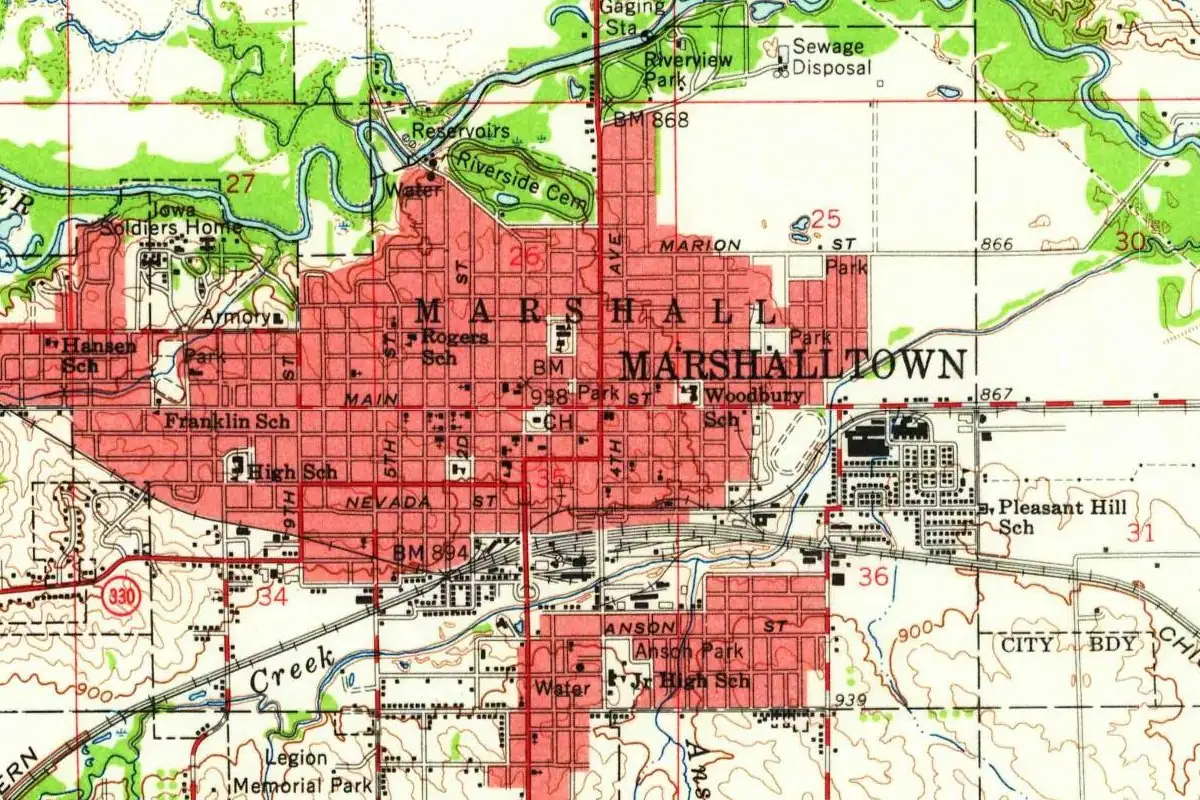
In 1892 a federal naming board ruled that Marshalltown, Iowa, should just be Marshall, and called the extra “town” a useless complication. It didn’t stick. The town had a reason for that word, and its name came from a town in Michigan that its founder never forgot.
A pretty town on the Kalamazoo
Henry Anson staked his claim here in May 1851 and built a cabin on what became Main Street. The 1878 county history says that “during his travels, Mr. Anson had seen the beautiful town of Marshall, Michigan, and such pleasant recollections clung to him of his sojourn in the valley of the Kalamazoo that he determined to name this region Marshall.” Mrs. N. Sanford, in her 1867 history of the county, says the same in fewer words: the town “was named after Marshall, Michigan, Mr. Anson having some pleasant memories of that place.” The village was surveyed in August 1853.
It helped that the county was already called Marshall. The 1878 historian thought that made the name especially fitting. The county was named for Chief Justice John Marshall, and that’s where at least one book goes wrong. Henry Gannett’s 1905 list for the U.S. Geological Survey says the city itself was named for the chief justice. The local histories, and William Stennett’s 1908 book on the Chicago & North Western’s towns, all point to Michigan.
Why the “town”
Marshall had a problem, though. Sanford says the founders added “town” because there was another town by the same name in Henry County. The 1878 history puts it in postal terms: “The name of Marshall became a confusing one, as there was a post office elsewhere in the State bearing a similar title.” So the people changed it to Marshalltown.
Washington’s edit
That’s where the federal government stepped in. The U.S. Board on Geographic Names, the federal board that rules on official place names, issued its first report in 1892. It didn’t like names with “city” or “town” stuck on the end, and it used this one as an example: “The practice of adding the word city or town, as Boise city, Marshalltown, as a part of the name is a useless complication, growing in most cases out of an optimistic spirit on the part of the promoters of the place.” In its list of decisions, the board adopted “Marshall” in Marshall County, Iowa, and listed Marshalltown as the rejected form.
By 1900 the board had changed its mind. Its second report lists “Marshalltown; county seat, P. O., and township, Marshall county, Iowa. (Not Marshall.)” and marks it as a revision of an earlier decision. The report doesn’t say why, but you can tell which name won: the city is still Marshalltown.
The founder’s son
The 1878 history has one more detail you might not expect. Before the town was even surveyed, its first baby was born: “Adrian C. Anson, son of Henry Anson, was born April 17, 1852.” That baby grew up to be a ballplayer. In his 1900 memoir, A Ball Player’s Career, Adrian C. Anson wrote that his father, Henry Anson, built the first log cabin in Marshalltown and that he himself was “the first white child that was born there,” on April 17, 1852. The National Baseball Hall of Fame lists him as Cap Anson, born in Marshalltown.
Sources & further reading
- The History of Marshall County, Iowa (Western Historical Company, 1878), pp. 467-469. Anson’s 1851 claim, Marshall, Michigan, and the valley of the Kalamazoo; the 1853 survey; the first birth; the confusing post office name and the change to Marshalltown.
- Mrs. N. Sanford, History of Marshall County, Iowa (1867), p. 77. “Named after Marshall, Michigan”; “town” added because of another Marshall in Henry County.
- U.S. Board on Geographic Names, First Report (1892), pp. 7, 30. “A useless complication,” and the decision for Marshall over Marshalltown.
- U.S. Board on Geographic Names, Second Report (1900), p. 86. Marshalltown, “Not Marshall,” marked as a revision.
- William H. Stennett, Place Names of the Chicago & North Western (1908), pp. 22, 99. Marshall County named for John Marshall; the town named from Marshall, Michigan.
- Henry Gannett, The Origin of Certain Place Names in the United States (USGS, 1905), p. 200. Gives Chief Justice John Marshall for the city.
- Adrian C. Anson, A Ball Player’s Career (1900), pp. 7-9. The founder’s son on his father’s cabin, his own birth on April 17, 1852, and the name taken from Marshall, Michigan.
- National Baseball Hall of Fame, “Cap Anson.” Cap Anson, born in Marshalltown in 1852.
- GNIS feature 458824 (U.S. Geological Survey). The federal record, with a Board on Geographic Names decision dated 1900.
Spot something wrong, or know more? Tell us here. You can also email us or use our contact page. Corrections are noted here with their date, never made silently.