Mankato, Minnesota: Blue Earth and a Water-Spirit Mix-Up
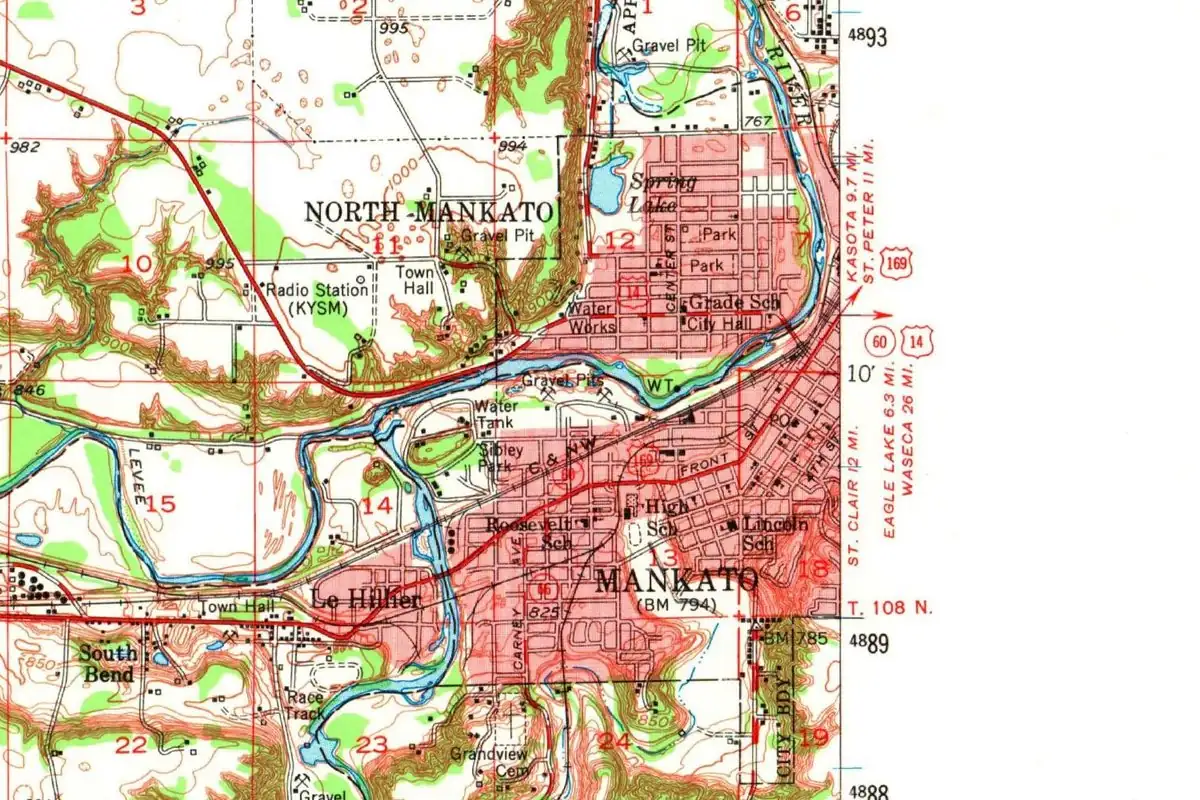
According to a 1909 county history, the man who suggested the name Mankato, Minnesota, in 1852 thought it belonged to a water spirit in a German tale. It’s really the Dakota name of the Blue Earth River, and it means blue earth, or green earth, depending on how you translate one short word.
A brook in a fairy tale
The mix-up starts with Joseph Nicollet, the French mapmaker who explored this country in the late 1830s. In his 1843 report to Congress, he wrote that he’d named the land around the “Mankato, or Blue Earth river” the Undine Region, after “an interesting and romantic German tale” about a heroine from “the extensive race of water-spirits.” She was, he added, “the niece of a great brook (the Mankato).”
Read that last line and you can see how it could happen, since in Nicollet’s retelling the Mankato is a character in the tale. Thomas Hughes, the Blue Earth County historian who wrote that 1909 history, says that’s what happened. In February 1852, a group in St. Paul formed the Blue Earth Settlement Claim Association to found a town at the mouth of the river. “The honor of christening the new city was accorded to Mrs. P. K. Johnson and Mrs. Henry Jackson, who selected the name ‘Mankato,’ upon the suggestion of Col. Robertson.” Robertson had taken it from Nicollet’s book, and “through some strange misunderstanding of the text, he thought the name to be that of a German water spirit, when in fact it was the Indian name of the Blue Earth river.”
Hughes thought it worked out anyway. “Though in a way unintentional,” he wrote, “no more appropriate name could be given the new city, than that of the noble river, at whose mouth it is located.”
Blue earth, or green
The Blue Earth River got its name from a bluish green clay in a bluff a few miles up from its mouth. Warren Upham, writing in 1920, says the Sisseton Sioux used it as paint. Around 1700, the French explorer Pierre-Charles Le Sueur thought it was copper ore. He built a post on the river, dug out a big load, and sailed for France in 1702 with two tons of it, “of which, however, nothing more is known.”
The Dakota name is Makato. Upham breaks it down as maka, earth, and to, blue or green. Stephen Riggs’s 1890 Dakota-English dictionary gives maka as “ground, earth” and to as “blue; green, and the intermediate shades,” and lists makato as “blue earth.” Hughes points out that the French called the stream the green river, which he thought was closer to the color of the clay, though “both are technically correct, as the Sioux language makes no distinction between the two colors.” The U.S. Geological Survey’s 1905 place-names bulletin, by Henry Gannett, goes with blue “or, more properly, ‘green earth.’”
Where the n came from
If the word is Makato, why does the city have an n? Nicollet already spelled it Mankato in 1843, nine years before the town. Upham just says the town kept the Dakota name “with slight change.” On the first map of Minnesota Territory, in 1850, a county was spelled Mahkahta.
Some Dakota speakers said the n belonged there. Hughes reports that Samuel J. Brown, the son of Major Joseph Brown and a Dakota mother, raised among the Sisseton in this area, “stoutly maintains that there is a nasal in the word,” so it should be “Manka” and not “Mahka.” Three other men of Dakota descent agreed with him, Hughes says. Riggs noted the same argument: some said the word for earth should be written with that nasal sound, though he leaned the other way.
Nicollet, for his part, never really explained his Undine idea. “I do not know why I fancied an analogy between the ideal country described in the tale, and that of the one before me,” he wrote, “but I involuntarily, as it were, adopted the name.” So the city’s name came out of a book about a water spirit, by way of a man who, if Hughes is right, misread it, and it still ended up being the river’s own Dakota name.
Sources & further reading
- Thomas Hughes, History of Blue Earth County (1909), chapters 1, 4 and 5. The Blue Earth Settlement Claim Association of February 1852; Mrs. P. K. Johnson, Mrs. Henry Jackson and Col. D. A. Robertson; Robertson’s misreading of Nicollet; Samuel J. Brown on “Manka”; the French “green” river and the two colors.
- J. N. Nicollet, Report Intended to Illustrate a Map of the Hydrographical Basin of the Upper Mississippi River (1843), p. 17. The Undine Region and “the niece of a great brook (the Mankato).”
- Warren Upham, Minnesota Geographic Names (1920), pp. 57-58, 61-62. The blue-green earth and the Sisseton; Le Sueur and the supposed copper; maka and to; Keating’s account of Long’s 1823 expedition, “the river where blue earth is gathered”; Mahkahta on the 1850 map; Hughes’s account, quoted.
- Stephen Return Riggs, A Dakota-English Dictionary (Smithsonian, 1890), pp. 305-306, 472. Maka, earth, with the note on its pronunciation; makato, blue earth; to, blue or green.
- Henry Gannett, The Origin of Certain Place Names in the United States (USGS, 1905), p. 198. Blue, “or, more properly, ‘green earth.’”
- GNIS feature 647438 (U.S. Geological Survey). The federal record for Mankato, which repeats Gannett’s definition.
Spot something wrong, or know more? Tell us here. You can also email us or use our contact page. Corrections are noted here with their date, never made silently.