St. Cloud, Minnesota: A Name Borrowed From a Napoleon Book
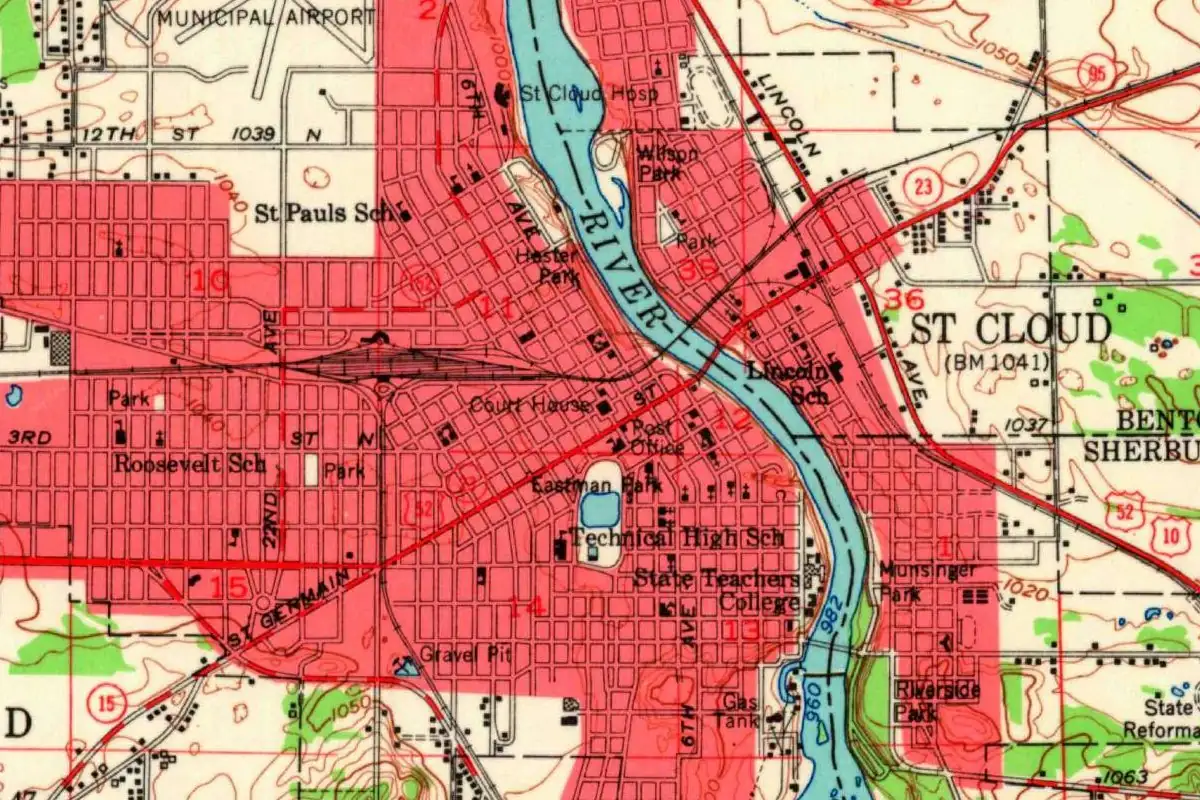
St. Cloud, Minnesota, got its name because the man who platted it had been reading a life of Napoleon. John L. Wilson noticed that the Empress Josephine spent a lot of her time at the palace of St. Cloud, just outside Paris, and he liked it so much he gave the name to his town on the Mississippi.
John L. Wilson’s reading
The account comes from William Bell Mitchell’s 1915 History of Stearns County. Wilson, born in Maine in 1820, came to Minnesota in 1851. In 1853 he was at Sauk Rapids building a sawmill, but he liked the west side of the river better. On July 19, 1853, he paid Ole Bergeson, a Norwegian squatter, $250 for his right to the land where downtown St. Cloud now stands. He platted it in the fall of 1854.
Then came the name. “The choosing of St. Cloud as the name for his new town was due to the fact that while reading the life of Napoleon I, Mr. Wilson had observed that the Empress Josephine spent much of her time at the magnificent palace at St. Cloud, a few miles out of Paris, a circumstance which appealed so strongly to his fancy that he adopted it.”
That’s the whole reason, as far as the record goes. Warren Upham quoted the same passage when he wrote up the state’s place names in 1920, and Henry Gannett, in the government’s 1905 book of place-name origins, says only that the proprietors named it “from the town in France.” A place Wilson read about caught his fancy, and that was enough.
A town born as triplets
You might expect a town with a name that fancy to start out as one tidy plan. It didn’t. Wilson’s St. Cloud wasn’t the only town on that stretch of riverbank. “When St. Cloud came into existence it was as a triplet,” Mitchell writes. Wilson’s survey was Middle Town. St. Cloud City, from the Curtis survey, was Lower Town. Lowry’s Addition, at first called Arcadia, was Upper Town. Over the years the three grew together into one city, under the name Wilson picked.
He also gave a lot of it away. Mitchell says Wilson was “very generous with his lots” to get newcomers to stay, and the 1915 history calls him “by common consent” the Father of St. Cloud. He lived on his land from 1853 until he died, on January 3, 1910.
The saint behind the palace
If you go one step further back, the French town has its own story. Upham explains that Saint Cloud, or Clodvald, was the youngest son of Clodomir, king of Orleans, and a grandson of Clovis. In the year 524, his uncles murdered his two older brothers, who were 10 and 7. Clodvald got away. Quoting the French historian Guizot, Upham says he gave up any claim to a kingdom, cut his own hair to become a churchman, and founded a monastery near Paris that took his name.
So a Minnesota city carries the name of a prince who gave up a kingdom, by way of a palace an empress liked and a settler who was reading about her husband.
Sources & further reading
- William Bell Mitchell, History of Stearns County, Minnesota (1915), vol. 2, pp. 1436-1437, and vol. 1, pp. 645-646 (biography of John L. Wilson). Wilson’s arrival, the land bought from Ole Bergeson, the 1854 plat, the Napoleon passage, the three original towns, his gifts of lots, and his dates.
- Warren Upham, Minnesota Geographic Names (1920), pp. 526-527. The same Napoleon passage, quoted; Saint Cloud, or Clodvald, after Guizot’s History of France.
- Henry Gannett, The Origin of Certain Place Names in the United States (USGS, 1905), p. 270. “Named by the original proprietors from the town in France.”
- GNIS feature 650559 (U.S. Geological Survey). The federal record for Saint Cloud: founded in 1851; incorporated as a town on March 1, 1856, and as a city on March 6, 1868.
Spot something wrong, or know more? Tell us here. You can also email us or use our contact page. Corrections are noted here with their date, never made silently.