Saint Paul, Minnesota: The Capital That Started as Pig's Eye
Before Saint Paul, Minnesota, had a saint’s name, the place was called Pig’s Eye, after a one-eyed whiskey seller named Pierre Parrant. The name it kept came from a log chapel that a French priest dedicated to Saint Paul in 1841.
Pierre Parrant’s bad eye
Warren Upham, who catalogued the state’s place names for the Minnesota Historical Society in 1920, calls Parrant the first settler of St. Paul, in 1838, and “a whiskey dealer.” He “had a defective eye,” Upham writes, and the nickname that came from it was “applied also to the village of St. Paul at its beginning.”
J. Fletcher Williams fills in the rest in his 1876 history of the city. Parrant was a Canadian voyageur who had only one good eye. A sutler’s clerk at Fort Snelling, Roswell P. Russell, started calling him “Pig’s Eye,” and it caught on. The French, Williams adds, said “Oeil de Cochon.”
Then the nickname jumped from the man to the place. In 1839, a young Canadian carpenter named Edmund Brissett was staying at Parrant’s and needed to send a letter to Joseph R. Brown, who ran a trading post on Grey Cloud Island, 12 miles downriver. He didn’t know what to write as the place. Williams quotes him: “it suddenly popped into my head to date it at Pig’s Eye, feeling sure that the place would be recognized, as Parrant was well known along the river.” The answer came back addressed to Brissett at Pig’s Eye. Parrant, Brissett said, “was very mad, and threatened to lick me, but never tried to execute it.”
Williams wasn’t happy that a man like that counted as the city’s founder. “Our pride almost revolts at the chronicling of such a humiliation,” he wrote. The man who gave the place its new name, though, wasn’t thinking about Parrant at all, as far as you can tell from his own account.
A log chapel for Saint Paul
The new name came from Father Lucian Galtier, a French-born priest who had settled at Mendota, near Fort Snelling, in 1840. In 1864, he wrote down how it happened, and both Williams and Upham print his account. In October 1841, logs were cut and a church went up, “so poor that it would well remind one of the stable at Bethlehem.” On November 1, Galtier blessed it and dedicated it to “Saint Paul, the apostle of nations.”
“I expressed a wish, at the same time, that the settlement would be known by the same name, and my desire was obtained,” he wrote. His reasoning was simple. He lived at Saint Peter’s, the old name for Mendota, and Paul usually goes with Peter. He also liked the sound of it: “The monosyllable is short, sounds well, and is understood by all denominations of Christians.”
Then a store went up, a grocery opened at the foot of a neighbor’s claim, and soon steamboats were landing there. From then on, Galtier wrote, the place was known as “Saint Paul Landing” and, later on, as “Saint Paul.” Henry Gannett’s 1905 federal list of place names sums it up in one line: the city was “named for a church which was built for M. Galtier.”
Pig’s Eye never really left
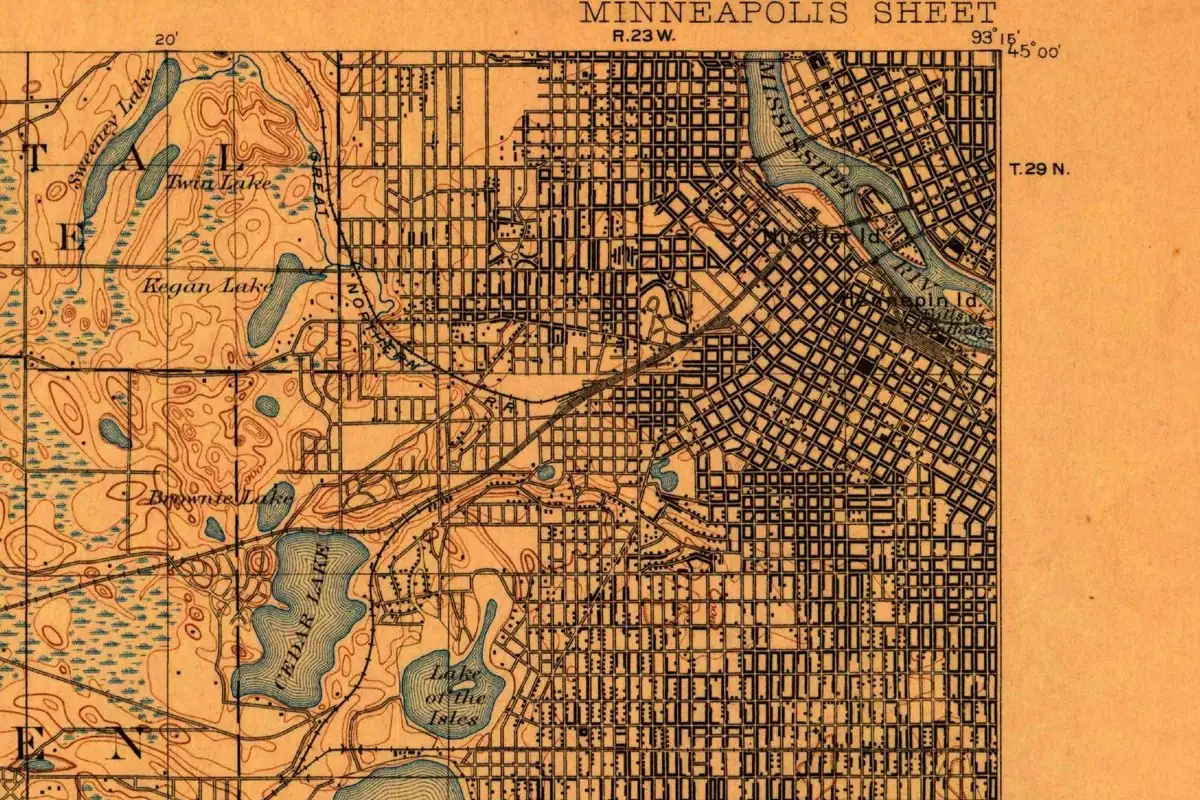
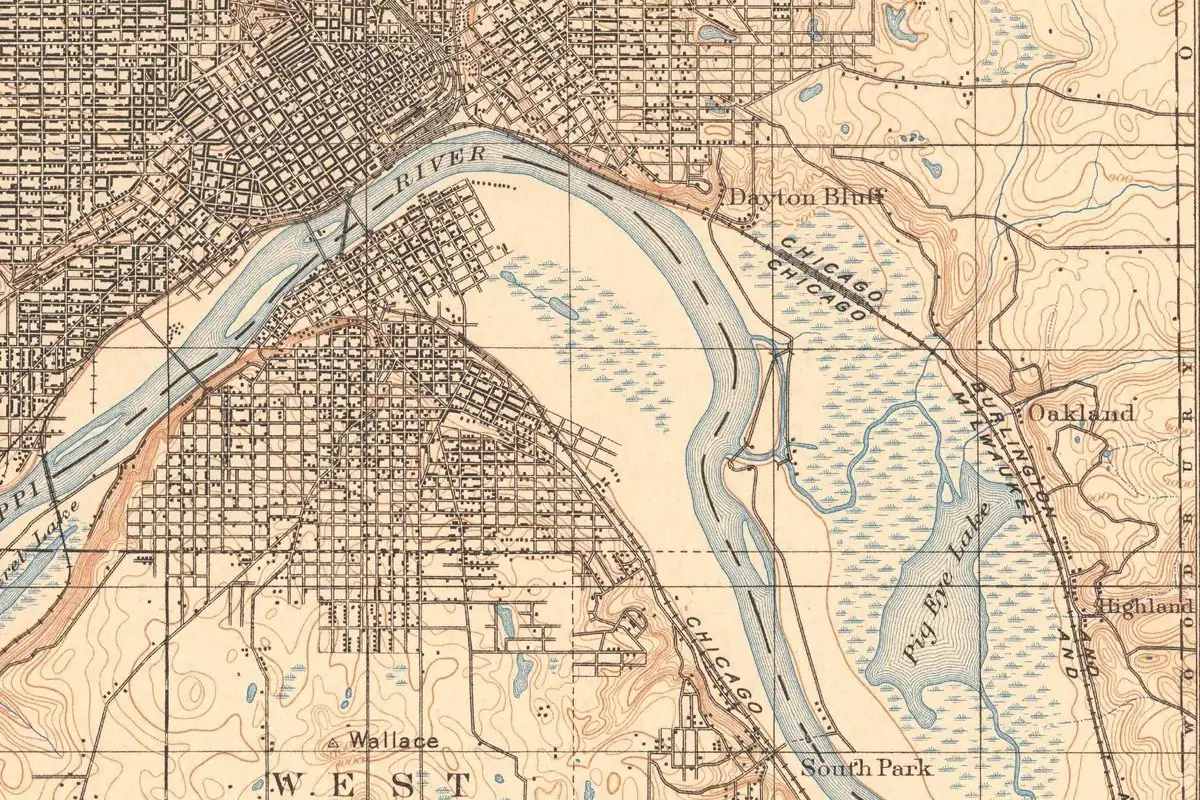
As it turns out, the old nickname just moved downstream. Around 1842, Parrant moved to the bottomland below Dayton’s Bluff, and the name went with him. Upham says Pig’s Eye lake and marsh were named for him, and that the French fur traders had called the lake Grand Marais, the great marsh. Williams, in 1876, figured it “will probably be known as such, until the end of time.” If you look at the 1896 government map above, you’ll find it there, southeast of downtown, printed as Pig Eye Lake.
Galtier, for his part, didn’t let go of his choice. He wrote that when “an effort was made to change the name,” he did all he could to stop it, writing from Prairie du Chien. Williams adds in a footnote that this happened while Congress was debating the bill to create Minnesota Territory, when some members objected to the name. The priest who had moved away to Iowa in 1844 still cared enough to fight for the name he gave a log chapel.
Sources & further reading
- J. Fletcher Williams, A History of the City of Saint Paul, and of the County of Ramsey, Minnesota (1876), pp. 64-65, 85-86, 111-113. Parrant as voyageur and founder; Roswell P. Russell and the nickname; Edmund Brissett’s 1839 letter dated “Pig’s Eye”; Galtier’s own account of the chapel and the name; the footnote on the move in Congress to change it.
- Warren Upham, Minnesota Geographic Names (1920), pp. 438-439, 442. Parrant as first settler in 1838 and whiskey dealer; Galtier’s account; Galtier at Mendota in 1840 and at Keokuk in 1844; Pig’s Eye lake and marsh, and the older name Grand Marais.
- Henry Gannett, The Origin of Certain Place Names in the United States (USGS, 1905), p. 271. “Named for a church which was built for M. Galtier.”
- GNIS feature 662851 (U.S. Geological Survey). The federal record for Saint Paul: the state capital, incorporated as a city on March 4, 1854.
Spot something wrong, or know more? Tell us here. You can also email us or use our contact page. Corrections are noted here with their date, never made silently.