How Brookings, South Dakota Got Its Name (Hint: "Ol' Wooden Legs")
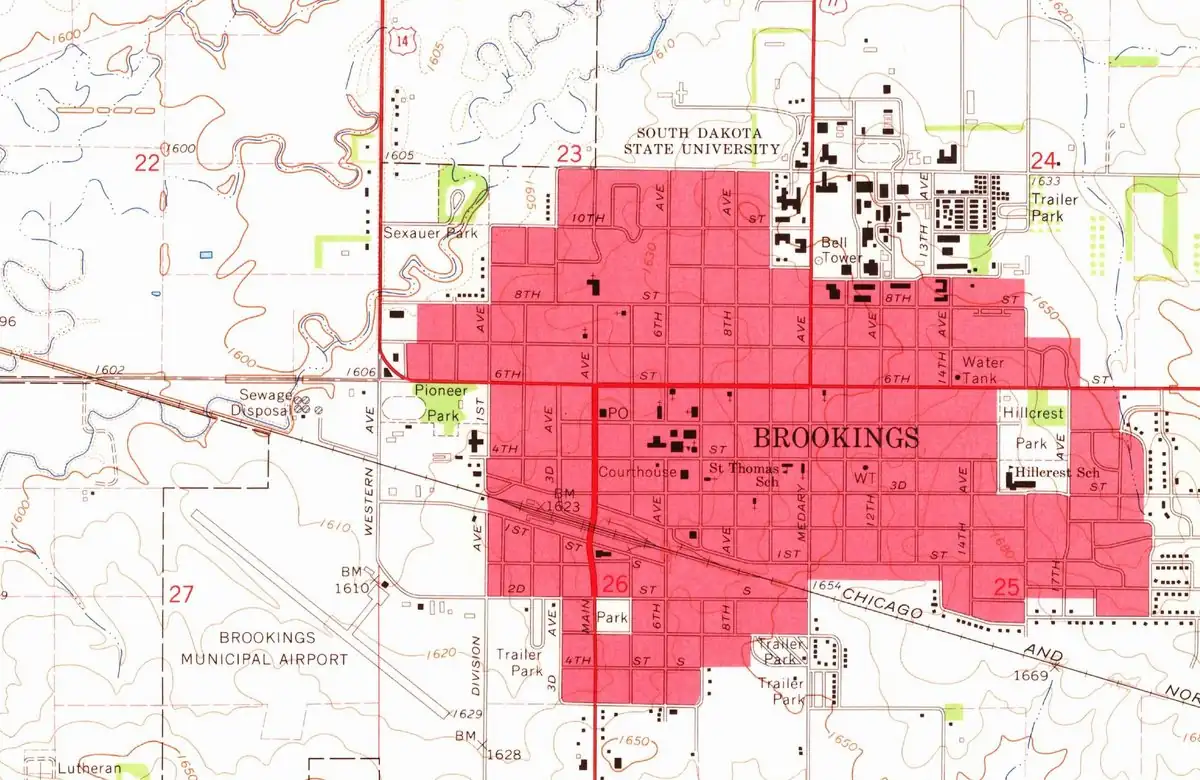
Brookings, South Dakota, is named for Wilmot W. Brookings, a pioneer promoter and judge who lost both feet to frostbite in 1858 and went on to help build Dakota Territory anyway. Funny thing is, he hardly ever visited the town that carries his name.
Where the name comes from
Wilmot Brookings showed up in what’s now South Dakota in 1857, when there was almost nothing there. South Dakota Magazine says he came with the Western Town Company, the Dubuque group that was trying to start a town at the falls of the Big Sioux River, and that he reached Sioux Falls on August 27, 1857. A state marker says he helped build the Dubuque House, the settlement’s first hotel, that September.
The next winter nearly killed him. South Dakota Magazine says that in January 1858 he set out on a trip, got caught in a blizzard, and froze his feet so badly that both had to be amputated. (Some retellings say his horse went through the ice of a creek first. The details shift depending on who’s telling it.) He spent the rest of his life on wooden legs, and the city’s visitor bureau still calls him “Ol’ Wooden Legs.”
It didn’t keep him out of public life. A 1908 railroad guide to place names describes him as “a judge of the Supreme Court of the territory of Dakota.” The county was named for him first, and the town took the same name.
Who named it, and when
The oldest sources give the credit to a settler. The 1908 guide says the town was “named by W. H. Skinner, an early settler for the Hon. Wilmot W. Brookings,” and that the Western Town Lot Company laid it out. The U.S. Geological Survey’s place-name record, which leans on a different South Dakota reference, says the same thing about Skinner and gives the year of the change as 1879.
The Brookings Register tells it from a different angle: it says the name was picked by men on a distant railroad board of directors to honor one of their own, and that Brookings himself had little to do with the town. The paper says he may have visited the town only once in his life. Both versions agree on the man being honored. They just disagree on who wrote his name down first.
What it was called before
Per the USGS record, the town was first named Ada, then changed to Brookings in 1879. We couldn’t find any record of who picked Ada or why, so that’s as far as the paper trail goes.
The bigger story is how this brand-new town became the county seat. The seat used to be Medary. A state historical marker says Brookings was platted on October 3 and 4, 1879, when the Chicago & North Western railroad reached the spot, and that after “a stiff election contest” with Aurora and Volga that November, Brookings replaced Medary as county seat. Look at the map above and you’ll still find a Medary Avenue running through Brookings.
Sources & further reading
- W. H. Stennett, A History of the Origin of the Place Names Connected with the Chicago & North Western and Chicago, St. Paul, Minneapolis & Omaha Railways (1908). A public-domain railroad guide. Says W. H. Skinner named the town for Wilmot W. Brookings and that it was laid out in 1880; its county entry calls Brookings a judge of the territorial Supreme Court.
- GNIS feature 1254074 (U.S. Geological Survey). The federal record for Brookings. Gives the first name, Ada, the 1879 change and Skinner’s suggestion. It cites a different South Dakota reference than the 1908 guide.
- South Dakota Magazine, “A Spirited Pioneer Promoter” (2013). Brookings’s arrival at Sioux Falls in 1857 with the Western Town Company and the January 1858 blizzard that cost him his feet.
- Brookings Register, “Who is this Brookings fellow?” The local paper’s profile. Says a railroad board picked the name and that Brookings may have visited the town only once.
- Visit Brookings, “The Legacy of Ol’ Wooden Legs.” The city visitor bureau’s telling of the nickname.
- Brookings state historical marker. The October 1879 platting when the railroad arrived and the November 1879 county-seat election that moved the seat from Medary. Read through the Historical Marker Database transcription.
- “The Dubuque House” historical marker. Names Wilmot W. Brookings among the builders of Sioux Falls’s first hotel in 1857. Read through a transcription of South Dakota’s state markers.
Spot something wrong? Corrections are noted here with their date, never made silently.