How Sioux Falls, South Dakota Got Its Name
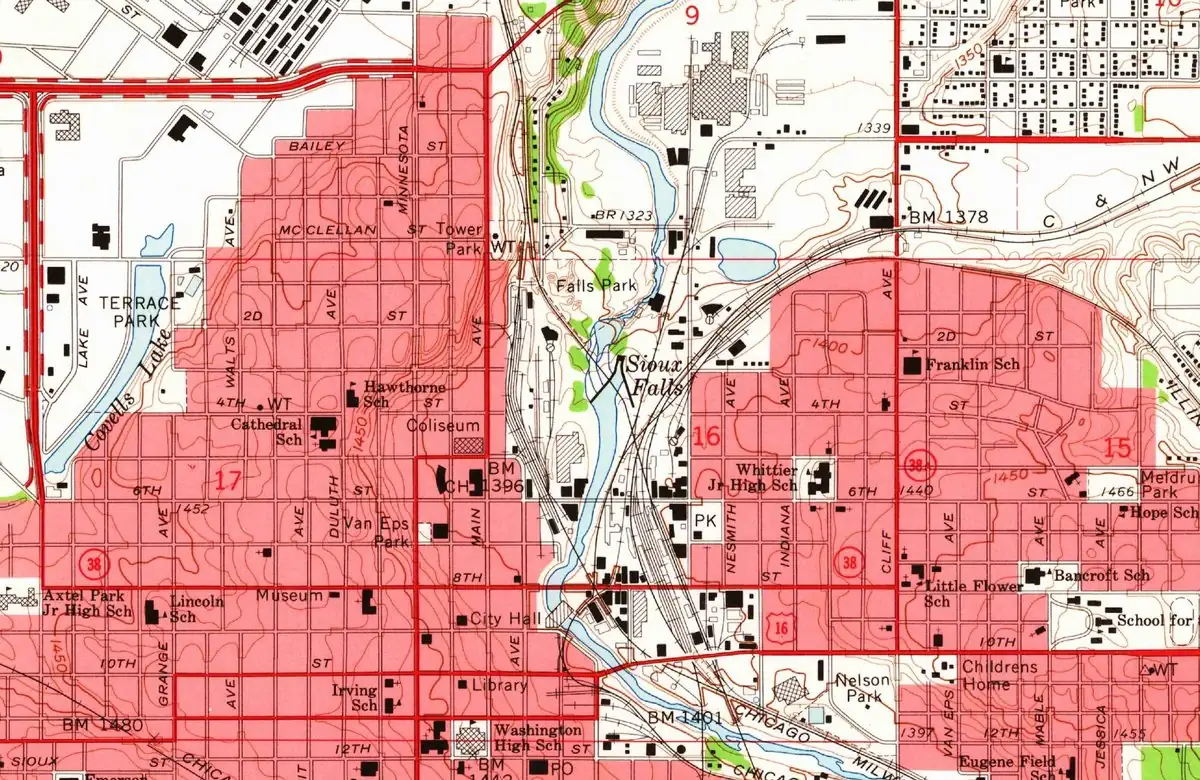
Sioux Falls, South Dakota, is named for the falls of the Big Sioux River, the string of rocky drops that still runs through the middle of the city. Land speculators came for those falls in the 1850s, and they put them right in the town’s name.
Where the name comes from
The falls were the whole point. A historical marker downtown says that in 1856 a Dubuque, Iowa, doctor named George Staples read a description of the falls by the explorer Philander Prescott, printed in Jacob Ferris’s book The States and Territories of the Great West. Staples and five partners formed the Western Town Company and set out to found a town beside them.
They weren’t alone. A second outfit, the Dakota Land Company of St. Paul, Minnesota, was after the same spot, and the marker says its men joined the Dubuque group in the spring of 1857.
A 1908 railroad guide to place names put it plainly: the town was named “for the falls in the Big Sioux River that runs through the place.” The U.S. Geological Survey’s place-name record repeats it almost word for word.
Who named it, and when
This is where the sources don’t quite line up. The 1908 guide, and the USGS record that copies it, say the name came from the Dakota Land Company. A KELO-TV history of Falls Park says it was the other group: the Western Town Company claimed 320 acres below the falls and named the town Sioux Falls in May 1857, just ahead of the St. Paul company, which ended up taking land above the falls instead.
Either way, it was picked for the falls. Most accounts put the naming in 1857, though the Dubuque men had already formed their company and set their sights on the falls in 1856. The only real question is which company’s men said the name first. The two groups ended up working side by side, and a marker says the town’s first hotel, the Dubuque House, went up in September 1857, built by Western Town Company members and Wilmot W. Brookings, the man a whole county and another city would later be named for.
The name before the name
The river had names long before the land companies showed up. The French mapmaker Joseph Nicollet described the falls in the late 1830s, and the 1908 guide says he wrote down what the Native people living near the falls called the falls and the river, and translated it as “thick wooded river.” That’s Nicollet’s translation, passed along secondhand, and we haven’t checked it against a Dakota dictionary, so take it as one explorer’s note rather than the final word. The same book says fur traders also knew the stream as the Calumet River.
A town that had to start over
The first Sioux Falls didn’t last long. In August 1862, during the U.S.-Dakota War, Judge Joseph Amidon and his son William were killed while cutting hay near town. A state marker says that two days later the territorial governor ordered the settlers to abandon Sioux Falls and head for Yankton. Nobody lived there again until 1865, when the Army set up Fort Dakota at the falls. The 1908 guide says soldiers stayed until 1869.
When they rebuilt, they kept the name. The falls were still there, and they still are. Today they’re the centerpiece of Falls Park, right on the edge of downtown.
Sources & further reading
- W. H. Stennett, A History of the Origin of the Place Names Connected with the Chicago & North Western and Chicago, St. Paul, Minneapolis & Omaha Railways (1908). A public-domain railroad guide. Says the town was named by the Dakota Land Company for the falls, mentions Nicollet’s note on the Native name for the falls and river and the traders’ “Calumet,” and dates Fort Dakota to 1865–1869.
- GNIS feature 1267670 (U.S. Geological Survey). The federal record for Sioux Falls. Its history note quotes the 1908 guide, so it isn’t a separate source.
- “Early Sioux Falls” historical marker. Says Dr. George Staples read Philander Prescott’s description of the falls in 1856 and formed the Western Town Company in Dubuque, and that Dakota Land Company men joined them in 1857. Read through the Historical Marker Database transcription.
- “The Amidon Affair” historical marker (1991). The August 1862 killings, the order to abandon Sioux Falls, and the return of settlers with Fort Dakota in 1865. Read through a transcription of South Dakota’s state markers.
- “The Dubuque House” historical marker. Dates the first hotel to September 1857 and names Wilmot W. Brookings among its builders. Read through a transcription of South Dakota’s state markers.
- KELO-TV, “Always an eye to industry,” Falls Park history, part 1. Credits the Western Town Company with naming the town in May 1857 and cites the Siouxland Heritage Museums. Useful for the other side of the “who named it” question.
Spot something wrong? Corrections are noted here with their date, never made silently.