How Duluth, Minnesota Got Its Name (For Two Town Lots)
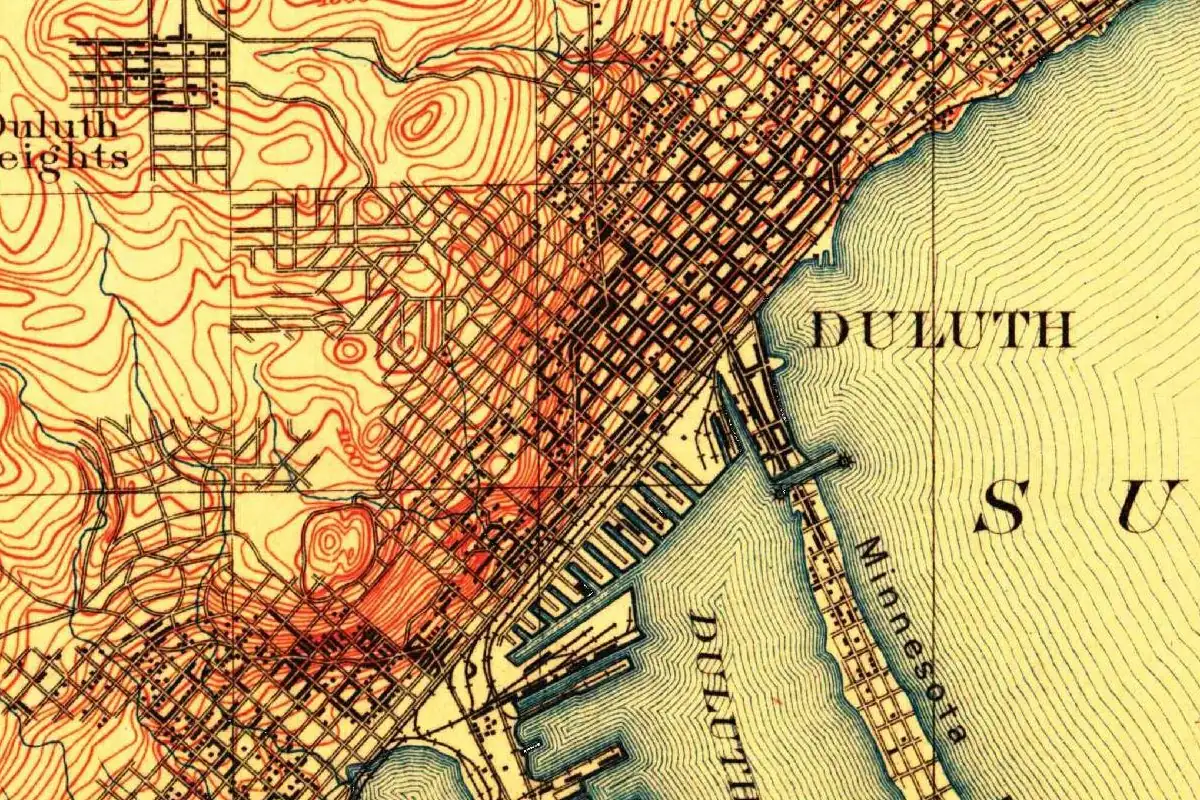
In 1856, a missionary was promised two town lots if he could find a good name for Duluth, Minnesota, so he went hunting through other people’s old books. He found the name of Daniel Greysolon Du Luth, a French explorer who had been at the head of Lake Superior almost two centuries earlier.
The name hunt of 1856
The story comes from John R. Carey, who was living in Superior at the time. In his history of early Duluth, published by the Minnesota Historical Society in 1901, Carey says the men laying out the new town, most of them living in Superior, Wisconsin, spent February 1856 asking “some of the learned citizens of Superior” for a name.
They turned to the Rev. Joseph G. Wilson of Logansport, Indiana, a home missionary who was spending that winter with Carey’s family. Wilson told Carey “he was promised two lots by the proprietors in the new town, in case he would suggest an appropriate name which they would accept.”
Wilson asked Carey for old books about early missionaries or explorers around Lake Superior. Carey didn’t have any. So Wilson made the rounds of homes where he thought he might find a library. At the home of George E. Nettleton, one of the proprietors, he found “an old English translation of the writings of the French Jesuits,” and in it he “ran across the name of Du Luth.” Wilson brought that name and a few others to a meeting of the proprietors one evening at Nettleton’s house. After some discussion, Du Luth won. Warren Upham’s 1920 book on Minnesota place names adds that the first plat of the town, recorded May 26, 1856, already spelled it the way you see it today.
The explorer behind the name
The federal place-names record for Duluth agrees that it’s named for “Sieur Daniel Graysolon Duluth, a French traveler,” and so does the bulletin Henry Gannett wrote for the U.S. Geological Survey in 1905. Upham gives more. Du Luth was born near Paris in 1649 and died in Montreal in 1710. You’ll also see his name spelled Du Lhut, Du Lhud, and Du Lud. In 1678 he paddled to Lake Superior with seven Frenchmen, and in the early fall of 1679 he called together many Native nations on or near the spot where the city stands. In 1680 he got Father Hennepin and two companions freed from captivity among the Sioux of Mille Lacs.
No party, and a pair of boots
Here’s the thing: nobody in 1856 expected much from the place. Carey says there was “no public celebration” for the new name, “as some Duluth people have claimed.” Superior, not Duluth, was supposed to be the great city at the head of the lake.
Wilson did his part to explain the choice. Carey says he wrote a short article about Du Luth for the Superior Chronicle. Neither Carey nor Upham says whether Wilson ever got his two lots, though.
Either way, a lot in Duluth soon wasn’t worth much. In the fall of 1857, Carey writes, the bottom “fell out of all the booms” at the head of the lake, and three-fourths of the people left. “A corner lot in Duluth was not worth a pair of boots,” he says. That October, Carey refused to trade two pairs of boots to Orrin W. Rice for two lots in Duluth, because with winter coming, the boots looked like the better deal. Two lots: the same price somebody had once offered for the city’s name.
Sources & further reading
- John R. Carey, “History of Duluth, and of St. Louis County, to the Year 1870,” Collections of the Minnesota Historical Society, vol. 9 (1901), pp. 253-255, 261. The proprietors in Superior; Rev. Joseph G. Wilson, the promise of two lots and the search through old books; the meeting at Nettleton’s house; no public celebration; the collapse of 1857 and the boots.
- Warren Upham, Minnesota Geographic Names (1920), pp. 480-481. Carey’s account, quoted; the first plat recorded May 26, 1856; Du Luth’s life, the spellings of his name, the 1679 gathering and Hennepin’s release.
- Henry Gannett, The Origin of Certain Place Names in the United States (USGS, 1905), p. 109. “Named for Sieur Daniel Graysolon Duluth, a French traveler.”
- GNIS feature 661145 (U.S. Geological Survey). The federal record for Duluth: named for Du Luth; incorporated as a town on May 19, 1857, and as a city on March 5, 1870.
Spot something wrong, or know more? Tell us here. You can also email us or use our contact page. Corrections are noted here with their date, never made silently.