Who Named Minneapolis, Minnesota? Two Friends, One Greek Word
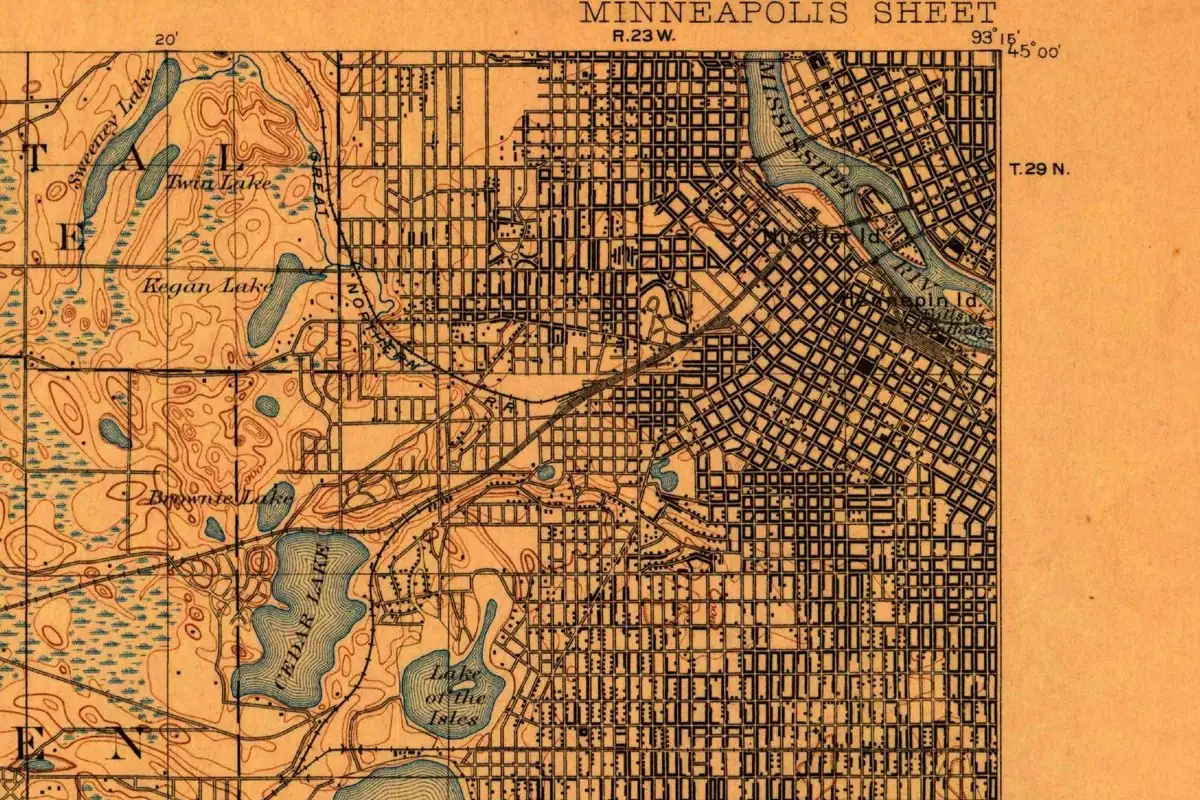
Nobody argues about what Minneapolis, Minnesota, means: it’s a Dakota word for water stuck onto the Greek word for city. What people have argued about, since at least 1881, is which of two friends came up with it.
Minne plus polis
Henry Gannett’s 1905 government list of place names puts it plainly: the name is “a combination of the Indian word minni, ‘water,’ and the Greek, polis, meaning ‘city.’” Stephen Riggs’s 1890 Dakota-English dictionary backs up the first half, with mini for water. It’s the same word you’ll find at the start of the state’s name, which we get into in How Minnesota Got Its Name.
At least one early writer noticed the odd mix. The 1881 history of Hennepin County admits the blend is “contrary to the usual rule in forming compounds,” but says it’s “a much more agreeable name than though both had been taken from the Greek, in which case the name would have been, perhaps, Hudorapolis.” So you can be glad the city didn’t end up as Hudorapolis.
Warren Upham, in his 1920 book Minnesota Geographic Names, says the city’s name was put together from Minnehaha, the waterfall, plus “polis.” And Minnehaha itself may have been the newcomers’ idea. Haha was the common Dakota word for a waterfall, Upham explains, and joining it to minne “seems to be a suggestion of white men.” He quotes Samuel W. Pond Jr., son of a missionary to the Dakota, on the falls: “The Indians never knew it by the latter name, bestowed upon it by the whites.”
All Saints, Albion, and Adasville
Before Minneapolis caught on, the young town on the west side of the Mississippi went by several names. Upham lists the ones floating around: All Saints, proposed by James M. Goodhue of the Minnesota Pioneer, plus Hennepin, Lowell, Brooklyn, Albion, and others.
The 1881 county history guesses at some of the thinking. All Saints, perhaps, because St. Paul and St. Anthony had done so well with saints’ names that a town with all of them on its side “must eclipse its rivals.” Lowell, because people hoped the place might rival the big mill town in Massachusetts. Isaac Atwater’s 1893 history of the city adds one more: some people called it “Adasville,” after a daughter of Charles Hoag. Keep that name in mind.
Hoag or Bowman
That’s where it gets interesting. Upham gives the date. On November 5, 1852, Charles Hoag brought a short article proposing “Minneapolis” to George D. Bowman, editor of the St. Anthony Express, on the very day the paper came out. Bowman ran it with no time for comment, then praised the idea in the next issue, on November 12. The new name soon pushed out all the others.
For decades, the credit went to Hoag, a former Philadelphia schoolteacher. The 1881 county history says the name is due to him and “has incorrectly been ascribed” to Bowman. Atwater’s 1893 history agrees that Hoag wrote the article.
Then, Upham writes, a letter turned up in 1915. Benjamin Drake Sr., a cousin of Bowman’s, had written that Bowman thought of the name while riding horseback from St. Anthony to Marine Mills, on the St. Croix River. The letter was printed after Drake’s death in Henry A. Castle’s History of Minnesota. Upham found the evidence for Bowman “quite conclusive.” But he didn’t take the credit away from Hoag. His guess was that Bowman mentioned the idea to Hoag, Hoag forgot where he’d heard it, and days or weeks later it came back to him as his own.
“So each of these excellent early citizens of Minneapolis may have honestly believed himself the favored first originator of the city’s name,” Upham wrote. Depending on which old history you pick up, you’ll get Hoag, Bowman, or both. The name itself never had that problem: once it was in print, it stuck.
Sources & further reading
- Henry Gannett, The Origin of Certain Place Names in the United States (USGS, 1905), p. 209. Minni, “water,” and the Greek polis, “city.”
- Stephen Return Riggs, A Dakota-English Dictionary (Smithsonian, 1890), pp. 160, 314. Mini, water; haha, waterfalls.
- Warren Upham, Minnesota Geographic Names (1920), pp. 223-224, 230-231. Hoag, Bowman and the St. Anthony Express of November 5 and 12, 1852; the earlier names; the 1915 Drake letter in Castle’s History of Minnesota; Upham’s view that both men may have believed they were first; how the name Minnehaha was formed, and Samuel W. Pond Jr.’s quote.
- George E. Warner and Charles M. Foote, History of Hennepin County and the City of Minneapolis (1881), pp. 374, 376. Credit to Hoag; why All Saints, Lowell and Albion were proposed; “Hudorapolis.”
- Isaac Atwater, History of the City of Minneapolis (1893), p. 39. “Adasville,” after Hoag’s daughter, and Hoag as the author of the article.
- GNIS feature 655030 (U.S. Geological Survey). The federal record for Minneapolis, incorporated as a city on March 2, 1866.
Spot something wrong, or know more? Tell us here. You can also email us or use our contact page. Corrections are noted here with their date, never made silently.