Pella, Iowa: A Dutch Colony's City of Refuge
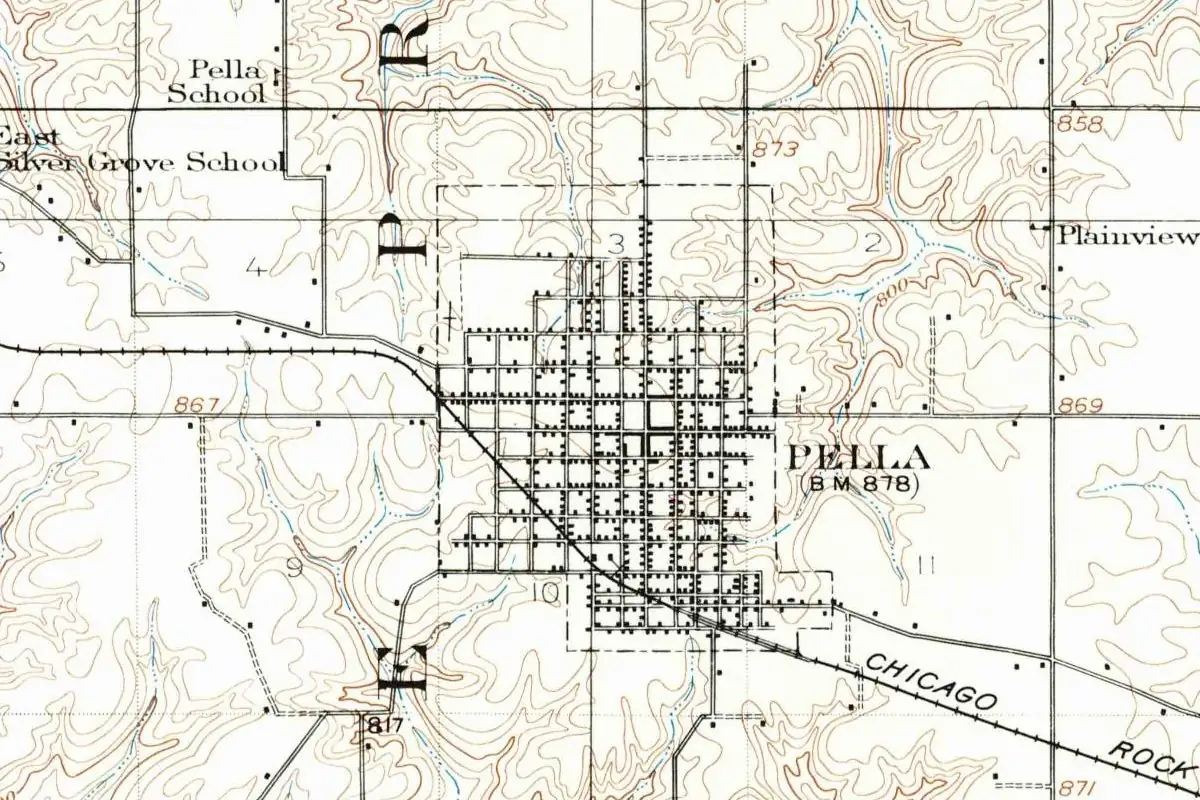
Pella, Iowa, is named for an ancient city of refuge. Its founder, a Dutch minister who’d broken with his country’s national church, picked it in 1848 for a colony of emigrants, and the street names on his town plat read almost like a sermon.
Scholte’s colony
Hendrick P. Scholte was a minister, born in Amsterdam in 1805. The 1915 History of Marion County says that in 1835 he and a group of other ministers walked out of the Netherlands’ national church and started their own. The church synod and the Dutch government came down hard on them for a while. The county history is careful to add that faith wasn’t the only reason so many people left: Scholte had also seen how hard life was for the poor.
The group asked to settle on Java and was turned down. They looked at Texas, which seemed too hot, and Missouri, which allowed slavery. Iowa won. In April 1847 more than seven hundred colonists sailed from Rotterdam and Amsterdam on four ships, landed at Baltimore, and made their way to St. Louis. Scholte and two others went ahead and found a prairie between the Skunk and Des Moines rivers.
Why “Pella”
The town was laid out in May 1848, and Scholte became its postmaster. The county history explains the name in two sentences: “The name of the town (Pella) is derived from a Hebrew word which signifies a city of refuge. It was the name of a small town in Palestine and was chosen by the proprietor because it offered an asylum to the people of his native land.” Henry Gannett’s 1905 federal list puts it a little more carefully: the Dutch settlers, it says, chose a word that to them meant “city of refuge.”
Scholte’s town plat says a lot about how he saw the place. The avenues, listed from east to west, were Hazel, Entrance, Inquiring, Perseverance, Reformation, Gratitude, Experience, Patience, Confidence, Expectation, Accomplishment, and West End. Some of those names have since been changed.
In 1871 the president of the town’s college, Central University of Iowa, worked the name into his inaugural address. Pella, he said, was “the name of the city of refuge to which the Christians fled when Jerusalem was being destroyed, and also the name of the capital of Macedonia, the birthplace of Alexander the Great.” You’ll notice he was describing two different ancient Pellas, and he was happy to claim both.
Straw Town
The refuge didn’t look like much at first. The U.S. Geological Survey’s database of place names says Pella “was known as Straw Town for a long time because the first improvised houses of the Dutch colony there were built of straw.” The county history describes sod houses dug a few feet into the ground and roofed with tall prairie grass, and some families lived in them for two winters.
It also tells about one night when a hungry ox mistook a sod house for a haystack, climbed onto the roof, and crashed through onto the family sleeping below. Everybody got out fine, the ox included. If you want a picture of Pella’s first years, that’s a good one.
Sources & further reading
- John W. Wright and W. A. Young, eds., History of Marion County, Iowa, and Its People, vol. 1 (1915). The 1848 plat and the avenue names (p. 147); the post office, the name and its meaning, and Scholte’s birth (p. 148); the 1835 church split and the reasons for leaving (p. 149); the 1847 voyage and the prairie (p. 150); the sod houses and the ox, a story the book takes from an earlier local writer named Donnel (pp. 150-151); President Dunn’s 1871 address (p. 266).
- Henry Gannett, The Origin of Certain Place Names in the United States (USGS, 1905), p. 240. “Colonized by Dutch settlers, to whom the word meant ‘city of refuge.’”
- GNIS feature 460063 (U.S. Geological Survey). The Straw Town nickname, founded 1848, incorporated 1868.
Spot something wrong, or know more? Tell us here. You can also email us or use our contact page. Corrections are noted here with their date, never made silently.