St. Joseph, Missouri: The Fur Trader or the Saint?
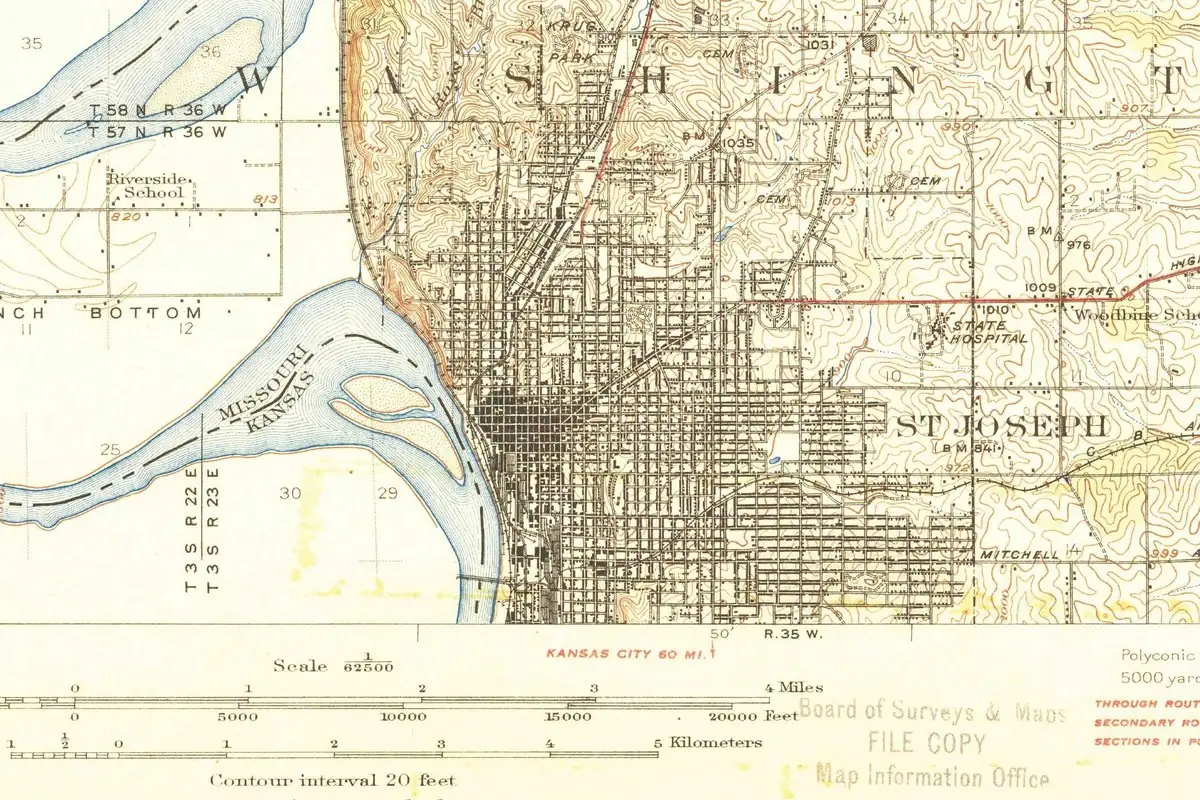
Fur trader Joseph Robidoux named St. Joseph, Missouri, in 1843. Local histories say he named it for himself; a 1911 encyclopedia says for his patron saint. The old county books have the stronger case, but the saint story is older than you might think.
Two maps, two names
Before it was a town, the place was the Blacksnake Hills, a trading post at the mouth of Blacksnake Creek. Chris L. Rutt’s 1898 history of Buchanan County says Robidoux, a trader of French parentage born in St. Louis, landed just above the hills in the fall of 1826 to trade for the fur company, moved to the creek’s mouth the next spring, and by 1830 owned the post himself.
By late 1842 the people at the Hills were pushing to have the county seat moved there, and Robidoux decided to make a town of it. Rutt says he had two rival surveyors, Frederick W. Smith and Simeon Kemper, each draw a plat. “Smith named his plat St. Joseph and Kemper named his Robidoux.” Robidoux picked Smith’s, and it was recorded in St. Louis on July 26, 1843. So you could just as easily be reading about Robidoux, Missouri.
An 1881 county history muddles one detail: its wording pairs Smith with “Robidoux” and Kemper with “St. Joseph,” the reverse of Rutt. But it agrees that Smith’s map was the one picked and that “the more civilized and felicitous appellative of St. Joseph was substituted for that of Blacksnake Hills.” It also adds a twist: both names, it says, were given “in honor of its founder.” So by that account, both names pointed at the same man.
The trader or the saint?
This is where the books part ways. The 1882 History of Pettis County, in its overview of the state, took the trader’s side and said so plainly: Robidoux “laid out the city, which was called St. Joseph in his honor, and not, as is commonly supposed, in honor of the Saint Joseph of the church calendar.” Henry Gannett’s 1905 list for the U.S. Geological Survey also says the city was “named for Joseph Robidoux, an early French settler,” the federal GNIS record repeats Gannett’s line, and David W. Eaton’s Missouri place-names series in 1916 has it as “named for Joseph Robideaux,” spelling and all.
The Encyclopaedia Britannica tells it the other way. Its 1911 edition says that “in 1843 Robidoux laid out a town here and named it St Joseph in honour of his patron saint.” So if you grew up hearing about the saint, you’re not making it up: the story was common enough in 1882 for a Missouri history to argue with it, and a major encyclopedia printed it in 1911.
Which version holds up better? The trader, by the weight of the record. The 1881 book is a local history of Buchanan County that knows the plats, the surveyors, and the recording date, and it says both proposed names were “in honor of its founder.” Rutt’s 1898 history tells the plat story in the same detail, though it doesn’t say whom the name honors. The 1882 history goes out of its way to reject the saint. The Britannica entry is a single sentence with no source and no detail about how the name was picked. One more thought, and this is our reading, not any source’s: the two stories don’t fully cancel out. A man named Joseph naming a town St. Joseph could have had both in mind. None of these sources says so, though.
His family on the street map
Robidoux didn’t stop at the town’s name. Rutt says he named the streets running back from the river Water, Levee, First, and so on, and the cross streets “after members of his family, beginning with Robidoux, then Faraon, Jules, Francis, Felix, Edmond, Charles, Sylvanie, Angelique and Messanie.” Rutt’s own book places Robidoux’s second house at the corner of Main and Jule streets, so the family names were in everyday use by then.
Sources & further reading
- The History of Buchanan County, Missouri (1881), pp. 404–405. The two maps by F. W. Smith and Simeon Kemper, both names “in honor of its founder,” St. Joseph replacing Blacksnake Hills, and Robidoux’s declaration of July 26, 1843.
- Chris L. Rutt, The Daily News’ History of Buchanan County and St. Joseph, Mo. (1898), pp. 77–80. Robidoux’s background, the post at the Blacksnake Hills from 1826, the rival plats (“Smith named his plat St. Joseph and Kemper named his Robidoux”), the recording on July 26, 1843, the street names, and Robidoux’s house at Main and Jule streets.
- The History of Pettis County, Missouri (1882), p. 111. “Called St. Joseph in his honor, and not, as is commonly supposed, in honor of the Saint Joseph of the church calendar.”
- David W. Eaton, “How Missouri Counties, Towns and Streams Were Named,” Missouri Historical Review, vol. 10 (1916), p. 264. “Named for Joseph Robideaux, an early French trader and settler.”
- Henry Gannett, The Origin of Certain Place Names in the United States (USGS, 1905), p. 271. “Named for Joseph Robidoux, an early French settler.”
- Encyclopaedia Britannica, 11th ed. (1911), vol. 24, “Saint Joseph,” p. 20. The patron-saint version: Robidoux “named it St Joseph in honour of his patron saint.”
- GNIS feature 730205 (U.S. Geological Survey). Gannett’s line, repeated in the federal record.
Spot something wrong, or know more? Tell us here. You can also email us or use our contact page. Corrections are noted here with their date, never made silently.