Sedalia, Missouri: Named for a Girl Called "Sed"
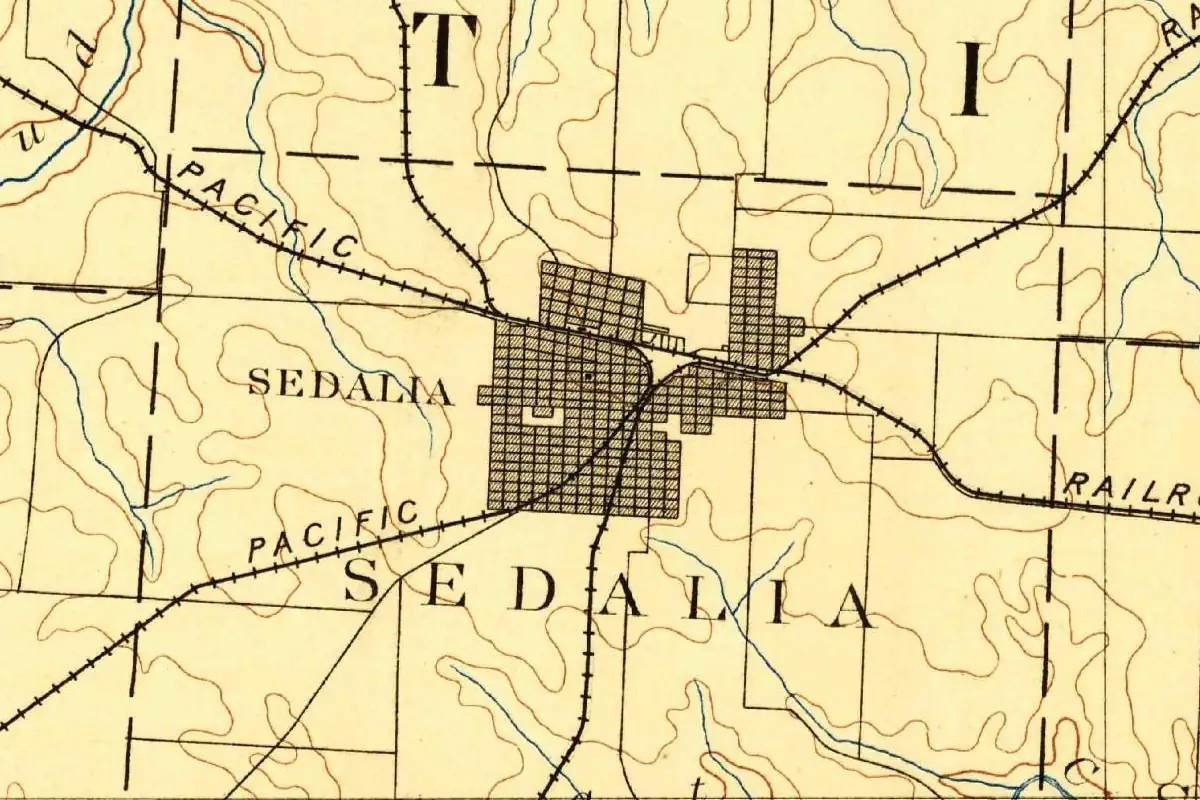
Sedalia, Missouri, began on paper as Sedville, named for the founder’s youngest daughter, Sarah, whose family called her “Sed.” A few years later the “ville” was swapped for something fancier, and Sedville became Sedalia.
A railroad town for Georgetown’s loss
The founder was Gen. George R. Smith. A 1917 piece in the Youth’s Companion, which David W. Eaton reprinted in his survey of Missouri place names, says Smith lived at Georgetown, about three miles north of today’s Sedalia, and had a hand in building the Missouri Pacific Railway. When he couldn’t get his neighbors to bring the line through Georgetown, he bought land beside the tracks and laid out a town of his own.
The county’s 1882 history gives the paperwork. On November 30, 1857, Smith filed the plat of a town called Sedville, “in honor of Gen. Smith’s youngest daughter, Sarah E. Smith, still living, whose pet or nick-name was ‘Sed.,’ an inexplicable corruption of Sarah or Sallie.” For about three years, the book says, the town “existed still only on paper.”
From Sedville to Sedalia
On October 16, 1860, Smith and Col. David W. Bouldin filed a new plat, this time called Sedalia, and it took in all of the old Sedville. Why the change? The 1882 history makes a guess: “Sed” could be joined to “the more euphonious termination ‘alia’, like Van-dalia, Cent-ralia, et cetera.”
The Youth’s Companion tells it with a name attached. A friend of Smith’s, Josiah Dent of St. Louis, “suggested that ‘ville’ was a commonplace termination, and that Sedalia would be a more beautiful and unusual name.” Smith liked it. You can take your pick, but both stories land in the same place: Sed plus a nicer ending.
Sedville or Sadieville?
There’s one wrinkle if you look the town up in Henry Gannett’s 1905 place-names book for the U.S. Geological Survey. Gannett calls Sedalia “A modification of the original name Sadieville,” named for Smith’s daughter. The plat filed in 1857, as the county history describes it, says Sedville, and so does the Youth’s Companion. The daughter is the same in every version. Only the spelling of her first town wanders.
Smith didn’t go unremembered either. Eaton lists another Pettis County town, Smithton, platted in 1859 and “named in honor of Gen. George R. Smith.” And Georgetown, the town Smith gave up on, lost more than the railroad: Eaton says it was the county seat until the seat moved to Sedalia.
Sources & further reading
- The History of Pettis County, Missouri (1882), pp. 404–405. The Sedville plat of November 30, 1857, Sarah E. Smith and her nickname, the Sedalia plat of October 16, 1860, with Bouldin, and the “alia” explanation.
- David W. Eaton, “How Missouri Counties, Towns and Streams Were Named,” Missouri Historical Review, vol. 11 (1917), pp. 339–340. The reprint of “How Sedalia Was Named” from the Youth’s Companion, January 4, 1917, with Georgetown, the railroad, and Josiah Dent’s suggestion; also Smithton and Georgetown as the old county seat.
- Henry Gannett, The Origin of Certain Place Names in the United States (USGS, 1905), p. 279. The “Sadieville” version.
- GNIS feature 729812 (U.S. Geological Survey). The federal record for Sedalia.
Spot something wrong, or know more? Tell us here. You can also email us or use our contact page. Corrections are noted here with their date, never made silently.