Kansas City, Missouri: The Town That Almost Was Port Fonda
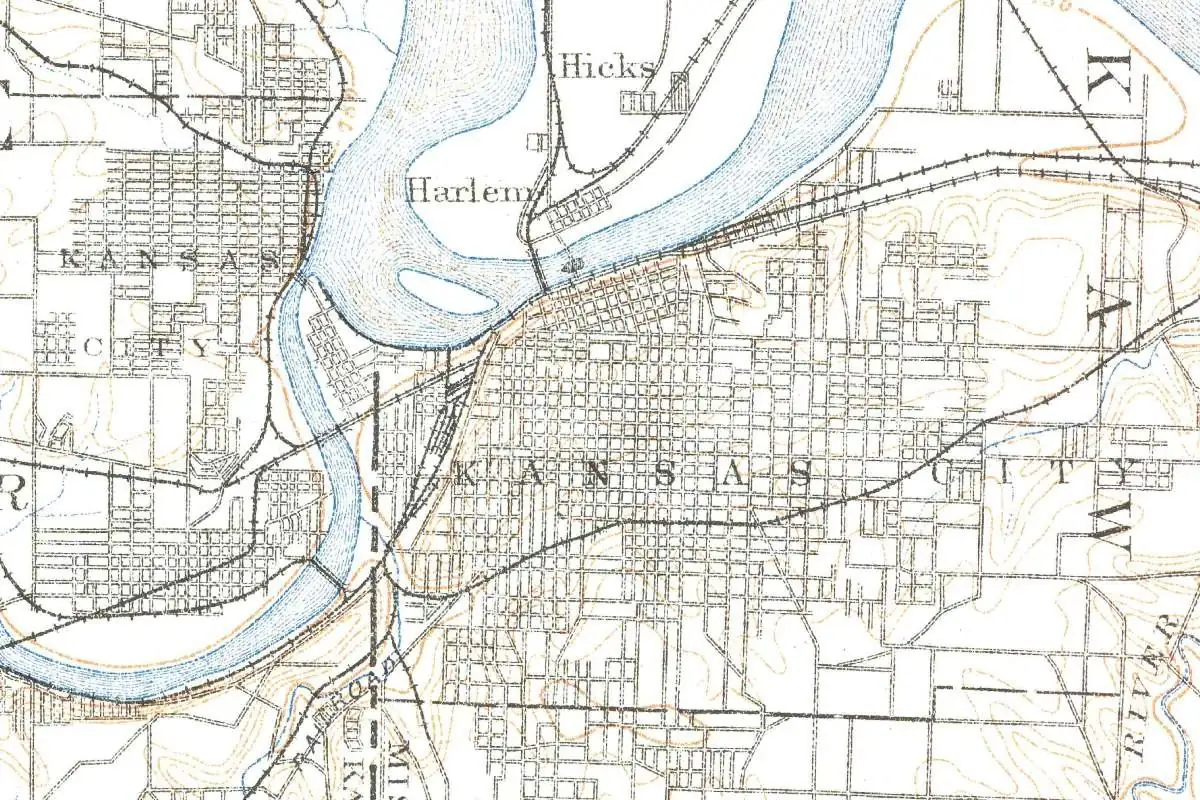
Kansas City, Missouri, almost became Port Fonda. Its founders called it Kansas in 1838, years before there was a Kansas Territory to borrow the name from.
A quarrel kills Port Fonda
In 1838 the land at the river landing belonged to the estate of Gabriel Prudhomme, a Frenchman who had died two years earlier. A group of Jackson County men formed a town company and bought the tract at auction for $4,220. Carrie Westlake Whitney tells what happened next in her 1908 history of the city. Some of the partners wanted to call the place “Port Fonda,” after Abraham Fonda, one of the owners. “Unfortunately for his fame,” she writes, Fonda got into a quarrel with another part owner, Henry Jobe, “who, with his friends, defeated the proposition to adopt the name Port Fonda.”
So they went with the river. “The proprietors decided to call the town ‘Kansas’ after the Kansas river,” Whitney says, and the river had been named for the Kansas Indians who lived along it. Henry Gannett’s 1905 list of place names for the U.S. Geological Survey files Kansas City under the same entry as the state and the river: “Named for an Indian tribe.” That tribe was the Kansa, also called the Kaw. What their name means is a separate puzzle, and we dig into it in How Kansas Got Its Name.
“Stealing the name Kansas”
By the late 1850s, people in the new Kansas Territory were grumbling that the Missouri town had swiped their name. Charles C. Spalding answered them in his Annals of the City of Kansas in 1858, and Whitney quotes him. When the town site was surveyed in 1838, he wrote, the owners agreed to call it Kansas “inasmuch as it was situated at the mouth of the Kansas river. Some suggested the name of ‘Kawsmouth’; but it was finally agreed that the name of the place should be Kansas.”
His point was simple: “no such Territory was known in the geography of our country till Kansas City had come to be a place of considerable trade.” Whitney dates the organizing of Kansas Territory to May 30, 1854. If anything, the town had the name first.
Westport Landing, Town of Kansas, City of Kansas
The name didn’t stick right away. W. H. Miller’s 1881 history says the rival towns of Independence and Westport nicknamed the place “Westport Landing” in derision, and because the town barely grew for years, a lot of people called it that. If you read Miller’s early chapters, you’ll run into “Westport Landing” more than once.
On paper, the name kept changing shape. David W. Eaton’s survey of Missouri place names, published in the Missouri Historical Review in 1917, says the first plat was the “Town of Kansas” in 1839, that the legislature changed it to the “City of Kansas” in 1853, and that it became “Kansas City” in 1889. Whitney has the same 1853 and 1889 dates and adds that “Town of Kansas” became the official name in 1850. So the city you know as Kansas City has only officially carried that exact name since 1889, about half a century after the founders settled on Kansas.
Sources & further reading
- Carrie Westlake Whitney, Kansas City, Missouri: Its History and Its People, 1808–1908, vol. 1 (1908). Prudhomme’s death in 1836 (p. 88); the Prudhomme sale, the town company, Port Fonda, Henry Jobe, and the quotation from Spalding’s 1858 Annals (pp. 91–92); the name changes of 1850, 1853, and 1889 (p. 109); Kansas Territory organized May 30, 1854 (p. 130).
- W. H. Miller, The History of Kansas City (1881). The company’s $4,220 purchase, the town “which they called Kansas,” and the “Westport Landing” nickname (pp. 29–30).
- David W. Eaton, “How Missouri Counties, Towns and Streams Were Named,” Missouri Historical Review, vol. 11 (1917), p. 177. Town of Kansas (1839), City of Kansas (1853), Kansas City (1889), and the name from the river and the tribe.
- Henry Gannett, The Origin of Certain Place Names in the United States (USGS, 1905), p. 172. Kansas City listed with the state and river: “Named for an Indian tribe.”
- GNIS feature 748198 (U.S. Geological Survey). The federal record for Kansas City, Missouri.
Spot something wrong, or know more? Tell us here. You can also email us or use our contact page. Corrections are noted here with their date, never made silently.