Topeka, Kansas: A Name Its Founders Couldn't Translate
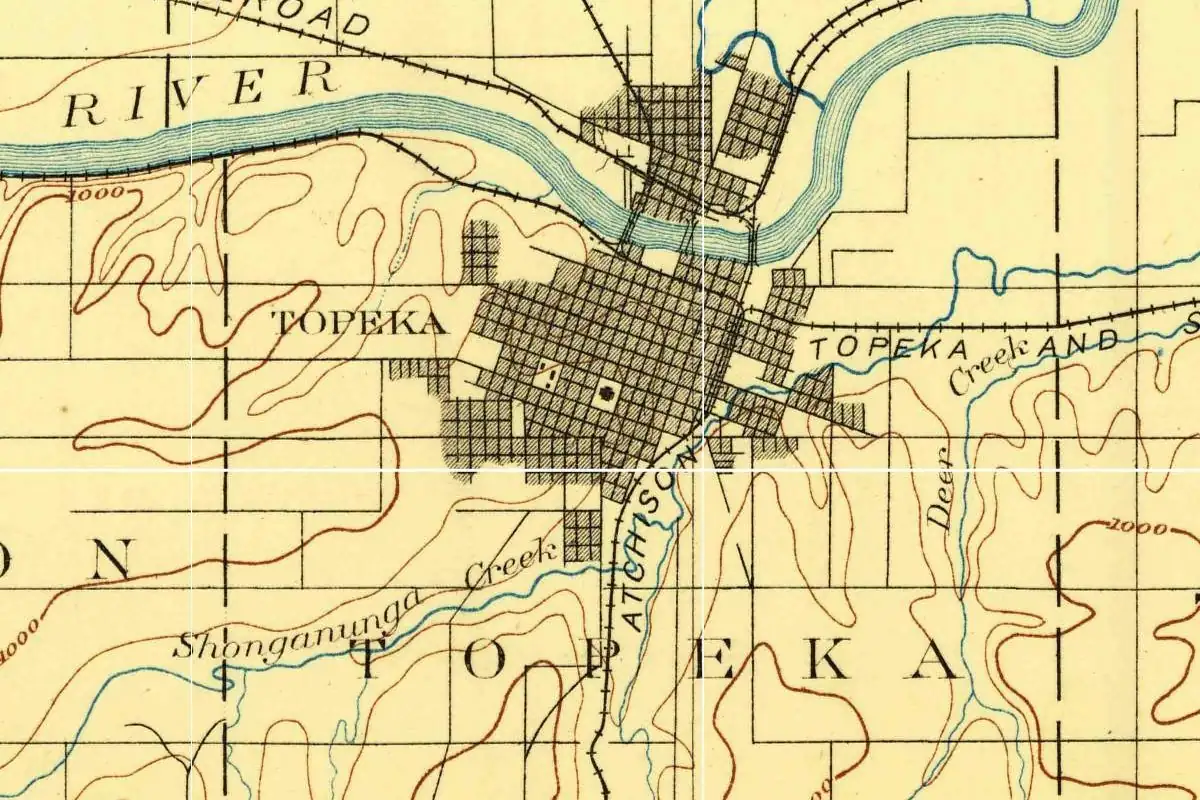
When F. W. Giles proposed the name Topeka, Kansas, in January 1855, he couldn’t say what the word meant. The explanations that came later all point to wild potatoes, and the most detailed one reads it as a good place to dig them.
A name nobody in the room had heard
The town was about a month old and still had no name. Giles, one of its founders, wrote the story down in Thirty Years in Topeka (1886). The free-state settlers worried that their pro-slavery neighbors would stick their new town with an insulting nickname, so the town association set the evening of January 1, 1855, for each member to offer a name. They talked it over that night and got nowhere.
The next evening, one man brought a word nobody knew. He “could neither give its derivation nor its signification,” Giles wrote, but it wasn’t on the list of U.S. post offices or in any English dictionary. That man was Giles himself. He’d heard the word that same day, January 2, from the Rev. S. Y. Lum. The big state history A. T. Andreas published in 1883 agrees that “the name was suggested by Mr. Giles.”
Part of the appeal was the spelling. Topeka has three consonants and three vowels, taking turns. “No one seeing it could fail of the proper pronunciation,” Giles wrote, and no one hearing it “could fail to know its orthography.” The name, he says, was “soon adopted with unanimity.”
Potatoes, but in whose language?
Once the town had the name, people wanted to know what it meant. You’ll find several answers in the old books, and they don’t all agree on the language.
- Giles reports that Col. W. A. Phillips, a former congressman, linked it to a Potawatomi word, “Topheika,” meaning “mountain potato.”
- He also says the families of mixed Kansa descent living across the river told the settlers the bottomlands there were known to the tribe as “To-pe-ka,” because it was a good place to gather the wild potato.
- John B. Dunbar, a former professor of languages at Washburn College, gave Giles the most detailed breakdown. He read it as three words shared by the Iowa, Omaha and Kansa languages: to, wild potato; pe, good; and okae, to dig. Put together, “a good place to dig potatoes.” He said the Iowas and Omahas often used it as a name for the Kansas River itself.
- Andreas calls it simply “the Indian word for wild potato.” Henry Gannett’s 1905 federal list of place names says it’s “Said to be the Sioux or Omaha Indian name for the so-called ‘Indian potato.’”
The Kansas State Historical Society’s list of city names, prepared for the U.S. Geological Survey and printed in 1902, went with Dunbar’s reading: “a good place to dig potatoes,” the root of a kind of sunflower that grew on the Kansas River lowlands. Dunbar called the plant the wild artichoke. In springs when food ran short, he said, the Kansa, the Iowa and other tribes came to this stretch of the valley and lived for weeks on what they could dig.
So all the versions come back to wild potatoes. What they don’t settle is whose word it was. Those are 19th-century analyses, and this article doesn’t rely on a modern linguist to confirm them. If you want the backstory of the state’s own name, it’s in How Kansas Got Its Name.
Two wrong turns
Giles had to knock down two other stories. A history by Halloway credited a Mr. Webb of the New England Emigrant Aid Society with suggesting the name. Giles called that “entirely wrong” and said Webb had nothing to do with founding the town.
Other people noticed that Topeka looks a lot like Tohopeka, the Alabama site of Andrew Jackson’s 1814 Battle of the Horseshoe. The Kansas State Historical Society asked B. F. Meek, president of the Alabama Historical Society, about it. His answer, which Giles printed, was that there could be no connection. Tohopeka, he said, comes from a different language family and means “barricade or fortification,” after the log breastwork the defenders built.
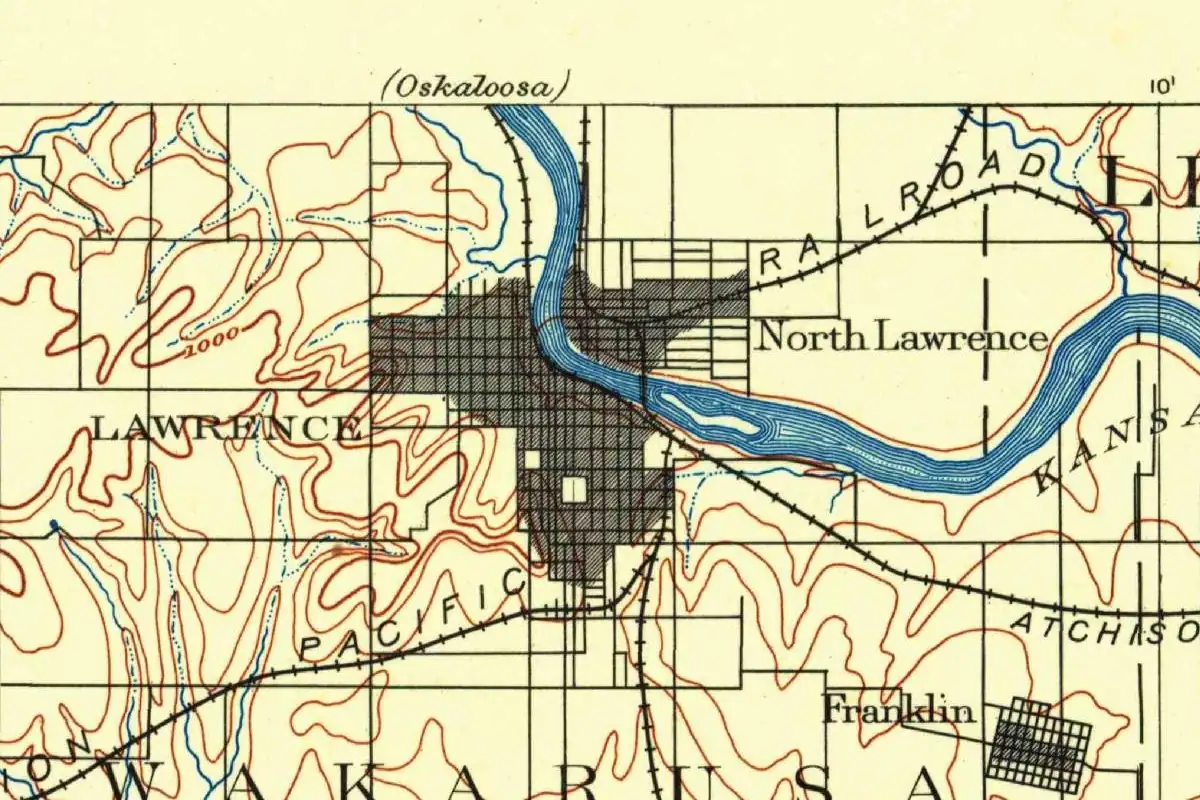
One more thing you might not expect: Giles and his party didn’t come straight to the site. According to Andreas, they walked from Kansas City to Lawrence, met with the free-state leaders there, and only then headed “up the Kaw” in December 1854 to look at the spot. Lawrence had gone through its own naming debate just a few months earlier.
Sources & further reading
- F. W. Giles, Thirty Years in Topeka (1886), pp. 51–55. The meetings of January 1 and 2, 1855, the name he heard from the Rev. S. Y. Lum, the spelling argument, Phillips’s Potawatomi reading, what the Kansa families said, Dunbar’s breakdown, and the Webb and Tohopeka stories.
- A. T. Andreas, History of the State of Kansas (1883), Shawnee County, pp. 539–540. The trip from Lawrence “up the Kaw,” the town company, and “the Indian word for wild potato,” suggested by Giles.
- Kansas State Historical Society, “Origin of City Names,” Collections, vol. 7 (1902), p. 485. “A good place to dig potatoes,” credited to Dunbar.
- Henry Gannett, The Origin of Certain Place Names in the United States, 2nd ed. (USGS, 1905), p. 302. The “Sioux or Omaha” reading.
- GNIS feature 485477 (U.S. Geological Survey). The federal record for Topeka: founded in 1854, state capital in 1861.
Spot something wrong, or know more? Tell us here. You can also email us or use our contact page. Corrections are noted here with their date, never made silently.