How Wichita, Kansas Got Its Name From a Wartime Camp
Wichita, Kansas, is named for the Wichita people, who camped on the Little Arkansas River during the Civil War. What the word Wichita means is another question, and nobody has pinned it down.
Refugees at the mouth of the Little Arkansas
The Wichita weren’t settled there by choice. A. T. Andreas’s History of the State of Kansas (1883) says they and their allied tribes had been “driven from the Indian Territory” in the winter of 1861–62 and had made temporary homes in Woodson County, Kansas. Early in the spring of 1864, they moved west and set up camp at the mouth of the Little Arkansas River.
Andreas puts the naming plainly: “The name of their camp was Wichita, from which the present city of Wichita derived its name.” The people in that camp farmed large fields of corn and vegetables. They stayed until the fall of 1867, then went back south.
It wasn’t an easy stay. Andreas says many of them died in the cholera epidemic of 1866–67. The Handbook of American Indians, published by the Smithsonian’s Bureau of American Ethnology, adds that they went home “having lost heavily by disease and hardship.”
Jesse Chisholm came with them
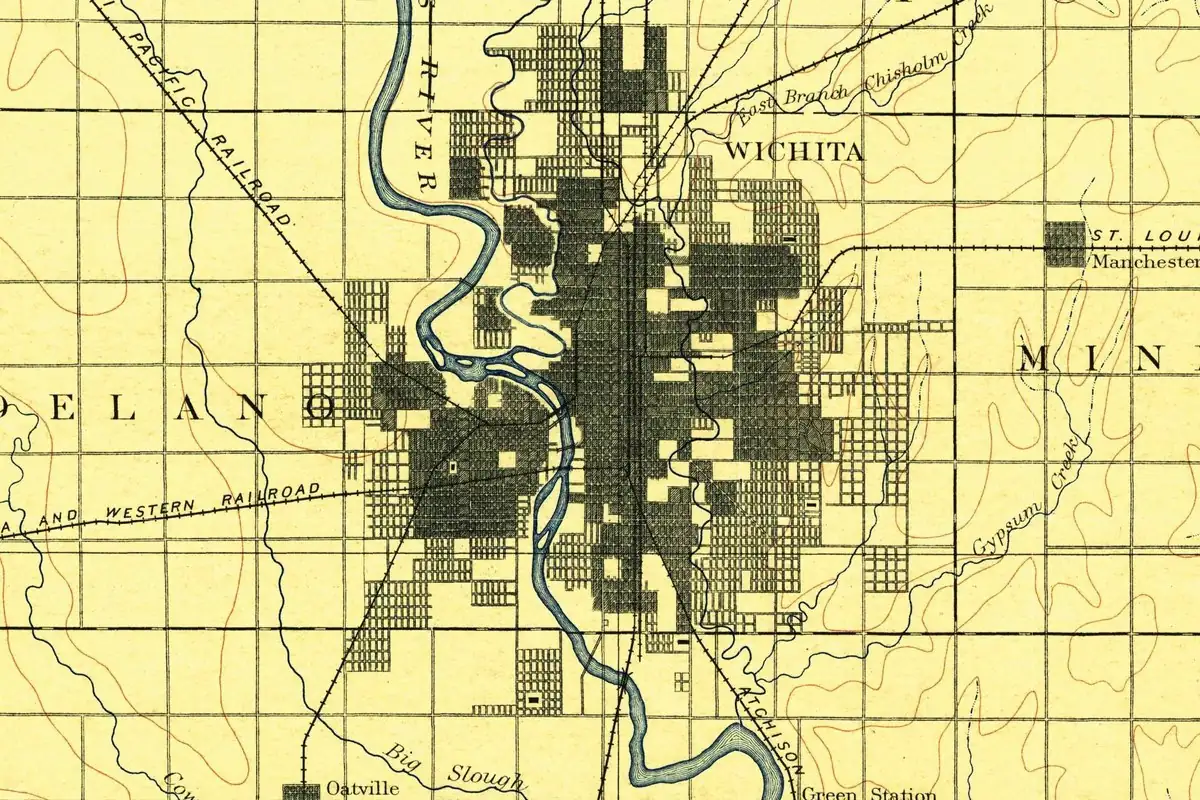
With the Wichita came Jesse Chisholm, whom Andreas describes as a Cherokee of mixed descent and “an adopted member of the Wichitas.” He built his house on a creek east of the town site, and the creek took his name. You can see it on the 1889 government map above, marked East Branch Chisholm Creek. In 1865 he marked out a trail from his ranch south to the Wichita Agency in Indian Territory, about 220 miles. That route became the Chisholm Trail.
The town itself came after the Wichita left. A town company organized in 1868, and Andreas says some of the Wichitas’ teepees were still standing on land north of the city as late as 1871. The Kansas State Historical Society’s 1902 list of city names sums it up in one line: the city is named “For a band of Wichita Indians, who came with Jesse Chisholm in 1864.”
What does “Wichita” mean?
This is where the old books stop agreeing, as you’ll see.
- Henry Gannett’s 1902 federal list of place names said the tribal name meant “white man.” When he put out the second edition in 1905, that meaning was gone. The entry just says the places were “Named for the Indian tribe.”
- Frank Blackmar’s 1912 Kansas: A Cyclopedia of State History said the word means “Scattered Lodges,” and added that “for a long time the little town lived up to its appellation.”
- The Smithsonian’s Handbook takes the most cautious line. It says the name is “of uncertain origin and etymology.”
The Handbook also points out that Wichita isn’t what the people called themselves. Their own name is Kitikiti’sh, which it says is also of uncertain meaning. Neighboring tribes and French traders had other names for them, many of them referring to their tattoos.
So the city’s name comes from a people and a camp, and that part is well documented. The translation you’ll sometimes see attached to it isn’t.
Sources & further reading
- A. T. Andreas, History of the State of Kansas (1883), Sedgwick County, pp. 1385 and 1389. The removal from Indian Territory, the 1864 camp called Wichita, Jesse Chisholm and the creek and trail named for him, the cholera of 1866–67, the 1868 town company, and the teepees still standing in 1871.
- Frederick Webb Hodge, ed., Handbook of American Indians North of Mexico, part 2 (Bureau of American Ethnology, 1912 impression), pp. 947–949. The name’s “uncertain origin and etymology,” the people’s own name, Kitikiti’sh, and their wartime refuge in Kansas until 1867.
- Kansas State Historical Society, “Origin of City Names,” Collections, vol. 7 (1902), p. 486. “For a band of Wichita Indians, who came with Jesse Chisholm in 1864.”
- Frank W. Blackmar, ed., Kansas: A Cyclopedia of State History, vol. 2 (1912), p. 912. The “Scattered Lodges” translation.
- Henry Gannett, The Origin of Certain Place Names in the United States, 1st ed. (USGS, 1902), p. 272, and 2nd ed. (USGS, 1905), p. 324. The “white man” meaning in 1902 and its absence in 1905.
- GNIS feature 473862 (U.S. Geological Survey). The federal record: founded in 1868, incorporated in 1870.
Spot something wrong, or know more? Tell us here. You can also email us or use our contact page. Corrections are noted here with their date, never made silently.