How Normal, Illinois Got Its Name From a Teachers' School
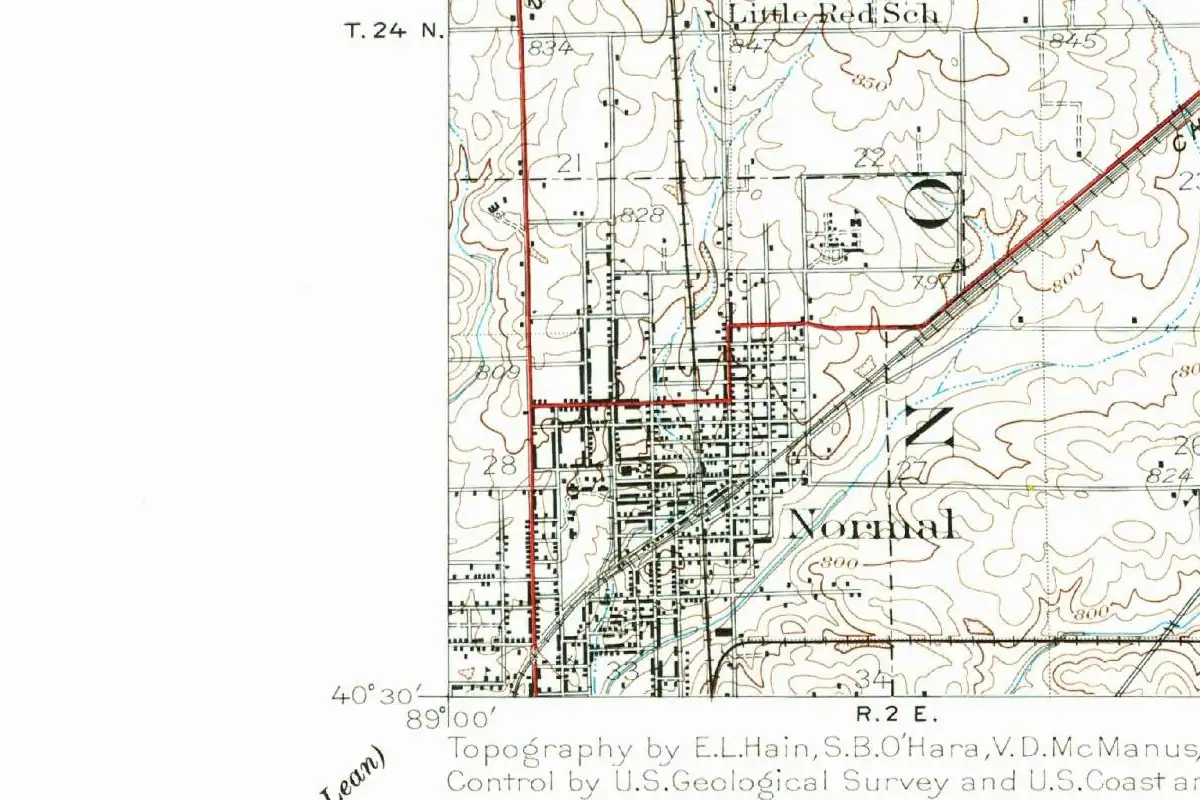
Normal, Illinois, is named for a school, not for being ordinary. The railroad stop called North Bloomington took the name of the new State Normal University, which the state set up to train teachers.
A town site without a town
Before the name, there was a railroad crossing. Jacob Hasbrouck’s 1924 history of McLean County says that when the crossing of two new railroads, the Illinois Central and the Chicago & St. Louis, was fixed north of Bloomington, the spot “was first called the ‘Junction,’ and later North Bloomington.” Lots went on sale on June 15, 1854, and the man behind the new town was Jesse W. Fell.
It wasn’t much to look at. The 1879 county history says North Bloomington in 1857 was “barely started,” “a town site without a town,” and that before 1855 it had exactly one inhabitant, the railroad agent at the crossing. If you’d asked for directions back then, you could have used either name, since people called it “indiscriminately by its proper name, or the ‘Junction.’”
Jesse Fell’s plan
Fell wanted more than a crossing. At that 1854 sale, Hasbrouck says, one block was already labeled “Seminary Block.” Fell was a strong temperance man, and he wrote into every deed that no liquor could be sold on the lot.
His chance came when the legislature passed a law on February 18, 1857, to create a state school for teachers. That’s the “normal” in the name: Hasbrouck calls it “the normal training school” and describes it as “a state institution for the training of teachers.” Fell and others raised money and made a bid for North Bloomington. It beat Peoria, the closest competitor, and the State Normal University was located there on May 7, 1857, according to the 1879 history. Hasbrouck adds that Fell had been planting trees for years, and that the committee picking the site liked what it saw.
North Bloomington becomes Normal
“In honor of the new school,” Hasbrouck writes, “the name of the Junction was changed from North Bloomington to Normal, and the township was likewise named. The change officially took place April 6, 1858.” The 1879 history gives the same date for the town’s “first existence.” Henry Gannett’s 1905 federal book of place names says it in one line: Normal is “so named because it is the seat of the State Normal School.”
You’ll find a different year in the federal place-names database, which says the current name was “adopted in 1865.” That’s seven years later than the date in both county histories, and neither of them mentions a name change in 1865. What both do record for that year is that Normal incorporated as a town: the 1879 history says the residents voted to do it on September 30, 1865. The same book says the village had only about 30 houses when the school building opened in the fall of 1860, and that Normal was a town of 1,000 people “as early as 1865.”
So a place that started as a junction and a few lots ended up with a name taken straight from a teachers’ school. The name came from the school, and most of the town grew up after the school did.
Sources & further reading
- Jacob L. Hasbrouck, History of McLean County, Illinois, vol. 1 (1924), pp. 113-114. The “Junction,” North Bloomington, Seminary Block, the no-liquor deeds, the bid against Peoria, the name change of April 6, 1858, and the town’s incorporation in 1865.
- The History of McLean County, Illinois (Wm. Le Baron, Jr., & Co., 1879). The school’s location on May 7, 1857, and the town’s start on April 6, 1858 (p. 425); the lot sale of June 15, 1854 (p. 426); North Bloomington as “a town site without a town” (p. 427); the town’s growth to 1,000 people by 1865 (p. 437); and the vote to incorporate on September 30, 1865 (p. 444).
- Henry Gannett, The Origin of Certain Place Names in the United States (USGS, 1905). “So named because it is the seat of the State Normal School.”
- GNIS feature 414548 (U.S. Geological Survey). Founded in 1854, incorporated in 1867, “Current name adopted in 1865.”
Spot something wrong, or know more? Tell us here. You can also email us or use our contact page. Corrections are noted here with their date, never made silently.