Muncie, Indiana: One Name, Four Translations
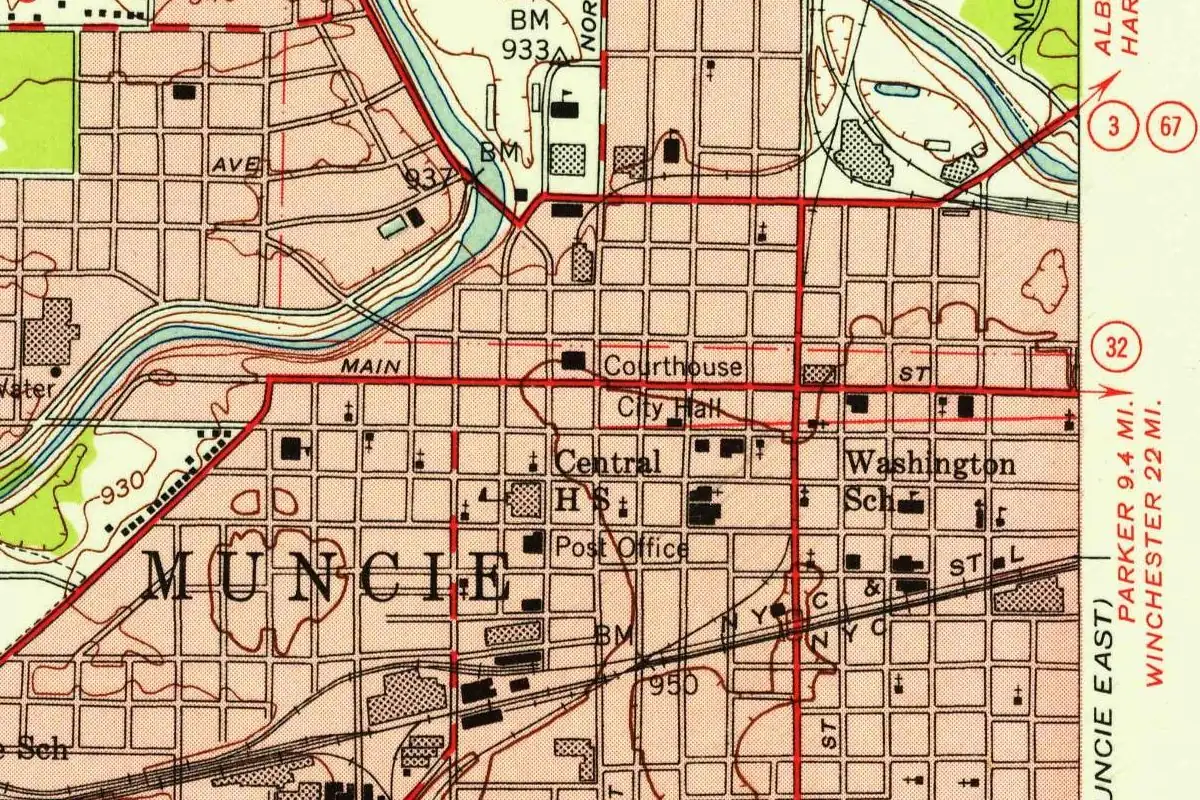
Old books give four different meanings for the word behind Muncie, Indiana, from “death” to “people of the stony country.” What they don’t argue about is where the name came from: the Munsee, a Delaware people who once had a town here. For its first couple of decades, the town wasn’t even Muncie. It was Muncietown.
A Delaware town on the White River
Jacob Piatt Dunn’s 1909 glossary of Indiana Indian names explains the start. The town was “originally known as Munseetown or Munceytown,” he wrote, because “there was a large town of the Delawares, mostly of the Munsee or Wolf clan, on the north side of the river at this point.” The Delawares, Dunn notes elsewhere in the glossary, call themselves Lenni Lenape. Their own name for the town wasn’t Munsee at all. It was Wah’-pi-kah-me’-kunk, which Dunn translates as “White River Town,” because it was the first Delaware town on the White River that travelers reached coming in on the trails.
Dunn also corrected a name you might see in older local histories. They said the town had once been called “Outainink,” meaning “Old Town.” Dunn says that’s a mix-up: the Delaware word uten-ink means “site of the town,” or “place where the town was,” and somebody mistook the description for a name.
Four answers for “Munsee”
The catch is the word itself. Henry Gannett’s 1902 list for the U.S. Geological Survey said Muncie came from the tribe’s name, “the word meaning ‘death,’ given to them on account of an epidemic of smallpox which nearly exterminated the tribe.” By the 1905 edition, Gannett had dropped that story. The new entry called the Munsee “a subtribe of the Delaware Indians formerly residing in Central Indiana” and said only, “It is said to refer to an ‘island.’”
Dunn had a different answer. He traced Munsee through older spellings like Monsey and Monthee back to Min’-si or Min’-thiu, “People of the Stony Country,” which he said referred to their old mountain home in the East. A 1908 history of Delaware County, edited by G. W. H. Kemper, gave a fourth reading, citing the federal Handbook of American Indians of 1906: “at the place where stones are gathered together.” The same book adds that this meaning has “of course, no relation to the city.” Dunn and the 1908 book at least agree on stones. Gannett’s two editions don’t even agree with each other.
The legislature trims a word
The town started out as Muncietown. Kemper’s history quotes the Muncietonian newspaper in 1837 saying it was laid out in 1827 and had 320 people, and its list of postmasters starts with the “Muncietown” office in 1828. “For nearly twenty years the county seat was known as Muncietown,” the book says, just as Anderson was Andersontown. Then the legislature shortened it. Not everyone was happy about that: in the Muncie Democrat of May 10, 1845, a writer “spoke regretfully of a late act of the legislature that changed the name to Muncie.”
So the “-town” went, and the Munsee stayed. If you want a single answer to what the name means, the books won’t give you one. What they agree on is who it’s for: a band of Delaware people who had a town on the White River, right where the city is now.
Sources & further reading
- Jacob Piatt Dunn, True Indian Stories, with Glossary of Indiana Indian Names (1909). Lenni Lenape (pp. 259-260); Munseetown, the Munsee or Wolf clan, Min’-si, “People of the Stony Country,” White River Town, and the “Outainink” mix-up (pp. 285-286).
- Jacob Piatt Dunn, Indiana and Indianans, vol. 1 (1919), p. 93. Dunn’s later entry for Muncie, with the same meaning.
- G. W. H. Kemper, ed., A Twentieth Century History of Delaware County, Indiana, vol. 1 (1908). The Munsee as the “Wolf tribe” and “at the place where stones are gathered together” (pp. 5-6); the 1837 description of Muncietown (pp. 105-106); the name change and the Muncie Democrat of 1845 (p. 108); the Muncietown post office of 1828 (p. 223).
- Henry Gannett, The Origin of Certain Place Names in the United States, 1st ed. (USGS, 1902), p. 186. The “death” and smallpox story.
- Henry Gannett, same title, 2nd ed. (USGS, 1905), p. 217. The revised entry: “It is said to refer to an ‘island.’”
- GNIS feature 439878 (U.S. Geological Survey). Location and county for Muncie. It has no note on the name.
Spot something wrong, or know more? Tell us here. You can also email us or use our contact page. Corrections are noted here with their date, never made silently.