Owensboro, Kentucky: From Yellow Banks to Rossboro to Owensboro
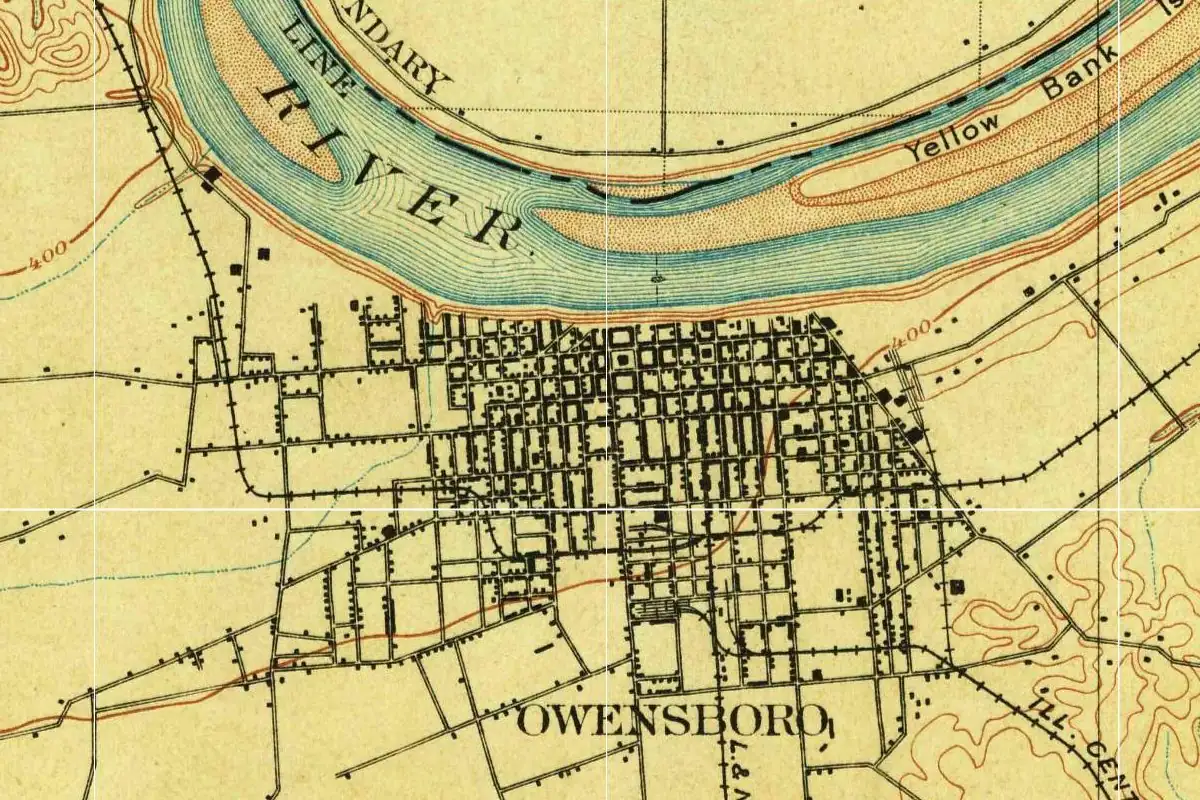
River travelers called the spot Yellow Banks, the 1816 town plat said Rossboro, and by 1818 it was Owensborough, for a colonel killed at Tippecanoe. Owensboro went through three names in a few years, and the first one was the hardest to shake.
Yellow clay on the Ohio
The 1883 History of Daviess County explains the oldest name plainly. Boatmen knew this stretch of the Ohio’s south bank as the “Lower” or “Big Yellow Banks,” usually shortened to Yellow Banks, from “the deep yellow color of the river bank, as it conspicuously exhibited itself to river travelers coming from either direction.” That bank of yellow clay, the book says, ran about six miles along the river.
The first cabin is credited to Bill Smothers, around the start of the 1800s. If that name rings a bell, it may be because Samuel Haycraft’s history of Elizabethtown describes a Bill Smothers in what’s now Daviess County as “a rollicking kind of outlaw.”
Rossboro, on paper
In 1815 the new county picked the site for its seat. The county surveyor, Capt. James W. Johnston, finished the first plat on March 23, 1816, and the commissioners and court approved it “with the name of Rossboro.” The land belonged to David Ross and other owners, with George Handley acting as their agent. The 1874 History of Kentucky by Lewis and Richard H. Collins agrees that the town was “originally called Rossborough.”
The colonel at Tippecanoe
Rossboro didn’t last. The county history dates the change to “probably” April 1818, and the evidence is a nice bit of detective work: in an old daybook kept by David Morton or his clerk, the page headings read “Yellow Banks” up to April 8 of that year, “and after that ‘Owensborough.’”
The new name honored Col. Abraham Owen, a Virginian who’d moved to Shelby County, Kentucky, in 1785 and was wounded twice at St. Clair’s defeat in 1791. In 1811 he joined Governor Harrison at Vincennes as an aide and fell at the Battle of Tippecanoe “at the side of his heroic chief.” Henry Gannett’s 1905 federal list and the GNIS record agree on Owen and Tippecanoe.
Here’s what you might not expect: the old name didn’t go quietly. The same county history says the post office was called Yellow Banks from its opening in 1818 or 1819 until 1837 or 1838, and the town “was scarcely known by any other name until about 1839 or ’40.” So for about twenty years, Owensborough was mostly a name on paper.
A county with a typo
Both of the men in the local names died at Tippecanoe. The county history says the Kentucky legislature went into mourning that December for “Colonel’s Daveiss, and Owen, and others who fell at Tippecanoe.” The county is named for the first of them, Joseph Hamilton Daveiss, and you’ll notice the spelling doesn’t match. The Collinses say it was named for him “although by some oversight not spelled as he spelled his name.” That’s how Owensboro ended up the seat of Daviess County, with the i and the e swapped.
Sources & further reading
- History of Daviess County, Kentucky (Inter-State Publishing Co., 1883). Bill Smothers and his cabin at the Yellow Banks (p. 65); “Lower” or “Big Yellow Banks,” the yellow clay, the 1816 plat “with the name of Rossboro,” David Ross and George Handley, the Morton daybook, the post office dates and “scarcely known by any other name” (p. 321); Abraham Owen’s life, his death at Tippecanoe and the legislature’s mourning (p. 322).
- Lewis Collins and Richard H. Collins, History of Kentucky, vol. 2 (1874). Daviess County named for Joseph Hamilton Daveiss but misspelled (p. 151); Owensboro “originally called Rossborough” (p. 152).
- Henry Gannett, The Origin of Certain Place Names in the United States (USGS, 1905). “Named for Col. Abraham Owen, of Kentucky, killed at Tippecanoe.”
- GNIS feature 500082 (U.S. Geological Survey). The same answer in the federal record.
- Samuel Haycraft, A History of Elizabethtown, Kentucky, and Its Surroundings (written 1869, published 1921), p. 23. Bill Smothers as “a rollicking kind of outlaw.”
Spot something wrong, or know more? Tell us here. You can also email us or use our contact page. Corrections are noted here with their date, never made silently.