Nashville, Tennessee: Which Nash Was It?
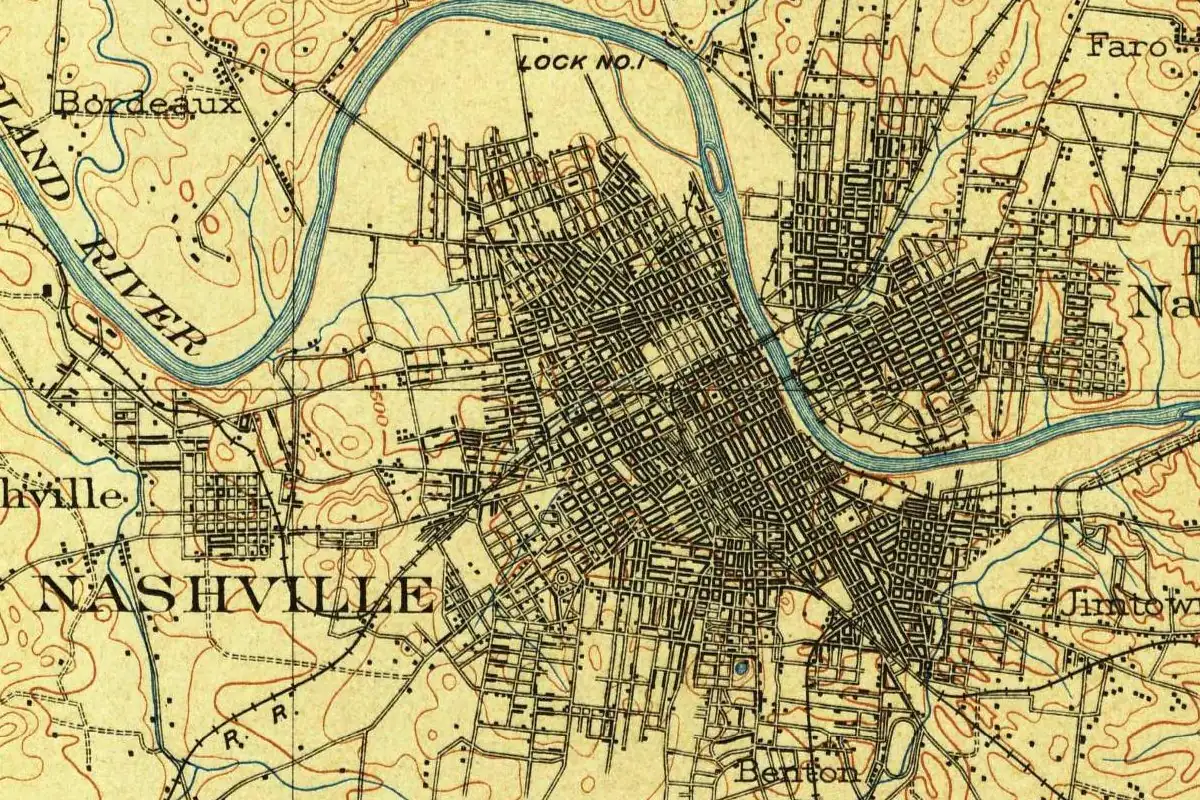
Henry Gannett’s 1905 place-name book said Nashville, Tennessee, honored Abner Nash, a governor, and only then mentioned General Francis Nash. The 1784 law that created the town is plainer: it says the place “shall be known and called Nashville, in memory of the patriotic and brave Gen. Nash.”
Two Nashes in one entry
Gannett’s book came out of the U.S. Geological Survey, and for Nashville it hedges. The city, he writes, was “named for Abner Nash, at one time governor of North Carolina. According to another authority it was named for Gen. Francis Nash.” The first edition of the same book, from 1902, had named only Gen. Francis Nash.
If you only had that page, you’d be stuck with a coin toss. But you don’t have to stop there. W. W. Clayton’s History of Davidson County, published in 1880, quotes the North Carolina act that set up the town, approved at the April session of 1784. The act calls him a general, and it says “in memory of.” Gannett’s other candidate, by his own description, was a governor.
A fort called Nashborough
The name is older than the town. Clayton says Capt. James Robertson led a company from the Holston country to the French Lick, a sulphur spring by the Cumberland River, and that they got there late in December 1779. When more settlers arrived in the spring of 1780, they built forts, and the main one stood on the bluff near a big spring. That post became headquarters, and “the name Nashborough was given to it in honor of Gen. Francis Nash, of North Carolina, who was mortally wounded at the battle of Germantown, October, 1777.”
You can still see the old name on the settlers’ own paperwork. A. W. Putnam’s 1859 history of Middle Tennessee prints the agreement the pioneers drew up for governing themselves, and it ends “Nashborough, 13th May, 1780.” Putnam also says the fort at the bluffs, “or Nashborough,” was picked as the main stronghold.
From borough to ville
Then North Carolina’s legislature made it official, and the “borough” became a “ville.” Clayton says the act ordered 200 acres on the south side of the Cumberland, “at a place called the Bluff, adjacent to the French Lick,” to be laid off in one-acre lots. Putnam marks the moment in his own way: “henceforth the place is no more Nashborough, but Nash-ville.” He dates the change to July 1784, a few months after the April session that Clayton gives for the act.
Clayton liked one detail enough to point it out. The county around the city is named for Gen. William Davidson, Gannett says, and Clayton notes that Nash and Davidson came from the same state, held the same rank and both fell in battle. In his words, their names “are therefore worthily associated in the metropolis and the metropolitan county of Tennessee.” That’s two fallen generals from the same state, and Tennessee’s capital wears both of them.
Sources & further reading
- W. W. Clayton, History of Davidson County, Tennessee (1880), p. 195. Robertson’s arrival at the French Lick in December 1779, the fort on the bluff, Nashborough named for Gen. Francis Nash, wounded at Germantown in October 1777, and the text of the 1784 act ending “in memory of the patriotic and brave Gen. Nash.”
- A. W. Putnam, History of Middle Tennessee (1859). The fort “at the Bluffs, or Nashborough” (p. 86), the settlers’ agreement dated “Nashborough, 13th May, 1780” (p. 100), and the change of name in July 1784 (p. 202).
- Henry Gannett, The Origin of Certain Place Names in the United States, 2nd ed. (U.S. Geological Survey, 1905). The Nashville entry that gives Abner Nash first and Gen. Francis Nash as the other authority’s answer (p. 220), and Davidson County named for Gen. William Davidson, “an officer of the Revolution” (p. 101). The first edition (USGS Bulletin 197, 1902, p. 188) gives Nashville, Tennessee, to Gen. Francis Nash alone.
- GNIS feature 1652484 (U.S. Geological Survey). The federal record for Nashville, capital of Tennessee.
Spot something wrong, or know more? Tell us here. You can also email us or use our contact page. Corrections are noted here with their date, never made silently.