Which Elizabeth? How Elizabethtown, Kentucky Got Its Name
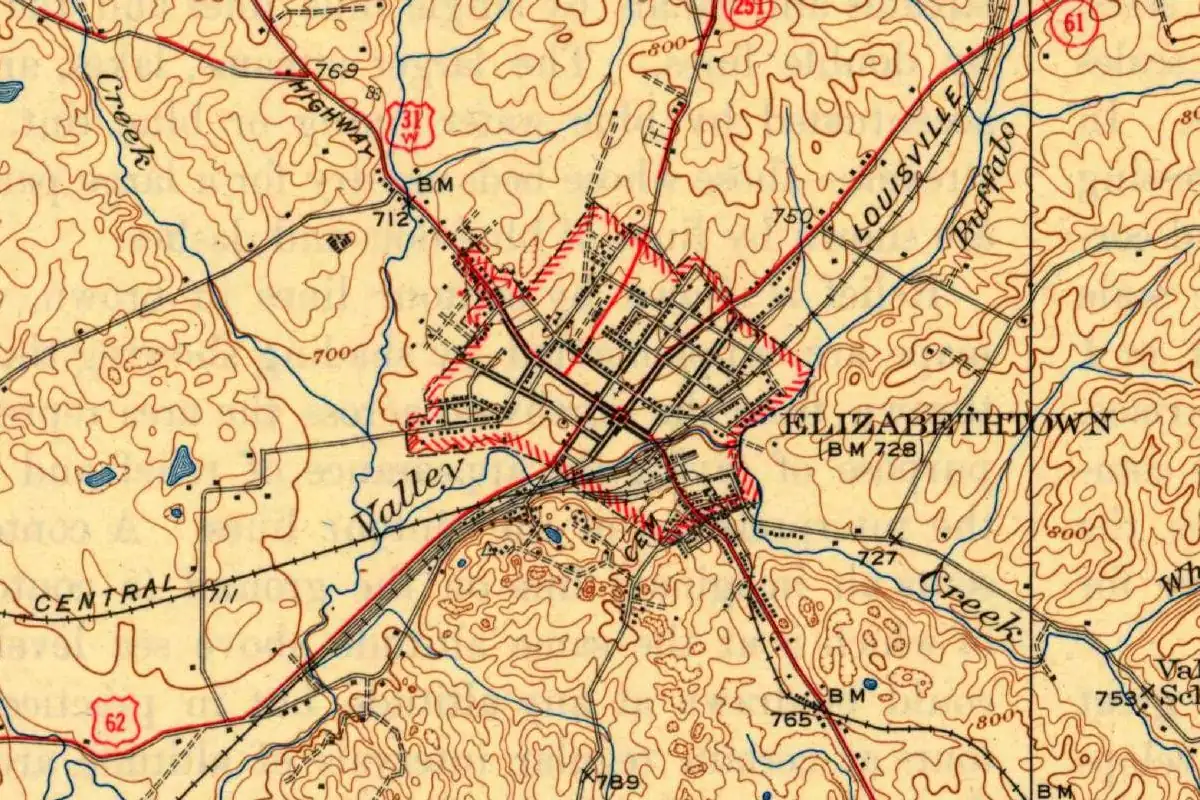
Ask which Elizabeth gave Elizabethtown, Kentucky, its name, and the answer depends on which old book you open. The town’s own early historian says she was Elizabeth Hynes, wife of the colonel who laid out the town. A federal list from 1905 says she was the wife of Col. John Hardin, the man the county is named for.
The colonel’s thirty acres
Three settlers got here first. According to the History of Kentucky that Lewis and Richard H. Collins published in 1874, in the fall and winter of 1780 Capt. Thomas Helm, Col. Andrew Hynes and Samuel Haycraft settled where Elizabethtown now stands and built three forts about a mile apart. When Hardin County needed a place for its public buildings, Hynes laid out 30 acres of his land for them in 1793, and he “called it Elizabethtown in honor of his wife’s Christian name.”
What the court record shows
The best witness is Samuel Haycraft, son of one of those three settlers, who wrote a history of the town for the Elizabethtown News in 1869. The town’s Woman’s Club published it as a book in 1921. Haycraft quotes the old county court records, and in the entries for the May 1795 term the court adjourns to its next session “to be held in Elizabethtown.”
“This is the first time that the place was designated as Elizabethtown,” he wrote. The name, he says, was given “in honor of the Colonel’s wife, Mrs. Elizabeth Hynes.” Two years later, at a court held on July 4, 1797, the justices made it official: the lots on “thirty acres of land, the property of the said Andrew Hynes,” would “be established and known by the name of Elizabethtown.”
The other Elizabeth
Henry Gannett’s 1905 book of place names for the U.S. Geological Survey tells it another way. His entry says the town was “named for the wife of Col. John Hardin, for whom the county was named.” He doesn’t give her first name, and he doesn’t mention Hynes at all.
So which is it? The Hynes version has a lot more going for it. It comes from a man who grew up in the town, it lines up with the court’s own wording about Hynes’s land, and the Collinses tell it the same way. Gannett’s book was a national list covering thousands of places, and his one line has nothing local behind it that we could find. If you’re keeping score, Elizabeth Hynes wins easily.
Fifty fistfights over a courthouse
Not everyone liked Hynes’s spot. The settlers on the Nolin wanted the county seat for themselves, and the Collinses say the quarrel lasted about ten years, “resulting in many hard words and harder fist-fights.” Haycraft, who remembered it as a boy, says that between 1794 and about 1803 the elections set off “at least fifty combats of fist and skull.” He once saw “about twenty couple fighting at once” at the end of Main Cross Street. By the time he wrote it all down, he could report that “these matters have long since been forgotten, feelings and friendly relations having been restored.”
Sources & further reading
- Samuel Haycraft, A History of Elizabethtown, Kentucky, and Its Surroundings (written 1869, published 1921). Haycraft as the son of a pioneer settler (preliminary note); the May 1795 court entry, “the first time that the place was designated as Elizabethtown,” and “Mrs. Elizabeth Hynes” (pp. 23–24); the fights between the Nolin and Valley settlements (pp. 24–25); the July 4, 1797 order establishing the town (pp. 26–27); Hynes’s 30 acres in 1793 and “the lady of Colonel Hynes, whose name was Elizabeth” (p. 70).
- Lewis Collins and Richard H. Collins, History of Kentucky, vol. 2 (1874), Hardin County. The county named for Col. John Hardin (p. 306); the three forts of 1780 (p. 307); Hynes naming the town for “his wife’s Christian name” and the long quarrel with the Nolin settlers (p. 308).
- Henry Gannett, The Origin of Certain Place Names in the United States (USGS, 1905). The competing version: “named for the wife of Col. John Hardin.”
- GNIS feature 491640 (U.S. Geological Survey). The federal record for Elizabethtown, which has no note on the name.
Spot something wrong, or know more? Tell us here. You can also email us or use our contact page. Corrections are noted here with their date, never made silently.