Annapolis, Maryland: Named for a Princess Before She Was Queen
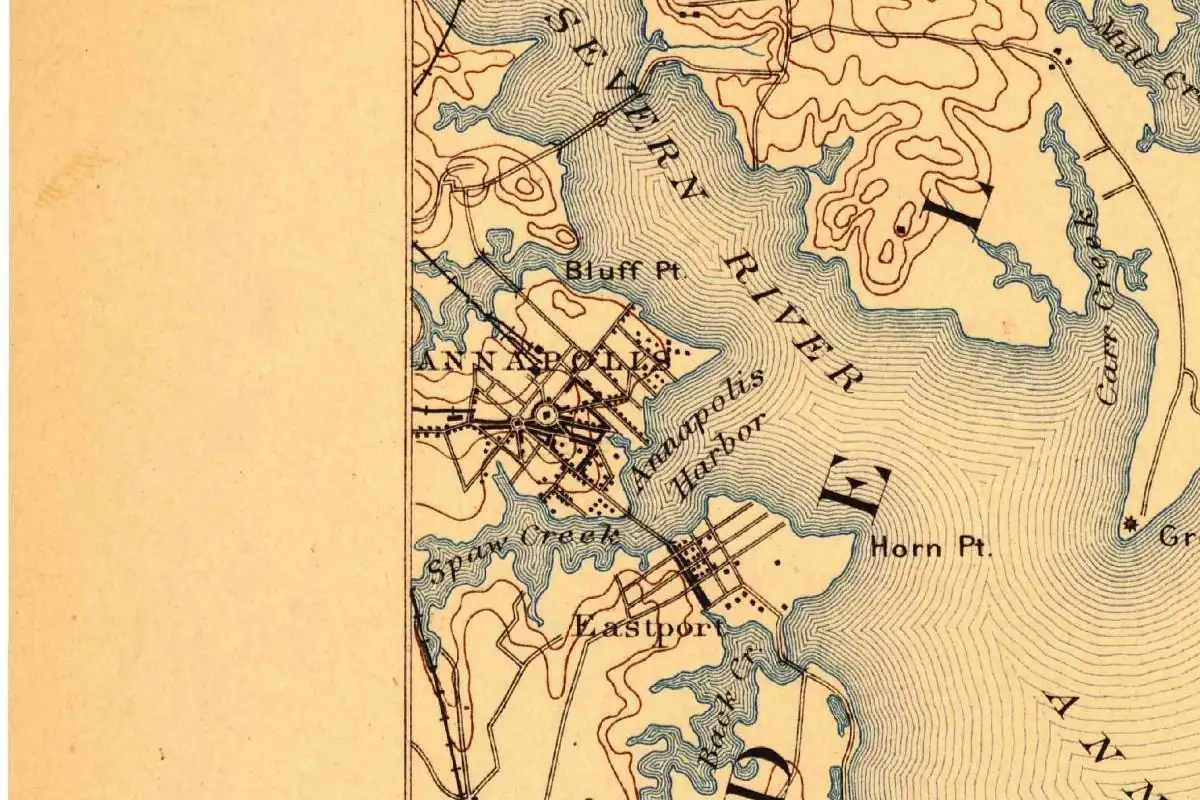
When Maryland’s new capital took the name Annapolis in 1695, the Anne it honored wasn’t a queen yet. She was Princess Anne, seven years from the throne. Before that, the place on the Severn River had gone through at least three other names.
Puritans call it Providence
The first English settlers came from Virginia. In 1649, about ten families from Richard Bennett’s plantation on the Nansemond River moved up to the Severn, Elihu Riley writes in his 1887 history of Annapolis. They were Puritans, pushed out by Virginia’s crackdown on their church, and Maryland offered them land if they’d swear loyalty to Lord Baltimore.
They called their colony “Providence,” as J. Thomas Scharf puts it in his 1879 History of Maryland. In 1650 the assembly turned that area, “formerly called by the name of Providence,” into a county “by the name of Annarundell county.” Riley thinks it was “probably” named for Lady Baltimore, born Anne Arundel, the late wife of Cecilius Calvert. So the county’s Anne came first, and she was a different Anne.
You’ll also want to know that Providence probably wasn’t on the exact spot of today’s city. Scharf quotes a researcher named Davis, who found the first settlement at Greenberry’s Point, “a little below the mouth of the Severn,” and believed Annapolis “was not founded till many years later.”
Proctor’s, then Ann-Arundel
By 1683 the name Providence seems to have dropped away. That year an act of the legislature, Riley says, called the place “The Town at Proctor’s” and made it a port of entry. Later records call it the “Town-Land at Proctors.”
Then the capital moved. Governor Francis Nicholson called the assembly to meet not at St. Mary’s, the old capital, but at “Anne Arundel town, afterwards called Annapolis,” in Scharf’s words. An act of October 18, 1694, renamed the Town-Land at Proctors the “Town and Port of Ann-Arundel,” and the assembly met there for the first time on February 28, 1694, by the old calendar (1695 by ours).
Anne’s city
The name stuck for about a year. In 1695 the assembly passed an act, quoted by Riley, saying the port “shall for ever hereafter be denominated, called and known by the Name and Port of Annapolis, and by no other Name or Distinction whatever.” Riley calls it “the more euphonious title.” Scharf sums it up more plainly: “they gave the town the name of Annapolis.” Later in the same book he hedges on why. The new name was “perhaps” just “a more elegant and euphonious version of ‘Anne Arundel town,’” he writes, “and perhaps in compliment to Anne, the heiress presumptive to the throne, who became queen seven years later.” The federal place-names database credits Nicholson’s encouragement and translates the name as “Anne’s City.”
So which Anne? Henry Gannett’s 1905 federal book on place names says the city was “named in honor of Queen Anne, of England, 1702-1714.” That’s the right woman, but look at the dates and you’ll notice something. Gannett’s own years for her reign start in 1702, seven years after the town took her name.
The townspeople said so themselves. After Annapolis got its city charter on August 10, 1708, its mayor, aldermen and residents petitioned Governor John Seymour, and Riley prints their letter, old spelling and all. The town, they wrote, had “formerly had the honour in Remembrance of Princess Anne, now our good Queen to be erected into a towne.” By then she’d been queen for six years. When the town took her name, she was still a princess.
Sources & further reading
- Elihu S. Riley, “The Ancient City”: A History of Annapolis, in Maryland, 1649–1887 (1887). The Puritans from Bennett’s plantation in 1649 (pp. 17–18); the 1650 act on “Annarundell county” and Lady Anne Arundel, “probably” (p. 21); “The Town at Proctor’s” in 1683 (p. 52); the 1694 act creating the “Town and Port of Ann-Arundel,” the first assembly there and the 1695 act naming Annapolis (p. 63); the 1708 charter and the petition “in Remembrance of Princess Anne” (p. 86).
- J. Thomas Scharf, History of Maryland, vol. 1 (1879). Davis on Greenberry’s Point (p. 200); the colony “which they called ‘Providence’” and the county act (p. 203); “Anne Arundel town, afterwards called Annapolis” (p. 344); “they gave the town the name of Annapolis” (p. 349); the name “perhaps” a more euphonious version of “Anne Arundel town” and “perhaps in compliment to Anne, the heiress presumptive to the throne” (p. 421).
- Henry Gannett, The Origin of Certain Place Names in the United States (USGS, 1905), p. 25. “Named in honor of Queen Anne, of England, 1702-1714.”
- GNIS feature 595031 (U.S. Geological Survey). Providence, the Town Land at Proctors, Anne Arundel Town, Nicholson’s role in the change to Annapolis, and “Anne’s City.”
Spot something wrong, or know more? Tell us here. You can also email us or use our contact page. Corrections are noted here with their date, never made silently.