Baltimore, Maryland: A Lord's Title and Two Places in Ireland
Baltimore, Maryland, carries the Calverts’ title, Lord Baltimore, and that title came from a place in Ireland. Which place depends on which book you open. Even the historian who wrote a whole book on the city’s early years gave two different answers, five years apart.
Sixty acres and a tenant farmer
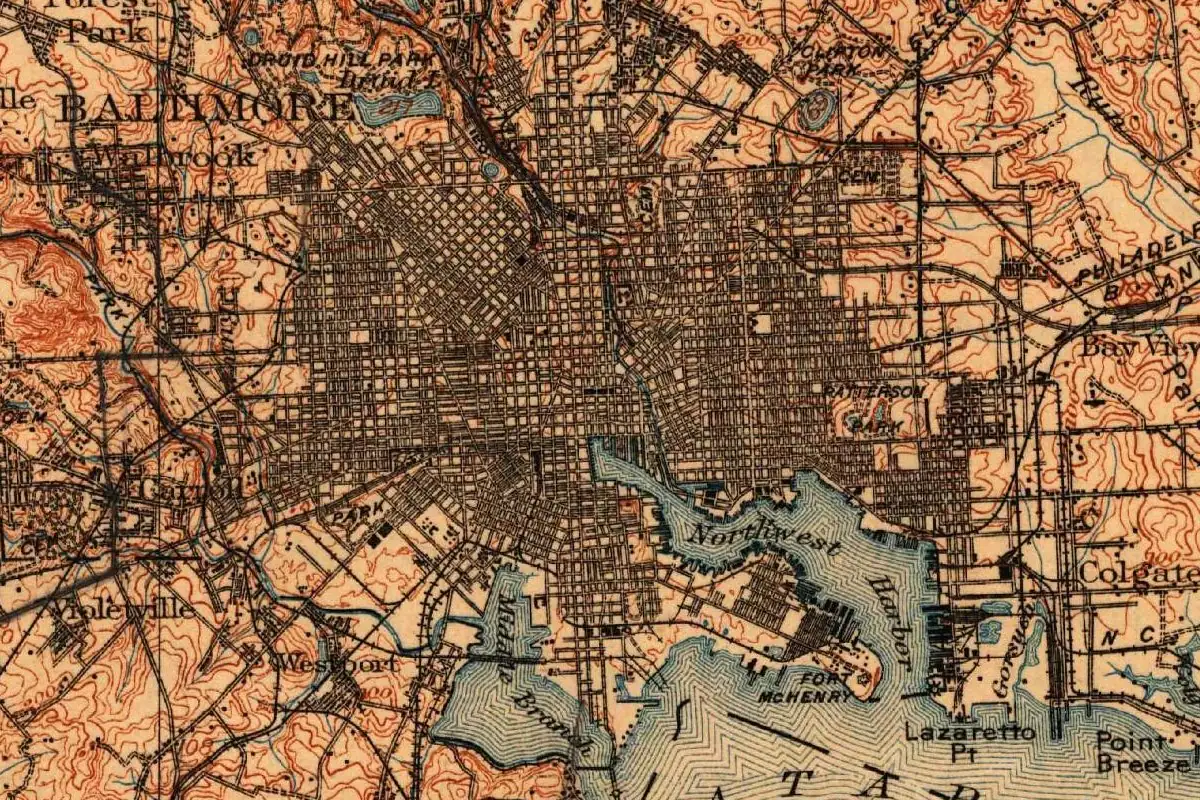
The town got its name in the summer of 1729. J. Thomas Scharf’s Chronicles of Baltimore (1874) says that up to then “no designation had been given” to the settlement on the northwest branch of the Patapsco River. On July 14, 1729, a petition was read in the colony’s upper house asking for “a Town, on the North side of Patapsco river, upon the land supposed to belong to Messrs. Charles and Daniel Carroll.”
The act passed on August 8, 1729. Its full title, as Scharf copies it, was “An Act for erecting a Town on the North side of Patapsco, in Baltimore County, and for laying out in Lots, Sixty Acres of Land, in and about the place where one John Fleming now lives.” Fleming was a tenant of the Carrolls, and the land was “commonly known by the name of ‘Cole’s Harbor.’” Near the end comes the line that matters: “The town to be called Baltimore Town.”
So a big city started out as 60 acres around one tenant’s farm. Scharf even tells you where to stand if you want to visit the spot: the east side of South Charles Street at Lombard.
Which Lord Baltimore?
The name was a compliment to the family that owned Maryland. When the commissioners agreed on a price with Charles Carroll that December, Scharf writes, the land was to become “a town called Baltimore Town, in honor of the Lord Proprietary.”
Scharf doesn’t say which Lord Baltimore he means. In 1729 the proprietor was Charles Calvert; the 1729 session that Scharf quotes opened in the name of “Charles, absolute Lord and Proprietary of the Province of Maryland and Avalon, Lord Baron of Baltimore.” In his 1882 History of Western Maryland, Scharf calls him “Charles, the Fifth Lord Baltimore.” Henry Gannett’s 1905 national place-names book for the U.S. Geological Survey and the federal place-names database both name a different Calvert: Cecilius, the second Lord Baltimore, who in Gannett’s words “settled the Maryland province in 1635.” None of these sources names Charles as the man being honored. What they all agree on is the title itself.
A promontory in Cork, or a barony in Longford
Here’s the thing about that title. The Calverts didn’t invent the word Baltimore. George Calvert, Cecilius’s father, got it when he was made an Irish lord in 1625, and it was the name of a place in Ireland.
In 1874, Scharf said the Lord Proprietary had “borrowed his from a town of the same name, which stands on a promontory in the sea, in the County of Cork, Ireland.” Five years later, in his three-volume History of Maryland, Scharf wrote that King James raised George Calvert “to the Irish peerage as Baron of Baltimore in the county of Longford, Ireland.”
The federal database goes with Cork. It says the Irish lord “took the name Baltimore from a seaport in County Cork,” following the custom of naming titles after local ports. These sources don’t settle it, so the honest answer is that the books disagree.
What the word means
They don’t agree on the Irish word, either. Gannett calls Baltimore “a Celtic word, meaning ‘large town.’” The federal database breaks it into two Gaelic parts, “bailte” and “mora,” and translates them as “big houses, homesteads, estates.” Either way, you end up with a name about big places, now worn by one.
If you want the other half of the Calvert story, the one about how the whole colony got its name, it’s in How Maryland Got Its Name.
Sources & further reading
- J. Thomas Scharf, The Chronicles of Baltimore (1874), pp. 18–21. No name for the settlement before 1729; the petition of July 14, 1729, on the Carrolls’ land; the title of the act of August 8, 1729, with John Fleming and Cole’s Harbor; “The town to be called Baltimore Town”; “in honor of the Lord Proprietary,” and the town of the same name “in the County of Cork, Ireland.” Also the spot at South Charles and Lombard streets.
- J. Thomas Scharf, History of Maryland, vol. 1 (1879), p. 40. George Calvert made “Baron of Baltimore in the county of Longford, Ireland” in 1625.
- J. Thomas Scharf, History of Western Maryland, vol. 1 (1882), p. 360. Charles as “the Fifth Lord Baltimore.”
- Henry Gannett, The Origin of Certain Place Names in the United States (USGS, 1905), p. 35. Named for Cecilius Calvert, Lord Baltimore; “A Celtic word, meaning ‘large town.’”
- GNIS feature 597040 (U.S. Geological Survey). Laid out in 1729 and named to honor Cecil Calvert; the title taken from a seaport in County Cork; the Gaelic “bailte” and “mora.”
Spot something wrong, or know more? Tell us here. You can also email us or use our contact page. Corrections are noted here with their date, never made silently.