How Pierre, South Dakota Got Its Name (and Why It's Said "Peer")
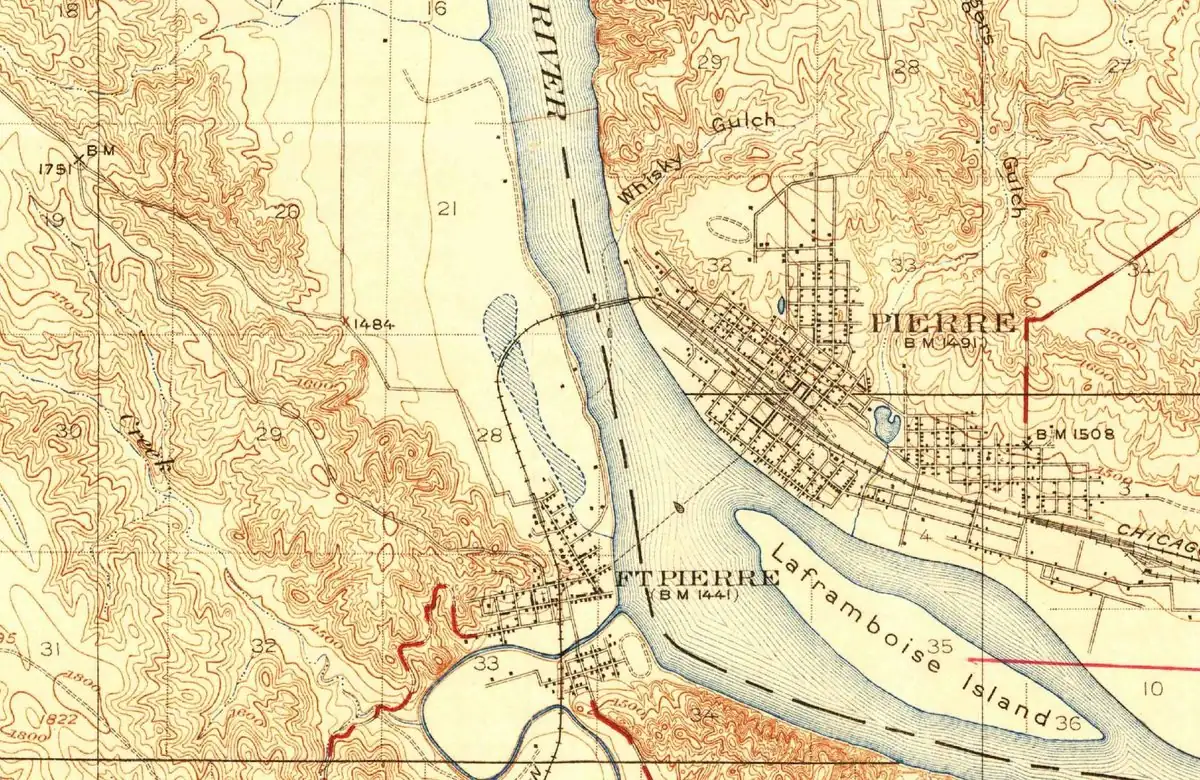
Pierre, South Dakota, takes its name from Fort Pierre, a fur-trading post across the Missouri River that was named for St. Louis fur trader Pierre Chouteau Jr. in 1832. So the state capital is named after a fort, and the fort is named after a St. Louis fur trader’s first name. Locals say it “Peer.”
Where the name comes from
Long before there was a town, the west bank of the Missouri near the mouth of the Bad River was fur country. A 1908 railroad guide to place names, written by a longtime officer of the Chicago & North Western, says several trading posts came and went there, and that the first real Fort Pierre was built by the American Fur Company in 1831 and 1832, about three miles above the mouth of the river.
The fort was “christened in June 1832, for Pierre Choteau, Jr., of St. Louis, Mo., who was on a visit to the fort when it was named,” the guide says. (It spells the family name without the U. Chouteau is the usual spelling.) A marker at the site says Chouteau ran the American Fur Company’s Western Department out of St. Louis. So the men at the post named it after the boss, while the boss was standing right there.
How the fort’s name crossed the river
The town of Pierre came almost fifty years later, and on the other side of the water. The 1908 guide says Pierre “was named from the old American Fur and Trading Company’s post, Fort Pierre, which was opposite on the west bank of the Missouri River,” and that the town was platted in 1880 by the Western Town Lot Company, which laid out dozens of towns along the Chicago & North Western line. The U.S. Geological Survey’s place-name record repeats that, quoting the same book.
That’s why there are two towns with nearly the same name staring at each other across the Missouri. Fort Pierre is on the west bank, near where the old trading post stood. Pierre, the newer town, is on the east bank, and it’s the one that became the state capital.
Why it’s “Peer”
If you’ve ever said “pee-AIR” out loud in South Dakota, somebody probably corrected you. KELO-TV’s list of place names outsiders get wrong puts Pierre first: it’s “Peer,” like a pier you fish off of.
Nobody has a clean, documented answer for when or why the French pronunciation got flattened into one syllable. What we can tell you is that the town didn’t drop Chouteau’s name. It just started saying it like a South Dakotan.
What’s left of the fort
The National Park Service says the site of Fort Pierre Chouteau was declared a National Historic Landmark in 1991. Nothing of the fort stands above ground anymore, but the Park Service says the archaeological remains are well preserved. The fur company sold the post to the U.S. Army in 1855, and the Army abandoned it two years later.
Sources & further reading
- W. H. Stennett, A History of the Origin of the Place Names Connected with the Chicago & North Western and Chicago, St. Paul, Minneapolis & Omaha Railways (1908). A public-domain railroad guide. Its Fort Pierre entry gives the June 1832 christening for Pierre Chouteau Jr. (it also says the fur company abandoned the post in 1857, which other sources correct: the Army bought it in 1855); its Pierre entry says the town was named from the fort and platted in 1880.
- GNIS feature 1266887 (U.S. Geological Survey). The federal record for Pierre. Its history note quotes the 1908 guide, so it isn’t a separate source.
- National Park Service, “Fort Pierre Chouteau: Pivotal Outpost on the Upper Missouri River.” The fort’s landmark status and what survives at the site.
- “Fort Pierre Chouteau: Fur Trade (1832-1855)” marker. Says the American Fur Company built the post in 1832 and named it for Pierre Chouteau Jr., head of its Western Department, and that the Army bought it in 1855. Read through the Historical Marker Database transcription.
- KELO-TV, “Here are eight South Dakota locations you may be saying wrong.” The local pronunciation: “Peer.”
Spot something wrong? Corrections are noted here with their date, never made silently.